Solution:
Concept: Manganese dioxide is an oxidising agent: it oxidises concentrated HCl to chlorine. Copper (II) oxide is a basic oxide and only neutralises the acid. Iron (II) and iron (III) hydroxides differ in colour. Lead chloride dissolves in hot water; lead sulphate does not.
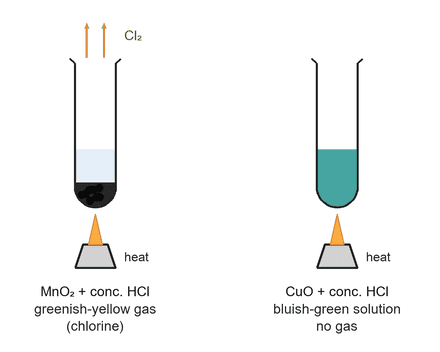
Step 1 — (i) Warm each oxide with concentrated HCl.
With manganese dioxide, a greenish-yellow gas (chlorine) with a pungent, choking smell is given off; it turns moist starch iodide paper blue-black.
MnO2+4HCl→MnCl2+2H2O+Cl2↑
With copper (II) oxide, the black solid dissolves to give a bluish-green solution of copper (II) chloride, and no gas is given off.
CuO+2HCl→CuCl2+H2O
Step 2 — (ii) Add NaOH to each iron salt solution.
Ferrous sulphate gives a dirty green precipitate of iron (II) hydroxide, insoluble in excess:
FeSO4+2NaOH→Fe(OH)2↓+Na2SO4
Ferric sulphate gives a reddish brown precipitate of iron (III) hydroxide, insoluble in excess:
Fe2(SO4)3+6NaOH→2Fe(OH)3↓+3Na2SO4

Step 3 — Add lead nitrate solution to each acid.
Lead nitrate gives a white precipitate with both acids, because lead chloride and lead sulphate are both only slightly soluble in cold water.
Pb(NO3)2+2HCl→PbCl2↓+2HNO3
Pb(NO3)2+H2SO4→PbSO4↓+2HNO3
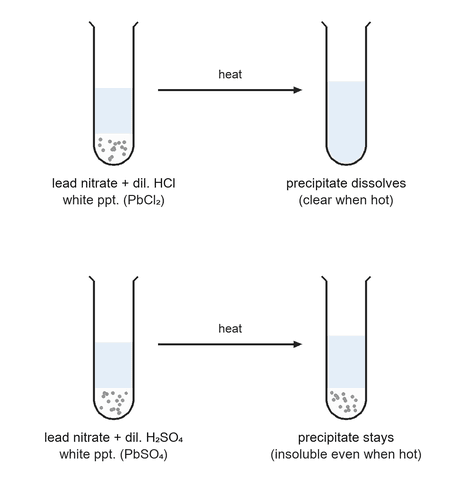
Step 4 — Heat both test tubes.
Since both precipitates are white, their colour cannot tell the acids apart. We use their solubility in hot water instead:
- Dilute hydrochloric acid: the white precipitate of lead chloride dissolves on heating, because lead chloride is soluble in hot water. It reappears as crystals when the solution cools.
- Dilute sulphuric acid: the white precipitate of lead sulphate does not dissolve even on heating, because lead sulphate is insoluble in hot water too.
Watch out: In (i) say WHICH gas and how you know it (colour, smell, starch iodide paper); 'a gas is evolved' is not enough.
Therefore, (i) MnO₂ gives greenish-yellow chlorine with conc. HCl, while CuO gives a bluish-green solution and no gas; (ii) ferrous sulphate gives a dirty green precipitate with NaOH, ferric sulphate a reddish brown one; (iii) the white precipitate from dilute HCl dissolves on heating, the one from dilute H₂SO₄ does not.
