Solution:
Concept: When an alkali is added to a salt solution, its hydroxide ions (OH−) join the metal ions and form the metal hydroxide. Most metal hydroxides are insoluble in water, so they appear as a precipitate. The colour of the precipitate, and whether it dissolves when more alkali is added, tell us which metal ion is present. Ammonium hydroxide is a weak alkali: it is only slightly ionised, so it gives only a few OH− ions. Sodium hydroxide is a strong alkali and gives many OH− ions.
Step 1 — (i) Reddish brown precipitate with NaOH.
Iron (III) hydroxide is the only reddish brown hydroxide in the tests we study, so solution A contains the iron (III) (ferric) ion:
Fe3++3OH−→Fe(OH)3↓

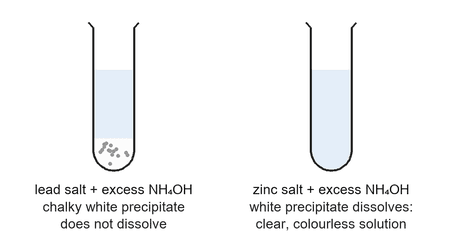
Step 2 — (ii) White precipitate with NH₄OH, insoluble in excess.
Zinc hydroxide is white but dissolves in excess NH4OH, and calcium ions give no precipitate with NH4OH at all. Lead hydroxide is chalky white and stays in excess NH4OH, so solution B contains the lead ion:
Pb2++2OH−→Pb(OH)2↓
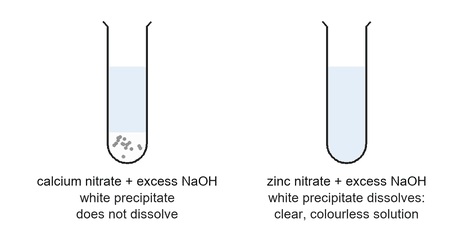
Step 3 — (iii) White precipitate with NaOH, insoluble in excess.
Zinc and lead also give white hydroxides with NaOH, but both dissolve in excess (as sodium zincate and sodium plumbite). Calcium hydroxide is white and only sparingly soluble, so it stays. Solution C contains the calcium ion:
Ca2++2OH−→Ca(OH)2↓
Watch out: In (ii) and (iii) the colour is white every time; the answer is decided by what happens in EXCESS of each alkali.
Note: Pb²⁺ and Ca²⁺ are the expected answers from the ions in the ICSE tables. Outside those tables, Al³⁺ also gives a white precipitate that stays in excess NH₄OH, and Mg²⁺ a white precipitate that stays in excess NaOH.
Therefore, (i) A contains Fe³⁺ (ferric ion); (ii) B contains Pb²⁺ (lead ion); (iii) C contains Ca²⁺ (calcium ion).
