
Question 22 marksAsked 2016Easy
State your observations when ammonium hydroxide solution is added drop by drop and then in excess to each of the following solutions:
(i) copper sulphate solution
(ii) zinc sulphate solution.
Confirming your payment
Sign up now and get 250 free tokens.
Previous Year Questions · Question 2 of 39
State your observations when ammonium hydroxide solution is added drop by drop and then in excess to each of the following solutions:
(i) copper sulphate solution
(ii) zinc sulphate solution.
Solution:
Concept: When an alkali is added to a salt solution, its hydroxide ions () join the metal ions and form the metal hydroxide. Most metal hydroxides are insoluble in water, so they appear as a precipitate. The colour of the precipitate, and whether it dissolves when more alkali is added, tell us which metal ion is present. Copper (II) hydroxide and zinc hydroxide dissolve in excess ammonium hydroxide because they form soluble ammine complexes: tetraammine copper (II) ions, which are deep (inky) blue, and tetraammine zinc (II) ions, which are colourless.
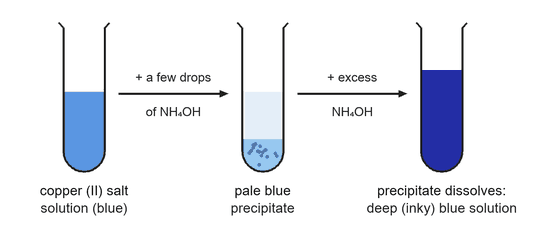
Step 1 — (i) Copper sulphate: add NH₄OH drop by drop.
The few ions from the first drops join the copper (II) ions, so a pale blue precipitate of copper (II) hydroxide forms:
Step 2 — (i) Copper sulphate: add excess NH₄OH.
In excess ammonium hydroxide the pale blue precipitate dissolves, giving a deep (inky) blue solution of tetraammine copper (II) sulphate:
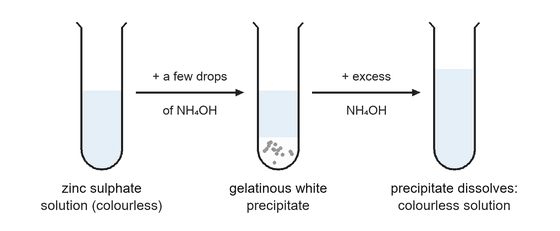
Step 3 — (ii) Zinc sulphate: add NH₄OH drop by drop.
The ions join the zinc ions, so a white gelatinous precipitate of zinc hydroxide forms:
Step 4 — (ii) Zinc sulphate: add excess NH₄OH.
In excess ammonium hydroxide the white precipitate dissolves, giving a colourless solution of tetraammine zinc (II) sulphate:
Watch out: Both precipitates dissolve in excess NH₄OH; what tells them apart is the colour: pale blue → deep blue for copper, white → colourless for zinc.
Therefore, (i) copper sulphate gives a pale blue precipitate that dissolves in excess NH₄OH to a deep (inky) blue solution; (ii) zinc sulphate gives a white gelatinous precipitate that dissolves in excess NH₄OH to a colourless solution.