
Question 221 markAsked 2023Easy
Complete and balance the following equations:
(b)
Confirming your payment
Sign up now and get 250 free tokens.
Previous Year Questions · Question 22 of 39
Complete and balance the following equations:
(b)
Solution:
Concept: When an alkali is added to a salt solution, its hydroxide ions () join the metal ions and form the metal hydroxide. Most metal hydroxides are insoluble in water, so they appear as a precipitate. The colour of the precipitate, and whether it dissolves when more alkali is added, tell us which metal ion is present. A balanced equation has the same number of atoms of each element on both sides, because atoms are neither made nor destroyed in a reaction.
Step 1 — Name the products.
Ammonium hydroxide precipitates copper (II) hydroxide from copper sulphate, and ammonium sulphate, , stays in solution.
Step 2 — Balance the equation.
Each ion needs two ions, so two are needed:
Step 3 — Count the atoms on both sides.
We check that every element balances:
| Atom | Left side | Right side |
|---|---|---|
| Cu | 1 | 1 |
| S | 1 | 1 |
| O | 6 | 6 |
| N | 2 | 2 |
| H | 10 | 10 |
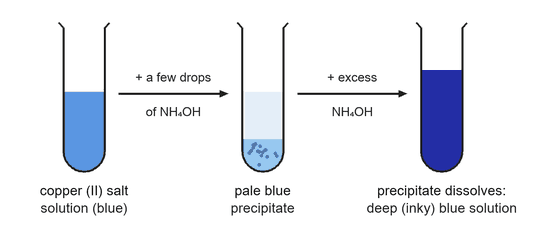
A pale blue precipitate of copper (II) hydroxide forms. If excess is added, it dissolves to a deep blue solution of tetraammine copper (II) sulphate:
Watch out: Write ammonium sulphate as (NH₄)₂SO₄, not NH₄SO₄: the ammonium ion carries one positive charge.
Therefore, CuSO₄ + 2NH₄OH → Cu(OH)₂↓ + (NH₄)₂SO₄.