
Question 161 markAsked 2020Easy
Write a balanced chemical equation for each of the following:
(iii) Reaction of lead nitrate solution with ammonium hydroxide.
Confirming your payment
Sign up now and get 250 free tokens.
Previous Year Questions · Question 16 of 39
Write a balanced chemical equation for each of the following:
(iii) Reaction of lead nitrate solution with ammonium hydroxide.
Solution:
Concept: When an alkali is added to a salt solution, its hydroxide ions () join the metal ions and form the metal hydroxide. Most metal hydroxides are insoluble in water, so they appear as a precipitate. The colour of the precipitate, and whether it dissolves when more alkali is added, tell us which metal ion is present. A balanced equation has the same number of atoms of each element on both sides, because atoms are neither made nor destroyed in a reaction.
Step 1 — Write the reactants and products.
Lead nitrate contains the ion, so ammonium hydroxide precipitates lead hydroxide, , and ammonium nitrate stays in solution.
Step 2 — Balance the equation.
Each ion needs two ions, so we need two , which also give two :
Step 3 — Count the atoms on both sides.
We check that every element balances:
| Atom | Left side | Right side |
|---|---|---|
| Pb | 1 | 1 |
| N | 4 | 4 |
| O | 8 | 8 |
| H | 10 | 10 |
A chalky white precipitate of lead hydroxide forms; it is insoluble in excess .
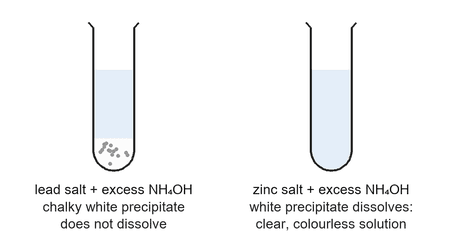
The figure compares lead with zinc: in excess the lead precipitate stays, while the zinc one dissolves.
Watch out: Lead nitrate is Pb(NO₃)₂, so the nitrogen count is 2 on the left from lead nitrate plus 2 from NH₄OH.
Therefore, Pb(NO₃)₂ + 2NH₄OH → Pb(OH)₂↓ + 2NH₄NO₃.