
Opening your dashboard
Class 8 Maths Chapter 18: Constructions Solutions
52 textbook questions with step-by-step answers, free to read, for ICSE 2026-27.
Get talked through Ch 18, not just shown the answer
Reading a finished solution is not the same as being able to do it. The AI tutor takes one question at a time and works it with you, in your own words, until you can.
- Ask it out loud, in your own words
- It gives you the next step, not the answer
- Stuck on part (ii)? Start there
52 questions with solutions
3 marks · Mixed difficulty
- 13 marks
Question 1
Given below are the angles x and y.
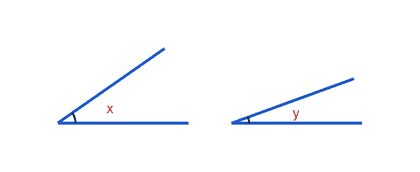
Without measuring these angles, construct :
(i) ∠ABC = x + y
(ii) ∠ABC = 2x + y
(iii) ∠ABC = x + 2y
Solve with AIWritten solution
Solution:
Concept: Angles can be added without measuring them by copying each angle with compasses at the same vertex, one after another, each copy starting on the arm of the previous one. To copy an angle: with its vertex as centre draw an arc cutting both arms; draw an arc of the same radius from the new vertex; then mark off on it the same chord (the distance between the two cut points). Equal chords on equal arcs give equal angles.
Given: The angles x and y shown in the figure; a ruler and a pair of compasses (a protractor only where the step says so).
Step 1 — Plan the construction.
Each required angle is a sum of the given angles, so we copy the given angles one after another at B. We use one compass radius for every arc, so all the copies can be stepped round a single arc drawn about B.
Step 2 — Part (i): draw the starting arm.
For ∠ABC = x + y, draw a ray BC. With B as centre and the same radius as used on the given angles, draw a long arc cutting BC.
Step 3 — Part (i): copy angle x next to BC, turning anticlockwise.
With the vertex of angle x as centre draw an arc cutting both its arms, and take the distance between the two cut points in the compasses. On the long arc about B, starting where it meets BC, cut off this same distance and join B to the new point, producing it to X1. Then ∠CBX1 = x.
Step 4 — Part (i): copy angle y next to BX1, turning anticlockwise.
With the vertex of angle y as centre draw an arc cutting both its arms, and take the distance between the two cut points in the compasses. On the long arc about B, starting where it meets BX1, cut off this same distance and join B to the new point, producing it to A. Then ∠X1BA = y.
Step 5 — Part (i): name the angle.
The copies lie side by side with no gaps or overlaps, so ∠ABC = x + y.
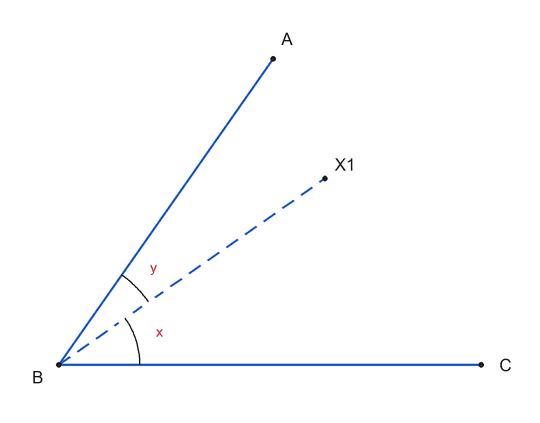
Step 6 — Part (ii): draw the starting arm.
For ∠ABC = 2x + y, draw a ray BC. With B as centre and the same radius as used on the given angles, draw a long arc cutting BC.
Step 7 — Part (ii): copy angle x next to BC.
Copy angle x again in the same way (the same radius and the same chord as before), starting where the long arc meets BC, and draw BX1. Then ∠CBX1 = x.
Step 8 — Part (ii): copy angle x next to BX1.
Copy angle x again in the same way (the same radius and the same chord as before), starting where the long arc meets BX1, and draw BX2. Then ∠X1BX2 = x.
Step 9 — Part (ii): copy angle y next to BX2.
Copy angle y again in the same way (the same radius and the same chord as before), starting where the long arc meets BX2, and draw BA. Then ∠X2BA = y.
Step 10 — Part (ii): name the angle.
The copies lie side by side with no gaps or overlaps, so ∠ABC = 2x + y.

Step 11 — Part (iii): draw the starting arm.
For ∠ABC = x + 2y, draw a ray BC. With B as centre and the same radius as used on the given angles, draw a long arc cutting BC.
Step 12 — Part (iii): copy angle x next to BC.
Copy angle x again in the same way (the same radius and the same chord as before), starting where the long arc meets BC, and draw BX1. Then ∠CBX1 = x.
Step 13 — Part (iii): copy angle y next to BX1.
Copy angle y again in the same way (the same radius and the same chord as before), starting where the long arc meets BX1, and draw BX2. Then ∠X1BX2 = y.
Step 14 — Part (iii): copy angle y next to BX2.
Copy angle y again in the same way (the same radius and the same chord as before), starting where the long arc meets BX2, and draw BA. Then ∠X2BA = y.
Step 15 — Part (iii): name the angle.
The copies lie side by side with no gaps or overlaps, so ∠ABC = x + 2y.
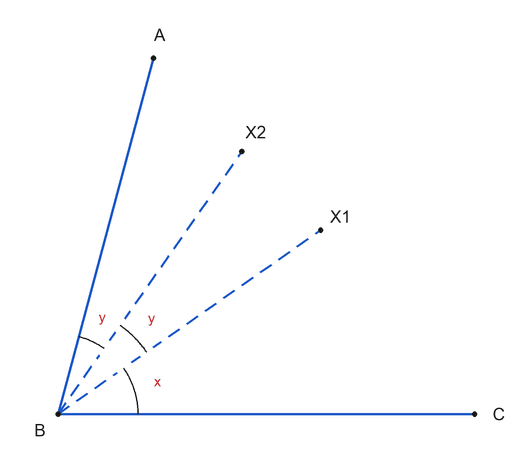
Step 16 — Check with a protractor (optional).
In the figure the given angles are x = 35° and y = 20°, so a protractor reads about 55°, 90°, 75° for parts (i), (ii) and (iii). The construction itself never uses the protractor.
Watch out: Start each new copy on the arm of the PREVIOUS copy, not on BC again, or the angles overlap instead of adding.
Therefore, ∠ABC = x + y, 2x + y and x + 2y are the three required angles (shown in the figures).
- 23 marks
Question 2
Given below are the angles x, y, and z.

Without measuring these angles construct :
(i) ∠ABC = x + y + z
(ii) ∠ABC = 2x + y + z
(iii) ∠ABC = x + 2y + z
Solve with AIWritten solution
Solution:
Concept: Angles can be added without measuring them by copying each angle with compasses at the same vertex, one after another, each copy starting on the arm of the previous one. To copy an angle: with its vertex as centre draw an arc cutting both arms; draw an arc of the same radius from the new vertex; then mark off on it the same chord (the distance between the two cut points). Equal chords on equal arcs give equal angles.
Given: The angles x, y and z shown in the figure; a ruler and a pair of compasses (a protractor only where the step says so).
Step 1 — Plan the construction.
Each required angle is a sum of the given angles, so we copy the given angles one after another at B. We use one compass radius for every arc, so all the copies can be stepped round a single arc drawn about B.
Step 2 — Part (i): draw the starting arm.
For ∠ABC = x + y + z, draw a ray BC. With B as centre and the same radius as used on the given angles, draw a long arc cutting BC.
Step 3 — Part (i): copy angle x next to BC, turning anticlockwise.
With the vertex of angle x as centre draw an arc cutting both its arms, and take the distance between the two cut points in the compasses. On the long arc about B, starting where it meets BC, cut off this same distance and join B to the new point, producing it to X1. Then ∠CBX1 = x.
Step 4 — Part (i): copy angle y next to BX1, turning anticlockwise.
With the vertex of angle y as centre draw an arc cutting both its arms, and take the distance between the two cut points in the compasses. On the long arc about B, starting where it meets BX1, cut off this same distance and join B to the new point, producing it to X2. Then ∠X1BX2 = y.
Step 5 — Part (i): copy angle z next to BX2, turning anticlockwise.
With the vertex of angle z as centre draw an arc cutting both its arms, and take the distance between the two cut points in the compasses. On the long arc about B, starting where it meets BX2, cut off this same distance and join B to the new point, producing it to A. Then ∠X2BA = z.
Step 6 — Part (i): name the angle.
The copies lie side by side with no gaps or overlaps, so ∠ABC = x + y + z.
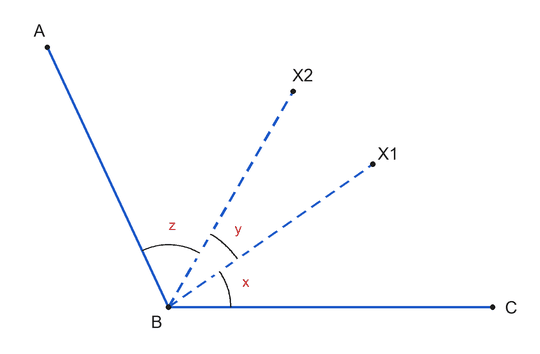
Step 7 — Part (ii): draw the starting arm.
For ∠ABC = 2x + y + z, draw a ray BC. With B as centre and the same radius as used on the given angles, draw a long arc cutting BC.
Step 8 — Part (ii): copy angle x next to BC.
Copy angle x again in the same way (the same radius and the same chord as before), starting where the long arc meets BC, and draw BX1. Then ∠CBX1 = x.
Step 9 — Part (ii): copy angle x next to BX1.
Copy angle x again in the same way (the same radius and the same chord as before), starting where the long arc meets BX1, and draw BX2. Then ∠X1BX2 = x.
Step 10 — Part (ii): copy angle y next to BX2.
Copy angle y again in the same way (the same radius and the same chord as before), starting where the long arc meets BX2, and draw BX3. Then ∠X2BX3 = y.
Step 11 — Part (ii): copy angle z next to BX3.
Copy angle z again in the same way (the same radius and the same chord as before), starting where the long arc meets BX3, and draw BA. Then ∠X3BA = z.
Step 12 — Part (ii): name the angle.
The copies lie side by side with no gaps or overlaps, so ∠ABC = 2x + y + z.
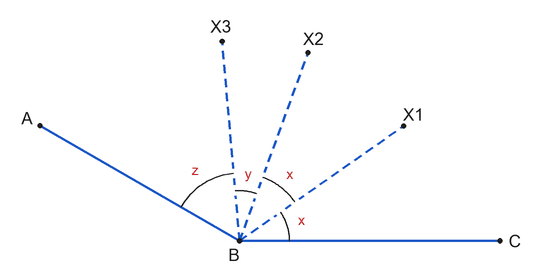
Step 13 — Part (iii): draw the starting arm.
For ∠ABC = x + 2y + z, draw a ray BC. With B as centre and the same radius as used on the given angles, draw a long arc cutting BC.
Step 14 — Part (iii): copy angle x next to BC.
Copy angle x again in the same way (the same radius and the same chord as before), starting where the long arc meets BC, and draw BX1. Then ∠CBX1 = x.
Step 15 — Part (iii): copy angle y next to BX1.
Copy angle y again in the same way (the same radius and the same chord as before), starting where the long arc meets BX1, and draw BX2. Then ∠X1BX2 = y.
Step 16 — Part (iii): copy angle y next to BX2.
Copy angle y again in the same way (the same radius and the same chord as before), starting where the long arc meets BX2, and draw BX3. Then ∠X2BX3 = y.
Step 17 — Part (iii): copy angle z next to BX3.
Copy angle z again in the same way (the same radius and the same chord as before), starting where the long arc meets BX3, and draw BA. Then ∠X3BA = z.
Step 18 — Part (iii): name the angle.
The copies lie side by side with no gaps or overlaps, so ∠ABC = x + 2y + z.
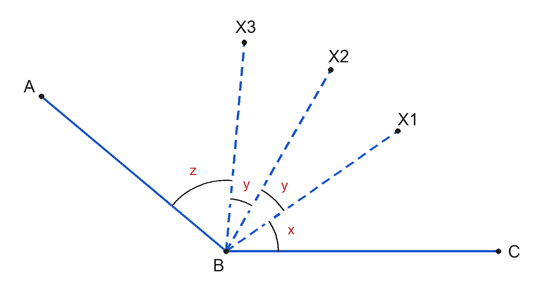
Step 19 — Check with a protractor (optional).
In the figure the given angles are x = 35°, y = 25° and z = 55°, so a protractor reads about 115°, 150°, 140° for parts (i), (ii) and (iii). The construction itself never uses the protractor.
Watch out: Start each new copy on the arm of the PREVIOUS copy, not on BC again, or the angles overlap instead of adding.
Therefore, ∠ABC = x + y + z, 2x + y + z and x + 2y + z are the three required angles (shown in the figures).
- 33 marks
Question 3
Draw a line segment BC = 4 cm. Construct angle ABC = 60°.
Solve with AIWritten solution
Solution:
Concept: An angle of 60° is made with compasses alone: if the compasses keep the same opening for BP, BQ and PQ, triangle BPQ is equilateral, and every angle of an equilateral triangle is 60°.
Given: BC = 4 cm and ∠ABC = 60°.
Step 1 — Draw the base.
Draw a line segment BC = 4 cm with the ruler.
Step 2 — Construct 60° at B.
With B as centre and any convenient radius, draw an arc cutting BC at P. With P as centre and the same radius, cut this arc at Q. Join BQ and produce it to A. Then BP, BQ and PQ are all equal to the radius, so triangle BPQ is equilateral and the angle at B is 60°.
Step 3 — Look at the finished figure and check it.
The finished construction is shown below, with the given measurements marked on it.
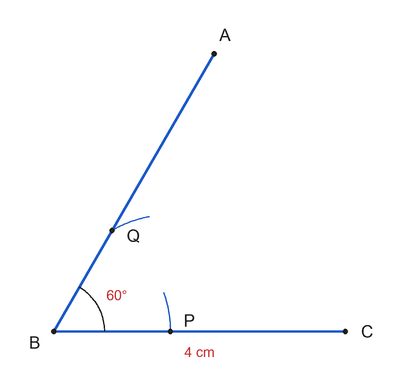
Notice that the 60° arc sits at B, between the arms BC and BA.
Watch out: Keep the compasses at the SAME radius while stepping off 60° arcs; changing it spoils the angle.
Therefore, ∠ABC = 60° is the required angle.
- 43 marks
Question 4
Construct angle ABC = 45° in which BC = 5 cm and AB = 4.6 cm.
Solve with AIWritten solution
Solution:
Concept: 45° is half of 90°, so we construct a right angle at B and bisect it. A length is then cut off on the bisector with compasses.
Given: ∠ABC = 45°, BC = 5 cm and AB = 4.6 cm.
Step 1 — Draw the base.
Draw BC = 5 cm.
Step 2 — Construct 45° at B.
At B, construct a 90° line from BC and bisect the right angle: with B as centre draw an arc cutting both arms, and with the two cut points as centres draw equal arcs meeting inside the angle. Join B to this point and produce it to X. It makes 90° ÷ 2 = 45° with BC.
Step 3 — Cut off AB.
With B as centre and radius 4.6 cm, cut BX at A. So AB = 4.6 cm lies on the 45° arm.
Step 4 — Look at the finished figure and check it.
The finished construction is shown below, with the given measurements marked on it.
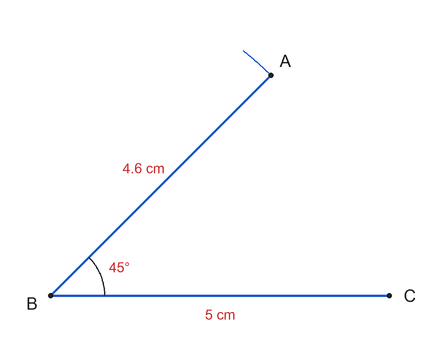
As an extra check, joining AC and measuring gives AC ≈ 3.7 cm.
Watch out: Bisect the 90° angle, not the 60° angle (that would give 30°).
Therefore, the required angle ABC = 45° is drawn, with BC = 5 cm and AB = 4.6 cm.
- 53 marks
Question 5
Construct angle ABC = 90°. Draw BP, the bisector of angle ABC. State, the measure of angle PBC.
Solve with AIWritten solution
Solution:
Concept: The bisector of an angle divides it into two equal angles, so each half of a right angle is 90° ÷ 2.
Given: ∠ABC = 90°, and BP bisects ∠ABC.
Step 1 — Draw the base.
Draw a line BC of any length.
Step 2 — Construct 90° at B.
With B as centre draw an arc cutting BC; with the same radius step off the 60° point and the 120° point along the arc. With these two points as centres and any equal radius, draw arcs meeting at a point, and join it to B, producing it to A. This line bisects the angle between 60° and 120°, so the angle is 90°.
Step 3 — Bisect ∠ABC.
With B as centre draw an arc cutting BA and BC. With the two cut points as centres and any equal radius (more than half the distance between them), draw arcs meeting at a point inside the angle. Join B to this point and produce it to P. Every point of this line is equally far from both arms, so it bisects ∠ABC.
Step 4 — Work out ∠PBC.
BP cuts the right angle into two equal parts, so each part is half of 90°.
Step 5 — Look at the finished figure and check it.
The finished construction is shown below, with the given measurements marked on it.

A protractor on the figure also reads ∠PBC = 45°.
Watch out: The bisector makes equal angles with BOTH arms, so ∠ABP is also 45°.
Therefore, ∠PBC = 45°.
- 63 marks
Question 6
Draw angle ABC of any suitable measure.
(i) Draw BP, the bisector of angle ABC.
(ii) Draw BR, the bisector of angle PBC and draw BQ, the bisector of angle ABP.
(iii) Are the angles ABQ, QBP, PBR and RBC equal?
(iv) Are the angles ABR and QBC equal?
Solve with AIWritten solution
Solution:
Concept: Bisecting an angle splits it into two equal halves; bisecting each half again splits the whole angle into four equal parts.
Given: ∠ABC of any suitable measure; BP bisects ∠ABC, BR bisects ∠PBC and BQ bisects ∠ABP.
Step 1 — Draw the angle.
Draw ∠ABC of any measure. We take ∠ABC = 120°, made with compasses. With B as centre and any convenient radius, draw an arc cutting BC. Keeping the same radius, step off two equal arcs along it from that point; each step turns through 60°. Join B to the second point and produce it to A. The angle is 60° + 60° = 120°.
Step 2 — Part (i): draw BP.
With B as centre draw an arc cutting BA and BC. With the two cut points as centres and any equal radius (more than half the distance between them), draw arcs meeting at a point inside the angle. Join B to this point and produce it to P. Every point of this line is equally far from both arms, so it bisects ∠ABC.
Step 3 — Part (ii): draw BR and BQ.
Bisect ∠PBC in the same way (arcs from the points where an arc about B cuts BP and BC) to get BR. Then bisect ∠ABP to get BQ.
Step 4 — Part (iii): compare the four angles.
BP makes the two halves equal: ∠ABP = ∠PBC. BQ halves ∠ABP and BR halves ∠PBC, and halves of equal angles are equal. So ∠ABQ, ∠QBP, ∠PBR and ∠RBC are all equal, each one quarter of ∠ABC. In our figure each is 120° ÷ 4 = 30°.
Step 5 — Part (iv): compare ∠ABR and ∠QBC.
∠ABR is made of ∠ABQ, ∠QBP and ∠PBR, three of the four equal parts. ∠QBC is made of ∠QBP, ∠PBR and ∠RBC, also three of the four equal parts. So ∠ABR = ∠QBC; in our figure each is 3 × 30° = 90°.
Step 6 — Look at the finished figure and check it.
The finished construction is shown below, with the given measurements marked on it.
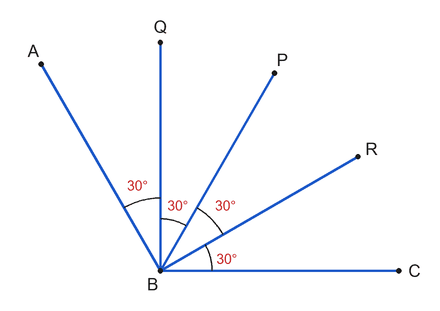
Each of the four marked angles in the figure is 30°.
Watch out: This holds for ANY starting angle, not only 120°: the four parts are always equal quarters.
Therefore, (iii) yes, ∠ABQ, ∠QBP, ∠PBR and ∠RBC are equal; (iv) yes, ∠ABR = ∠QBC.
- 73 marks
Question 7
Draw a line segment AB of length 5.3 cm. Using two different methods bisect AB.
Solve with AIWritten solution
Solution:
Concept: Bisecting a line segment means dividing it into two equal parts at its mid-point. Every point that is equally far from A and B lies on the perpendicular bisector of AB.
Given: AB = 5.3 cm; a ruler and a pair of compasses (a protractor only where the step says so).
Step 1 — Understand the task.
To bisect AB means to find its mid-point M, so that AM and MB are both half of 5.3 cm.
Step 2 — Method 1: draw AB.
Draw AB = 5.3 cm.
Step 3 — Method 1: draw the perpendicular bisector.
With A as centre and radius 3.6 cm (more than half of AB), draw arcs above and below AB. With B as centre and the same radius, cut these arcs at P and Q. Join PQ, cutting AB at M.
P and Q are each the same distance from A as from B, so both lie on the perpendicular bisector of AB, and M is the mid-point of AB.

Step 4 — Method 2: draw AB and two equal angles.
Draw AB = 5.3 cm again; then, at A, construct ∠BAX = 60° above AB, and at B construct ∠ABY = 60° below AB (each by the equilateral-triangle method with compasses).
Step 5 — Method 2: cut off equal lengths and join.
With the same compass opening (say 3 cm), cut off AP on AX and BQ on BY. Join PQ, cutting AB at M.
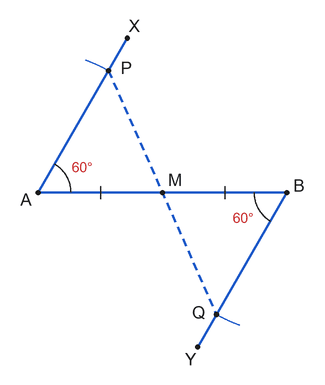
Step 6 — Method 2: why M is the mid-point.
∠PAB and ∠QBA are equal alternate angles, so AX is parallel to BY. In triangles AMP and BMQ: AP = BQ (same opening), ∠PAM = ∠QBM (both 60°) and ∠AMP = ∠BMQ (vertically opposite). So the triangles are congruent (AAS) and AM = MB.
Step 7 — Check by measuring.
In both figures a ruler reads AM ≈ 2.65 cm and MB ≈ 2.65 cm; the equal parts are marked with ticks.
Watch out: In Method 1 the radius must be MORE than half of AB (more than 2.65 cm), or the arcs from A and B do not meet.
Therefore, M is the mid-point of AB by both methods, with AM and MB both 2.65 cm.
- 83 marks
Question 8
Draw a line segment PQ = 4.8 cm. Construct the perpendicular bisector of PQ.
Solve with AIWritten solution
Solution:
Concept: Every point that is equally far from P and Q lies on the perpendicular bisector of PQ, so two such points fix it.
Given: PQ = 4.8 cm.
Step 1 — Draw the segment.
Draw PQ = 4.8 cm.
Step 2 — Mark two points equally far from P and Q.
With P as centre and radius 3.2 cm (more than half of PQ), draw arcs above and below PQ. With Q as centre and the same radius, cut these arcs at X and Y.
Step 3 — Join them.
Join XY, cutting PQ at M. XY is the perpendicular bisector of PQ.
Step 4 — Look at the finished figure and check it.
The finished construction is shown below, with the given measurements marked on it.
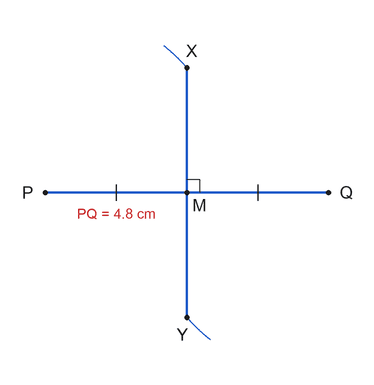
On measuring, PM ≈ 2.4 cm, MQ ≈ 2.4 cm and ∠XMQ = 90°.
Watch out: Use the same radius from P and from Q; different radii give a point that is NOT on the bisector.
Therefore, XY is the required perpendicular bisector of PQ (PM and MQ are both 2.4 cm, and ∠XMQ = 90°).
- 93 marks
Question 9
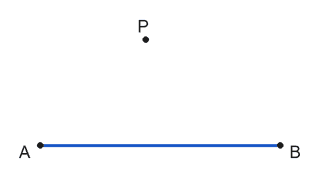
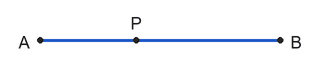
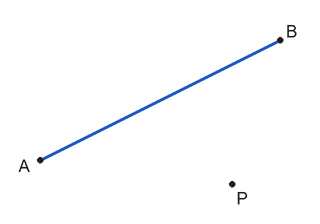
In each of the following, draw perpendicular through point P to the line segment AB :
(i)
(ii)
(iii)
 Solve with AI
Written solution
Solution:
Concept: A perpendicular to a line through a point P is the perpendicular bisector of a segment XY of the line whose ends are equally far from P.
Given: The line segment AB and the point P in each figure; a ruler and a pair of compasses (a protractor only where the step says so).
Step 1 — Know the idea used in every part.
Draw an arc about P to get two points X and Y on AB that are equally far from P. Any point equally far from X and Y lies on the perpendicular bisector of XY, and P is one such point. So the perpendicular bisector of XY passes through P and is perpendicular to AB.
Step 2 — Part (i): P outside AB.
With P as centre and a radius large enough, draw an arc cutting AB at X and Y. With X and Y as centres and the same radius, draw arcs meeting at Q on the other side of AB. Join PQ, meeting AB at M. Then PQ is perpendicular to AB.

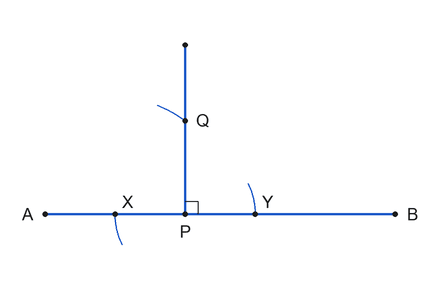
Step 3 — Part (ii): P on AB.
With P as centre and a small radius, draw arcs cutting AB at X and Y, one on each side of P. With X and Y as centres and a radius greater than PX, draw arcs meeting at Q. Join PQ; it is perpendicular to AB at P.
Step 4 — Part (iii): P outside a slanting AB.
Do exactly as in part (i): an arc about P cuts AB at X and Y, equal arcs from X and Y meet at Q on the other side of AB, and PQ meets AB at M. The method does not depend on how AB is tilted.
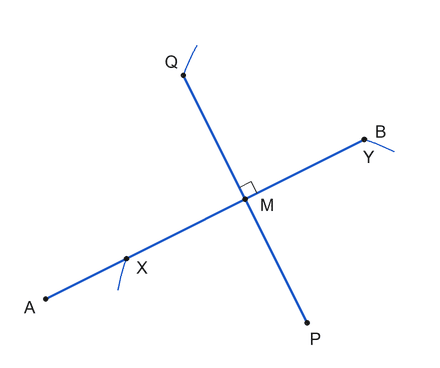
Watch out: In parts (i) and (iii) the arc about P must cut AB at TWO points; if it only touches AB, increase the radius.
Therefore, PQ is the required perpendicular through P to AB in each part (marked with a right angle).
- 103 marks
Question 10
Draw a line segment AB = 5.5 cm. Mark a point P, such that PA = 6 cm and PB = 4.8 cm. From point P, draw a perpendicular to AB.
Solve with AIWritten solution
Solution:
Concept: A point is fixed by its distances from two known points (two arcs). The perpendicular from an outside point is then drawn with equal arcs, as the perpendicular bisector of a chord of the arc about P.
Given: AB = 5.5 cm, PA = 6 cm and PB = 4.8 cm.
Step 1 — Draw the base.
Draw AB = 5.5 cm.
Step 2 — Locate P.
With A as centre and radius 6 cm, and B as centre and radius 4.8 cm, draw two arcs meeting at P above AB.
Step 3 — Mark two points on AB equally far from P.
With P as centre and radius 4.6 cm, draw an arc cutting AB at X and Y.
Step 4 — Find a second point of the perpendicular.
With X and Y as centres and radius 3 cm, draw arcs meeting at Q below AB.
Step 5 — Draw the perpendicular.
Join PQ, cutting AB at M. PM is perpendicular to AB.
Step 6 — Look at the finished figure and check it.
The finished construction is shown below, with the given measurements marked on it.
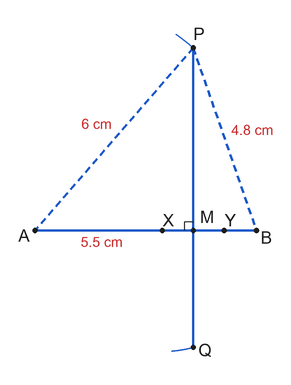
On measuring, PM ≈ 4.5 cm, and M is about 3.9 cm from A.
Watch out: P is about 4.5 cm from AB, so the arc from P needs a radius a little MORE than that (we used 4.6 cm) to cut AB twice between A and B; a much larger radius cuts the line beyond B.
Note: The radii 4.6 cm and 3 cm are our choice; any radius that cuts AB twice, and any equal radii from X and Y that meet, give the same line.
Therefore, PM is the required perpendicular from P to AB (PM ≈ 4.5 cm).
- 113 marks
Question 11
Draw a line segment AB = 6.2 cm. Mark a point P in AB such that BP = 4 cm. Through point P draw perpendicular to AB.
Solve with AIWritten solution
Solution:
Concept: A point on a line is located by cutting off a length with compasses. The perpendicular at a point on a line is the perpendicular bisector of a small segment XY centred at that point.
Given: AB = 6.2 cm and BP = 4 cm, with P on AB.
Step 1 — Draw the segment.
Draw AB = 6.2 cm.
Step 2 — Locate P.
With B as centre and radius 4 cm, cut AB at P. Then AP is what is left of AB.
Step 3 — Mark X and Y.
With P as centre and radius 1.5 cm, draw arcs cutting AB at X and Y, one on each side of P.
Step 4 — Draw the perpendicular.
With X and Y as centres and radius 2.4 cm (more than PX), draw arcs meeting at Q. Join PQ and produce it.
Step 5 — Look at the finished figure and check it.
The finished construction is shown below, with the given measurements marked on it.
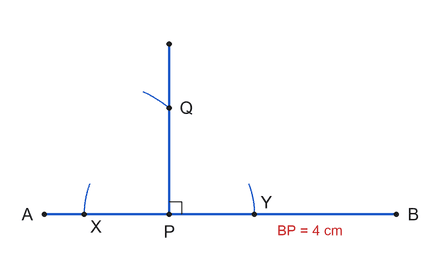
On measuring, AP ≈ 2.2 cm and ∠QPB = 90°.
Watch out: Measure BP from B, not from A; P is 4 cm from B, so it is only 2.2 cm from A.
Therefore, PQ is the required perpendicular to AB through P.
- 123 marks
Question 12
Draw a line AB = 6 cm. Mark a point P anywhere outside the line AB. Through point P, construct a line parallel to AB.
Solve with AIWritten solution
Solution:
Concept: If a transversal makes a pair of equal alternate angles with two lines, the two lines are parallel. So a line through a point parallel to a given line is drawn by copying an angle on the other side of a transversal.
Given: AB = 6 cm and a point P outside AB.
Step 1 — Draw AB and P.
Draw AB = 6 cm and mark a point P outside it.
Step 2 — Draw a transversal.
Take any point Q on AB and join PQ. ∠PQA is the angle PQ makes with AB.
Step 3 — Copy ∠PQA at P.
With Q as centre and a small radius, draw an arc cutting QA and QP. With P as centre and the same radius, draw an arc cutting PQ, on the side of PQ towards B. Take the distance between the two cuts on the first arc in the compasses and, from the point where the second arc meets PQ, cut the second arc at R.
Step 4 — Draw the parallel line.
Join PR and produce it both ways to get XY. Then ∠QPR = ∠PQA (marked α), and these are alternate angles.
Step 5 — Look at the finished figure and check it.
The finished construction is shown below, with the given measurements marked on it.
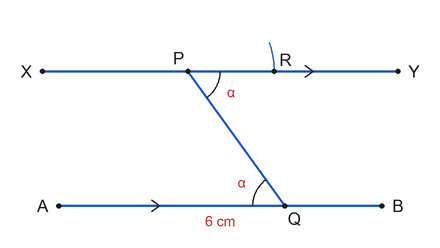
The two equal angles α are marked, and the arrows show the parallel lines.
Watch out: Copy the angle on the OTHER side of PQ (alternate angles); copying it on the same side gives a line that is not parallel.
Therefore, XY is the required line through P parallel to AB.
- 133 marks
Question 13
Draw a line MN = 5.8 cm. Locate a point A which is 4.5 cm from M and 5 cm from N. Through A draw a line parallel to line MN.
Solve with AIWritten solution
Solution:
Concept: If a transversal makes a pair of equal alternate angles with two lines, the two lines are parallel. So a line through a point parallel to a given line is drawn by copying an angle on the other side of a transversal.
Given: MN = 5.8 cm, MA = 4.5 cm and NA = 5 cm.
Step 1 — Draw MN and locate A.
Draw MN = 5.8 cm. With M as centre and radius 4.5 cm, and N as centre and radius 5 cm, draw arcs meeting at A above MN. Join MA.
Step 2 — Copy ∠AMN at A.
With M as centre and a small radius, draw an arc cutting MN and MA. With A as centre and the same radius, draw an arc cutting AM, on the side of AM away from N. Cut this arc at R with the same chord as on the first arc.
Step 3 — Draw the parallel line.
Join AR and produce it both ways to get XY. ∠RAM = ∠AMN (marked α), and these are alternate angles, so XY ∥ MN.
Step 4 — Look at the finished figure and check it.
The finished construction is shown below, with the given measurements marked on it.
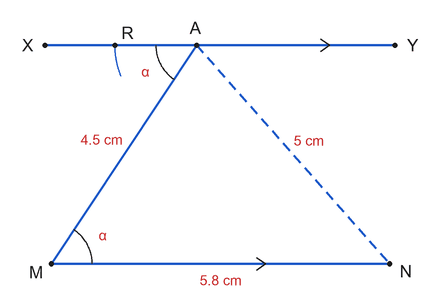
In the figure α ≈ 56° at both M and A.
Watch out: The two arcs from M and N also meet at a second point below MN; either can be taken as A, and we took the one above.
Therefore, XY is the required line through A parallel to MN.
- 143 marks
Question 14
Draw a straight line AB = 6.5 cm. Draw another line which is parallel to AB at a distance of 2.8 cm from it.
Solve with AIWritten solution
Solution:
Concept: The distance between two parallel lines is measured along a perpendicular. Two points, each 2.8 cm from AB along perpendiculars on the same side, fix the parallel line.
Given: AB = 6.5 cm; the parallel line is to be 2.8 cm from AB.
Step 1 — Draw AB.
Draw AB = 6.5 cm and take two points L and M on it, well apart.
Step 2 — Draw perpendiculars.
Construct perpendiculars to AB at L and at M (equal arcs from two points on either side, as in Exercise 18(B)).
Step 3 — Cut off 2.8 cm on each.
With L as centre and radius 2.8 cm, cut the perpendicular at L at P. With M as centre and radius 2.8 cm, cut the perpendicular at M at Q, on the same side of AB.
Step 4 — Draw the line.
Join PQ and produce it both ways. P and Q are both 2.8 cm from AB, so PQ is parallel to AB.
Step 5 — Look at the finished figure and check it.
The finished construction is shown below, with the given measurements marked on it.
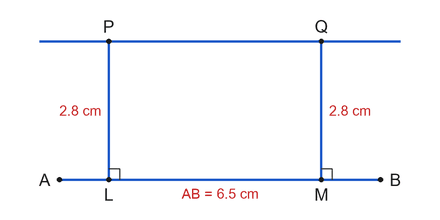
LP and MQ are both 2.8 cm and both perpendicular to AB.
Watch out: Cut off both 2.8 cm lengths on the SAME side of AB.
Note: A second such line can be drawn on the other side of AB in the same way.
Therefore, PQ is the required line, parallel to AB at a distance of 2.8 cm.
- 153 marks
Question 15
Construct an angle PQR = 80°. Draw a line parallel to PQ at a distance of 3 cm from it and another line parallel to QR at a distance of 3.5 cm from it. Mark the point of intersection of these parallel lines as A.
Solve with AIWritten solution
Solution:
Concept: All points at a fixed distance from a line lie on a line parallel to it. So the points 3 cm from PQ form a line parallel to PQ, the points 3.5 cm from QR form a line parallel to QR, and A is where these two lines meet.
Given: ∠PQR = 80°; the lines are 3 cm from PQ and 3.5 cm from QR.
Step 1 — Draw the angle.
Draw QR and, with a protractor, draw QP so that ∠PQR = 80°. (80° cannot be made from 60° and 90° by bisecting, so the protractor is needed here.)
Step 2 — Draw the line parallel to QR.
At two points of QR construct perpendiculars to QR and cut off 3.5 cm on each, inside the angle. Join these two points and produce the line.
Step 3 — Draw the line parallel to PQ.
At two points of QP construct perpendiculars to QP and cut off 3 cm on each, inside the angle. Join these two points and produce the line.
Step 4 — Mark A.
Mark A where the two parallel lines meet.
Step 5 — Look at the finished figure and check it.
The finished construction is shown below, with the given measurements marked on it.
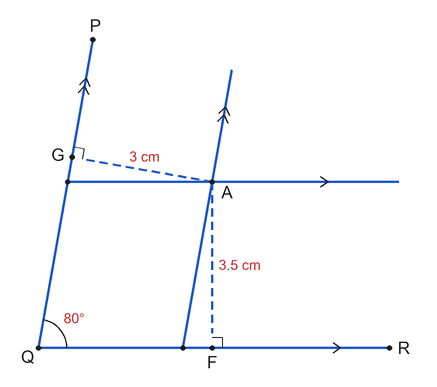
In the figure the dashed perpendiculars show that A is 3.5 cm from QR and 3 cm from PQ. On measuring, QA ≈ 5.1 cm.
Watch out: The 3 cm line goes with PQ and the 3.5 cm line goes with QR; swapping them gives a different point.
Note: Each parallel line could also be drawn on the other side of its arm; we drew both inside the angle, which puts A inside ∠PQR.
Therefore, A is the required point, 3 cm from PQ and 3.5 cm from QR (QA ≈ 5.1 cm).
- 163 marks
Question 16
Draw an angle ABC = 60°. Draw the bisector of it. Also, draw a line parallel to BC a distance of 2.5 cm from it. Let this parallel line meet AB at point P and angle bisector at point Q. Measure the length of BP and PQ. Is BP = PQ?
Solve with AIWritten solution
Solution:
Concept: Bisecting 60° gives two angles of 30°. A line parallel to BC makes equal alternate angles with any transversal, and in a triangle the sides opposite equal angles are equal.
Given: ∠ABC = 60°, BD bisects it, and the line through P and Q is parallel to BC at a distance of 2.5 cm.
Step 1 — Construct 60° at B.
With B as centre and any convenient radius, draw an arc cutting BC at L. With L as centre and the same radius, cut this arc at N. Join BN and produce it to A. Then BL, BN and LN are all equal to the radius, so triangle BLN is equilateral and the angle at B is 60°.
Step 2 — Bisect the angle.
With B as centre draw an arc cutting BA and BC. With the two cut points as centres and any equal radius (more than half the distance between them), draw arcs meeting at a point inside the angle. Join B to this point and produce it to D. Every point of this line is equally far from both arms, so it bisects ∠ABC. Each half is 30°.
Step 3 — Draw the parallel line.
At two points of BC construct perpendiculars and cut off 2.5 cm on each, on the same side as A. Join these points and produce the line.
Step 4 — Mark P and Q.
Mark P where this line meets BA and Q where it meets the bisector BD.
Step 5 — Measure and compare.
On measuring, BP ≈ 2.9 cm and PQ ≈ 2.9 cm, so BP = PQ.
Step 6 — See why BP = PQ.
PQ ∥ BC and BQ is a transversal, so the alternate angles ∠PQB and ∠QBC are equal, and each is 30°. Also ∠PBQ = 30°. In triangle PBQ the angles at B and Q are equal, so the sides opposite them are equal: BP = PQ.
Step 7 — Look at the finished figure and check it.
The finished construction is shown below, with the given measurements marked on it.
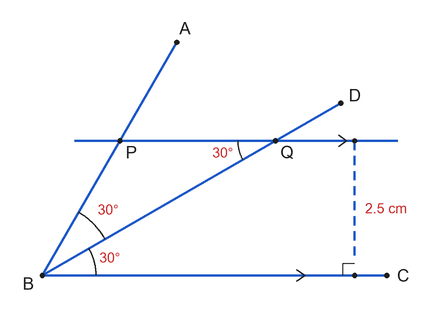
The figure marks the 30° angles at B and at Q, and the 2.5 cm gap.
Watch out: Measure the 2.5 cm along a PERPENDICULAR to BC, not along BA.
Therefore, BP ≈ 2.9 cm and PQ ≈ 2.9 cm, so yes, BP = PQ.
- 173 marks
Question 17
Construct an angle ABC = 90°. Locate a point P which is 2.5 cm from AB and 3.2 cm from BC.
Solve with AIWritten solution
Solution:
Concept: Points 2.5 cm from AB lie on a line parallel to AB, 2.5 cm away; points 3.2 cm from BC lie on a line parallel to BC, 3.2 cm away. P is where the two lines meet.
Given: ∠ABC = 90°; P is 2.5 cm from AB and 3.2 cm from BC.
Step 1 — Construct the right angle.
Draw BC. With B as centre draw an arc cutting BC; with the same radius step off the 60° point and the 120° point along the arc. With these two points as centres and any equal radius, draw arcs meeting at a point, and join it to B, producing it to A. This line bisects the angle between 60° and 120°, so the angle is 90°.
Step 2 — Draw the line 2.5 cm from AB.
Draw a line parallel to AB at a distance of 2.5 cm, inside the angle (perpendiculars at two points of AB, cut off 2.5 cm on each, join).
Step 3 — Draw the line 3.2 cm from BC.
Draw a line parallel to BC at a distance of 3.2 cm, inside the angle, in the same way.
Step 4 — Mark P.
Mark P where the two lines meet.
Step 5 — Look at the finished figure and check it.
The finished construction is shown below, with the given measurements marked on it.
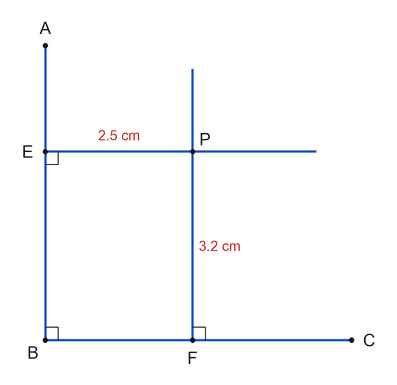
In the figure EP = 2.5 cm (the distance of P from AB) and FP = 3.2 cm (the distance of P from BC). On measuring, BP ≈ 4.1 cm.
Watch out: The 2.5 cm is measured from AB, so it is the horizontal gap in the figure, not the vertical one.
Note: We took P inside the right angle ABC; drawing the parallel lines on the other sides of the arms gives points outside the angle.
Therefore, P is the required point, 2.5 cm from AB and 3.2 cm from BC (BP ≈ 4.1 cm).
- 183 marks
Question 18
Construct a quadrilateral ABCD; if:
(i) AB = 4.3 cm, BC = 5.4, CD = 5 cm, DA = 4.8 cm and angle ABC = 75°.
Solve with AIWritten solution
Solution:
Concept: A quadrilateral is constructed by splitting it into triangles: each triangle is fixed by three suitable measurements (three sides, two sides and the included angle, or two angles and a side), and the fourth vertex is then cut off by arcs or along a known direction.
Given: AB = 4.3 cm, BC = 5.4 cm, CD = 5 cm, DA = 4.8 cm and ∠ABC = 75°.
Step 1 — Plan.
BC, ∠B and BA fix triangle ABC (two sides and the included angle). Then D is 4.8 cm from A and 5 cm from C.
Step 2 — Draw BC.
Draw BC = 5.4 cm.
Step 3 — Construct 75° at B.
At B, construct a 60° line and a 90° line from BC (as above). Bisect the angle between them and produce the bisector to X. It lies half-way between 60° and 90°, so it makes 75° with BC.
Step 4 — Locate A.
With B as centre and radius 4.3 cm, cut BX at A.
Step 5 — Locate D.
With A as centre and radius 4.8 cm, and C as centre and radius 5 cm, draw arcs meeting at D, on the side of AC away from B.
Step 6 — Complete.
Join AD and CD.
Step 7 — Look at the finished figure and check it.
The finished construction is shown below, with the given measurements marked on it.
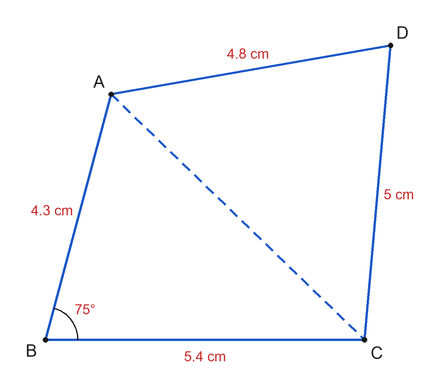
On measuring, AC ≈ 6.0 cm and BD ≈ 7.7 cm.
Watch out: Cut the fourth vertex off on the side AWAY from the first triangle, or the quadrilateral folds over itself.
Note: The stem prints “BC = 5.4” without a unit; it is taken as 5.4 cm.
Therefore, ABCD is the required quadrilateral.
- 193 marks
Question 19
Construct a quadrilateral ABCD; if:
(ii) AB = 6 cm, CD = 4.5 cm, BC = AD = 5 cm and ∠BCD = 60°.
Solve with AIWritten solution
Solution:
Concept: A quadrilateral is constructed by splitting it into triangles: each triangle is fixed by three suitable measurements (three sides, two sides and the included angle, or two angles and a side), and the fourth vertex is then cut off by arcs or along a known direction.
Given: AB = 6 cm, CD = 4.5 cm, BC = 5 cm, AD = 5 cm and ∠BCD = 60°.
Step 1 — Plan.
BC, ∠C and CD fix triangle BCD (two sides and the included angle). Then A is 6 cm from B and 5 cm from D.
Step 2 — Draw BC.
Draw BC = 5 cm.
Step 3 — Construct 60° at C.
With C as centre and any convenient radius, draw an arc cutting CB at P. With P as centre and the same radius, cut this arc at Q. Join CQ and produce it to Y. Then CP, CQ and PQ are all equal to the radius, so triangle CPQ is equilateral and the angle at C is 60°.
Step 4 — Locate D.
With C as centre and radius 4.5 cm, cut CY at D.
Step 5 — Locate A.
With B as centre and radius 6 cm, and D as centre and radius 5 cm, draw arcs meeting at A, on the side of BD away from C.
Step 6 — Complete.
Join AB and AD.
Step 7 — Look at the finished figure and check it.
The finished construction is shown below, with the given measurements marked on it.

On measuring, the diagonal BD ≈ 4.8 cm.
Watch out: Cut the fourth vertex off on the side AWAY from the first triangle, or the quadrilateral folds over itself.
Therefore, ABCD is the required quadrilateral.
- 203 marks
Question 20
Construct a quadrilateral ABCD; if:
(iii) AB = 8 cm, BC = 5.4 cm, AD = 6 cm, ∠A = 60° and ∠B = 75°.
Solve with AIWritten solution
Solution:
Concept: A quadrilateral is constructed by splitting it into triangles: each triangle is fixed by three suitable measurements (three sides, two sides and the included angle, or two angles and a side), and the fourth vertex is then cut off by arcs or along a known direction.
Given: AB = 8 cm, BC = 5.4 cm, AD = 6 cm, ∠A = 60° and ∠B = 75°.
Step 1 — Plan.
At each end of AB we know an angle and a side, which fix D and C. Joining them completes ABCD.
Step 2 — Draw AB.
Draw AB = 8 cm.
Step 3 — Locate D.
With A as centre and any convenient radius, draw an arc cutting AB at P. With P as centre and the same radius, cut this arc at Q. Join AQ and produce it to X. Then AP, AQ and PQ are all equal to the radius, so triangle APQ is equilateral and the angle at A is 60°. With A as centre and radius 6 cm, cut AX at D.
Step 4 — Locate C.
Work on the same side of AB as D. At B, construct a 60° line and a 90° line from BA (as above). Bisect the angle between them and produce the bisector to Y. It lies half-way between 60° and 90°, so it makes 75° with BA. With B as centre and radius 5.4 cm, cut BY at C.
Step 5 — Complete.
Join CD.
Step 6 — Look at the finished figure and check it.
The finished construction is shown below, with the given measurements marked on it.
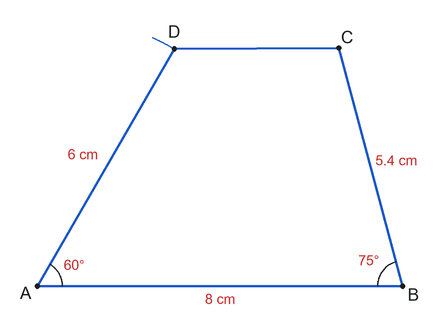
On measuring, CD ≈ 3.6 cm.
Watch out: Draw both angles on the SAME side of AB.
Therefore, ABCD is the required quadrilateral.
- 213 marks
Question 21
Construct a quadrilateral ABCD; if:
(iv) AB = 5 cm, BC = 6.5 cm, CD = 4.8 cm, ∠B = 75° and ∠C = 120°.
Solve with AIWritten solution
Solution:
Concept: A quadrilateral is constructed by splitting it into triangles: each triangle is fixed by three suitable measurements (three sides, two sides and the included angle, or two angles and a side), and the fourth vertex is then cut off by arcs or along a known direction.
Given: AB = 5 cm, BC = 6.5 cm, CD = 4.8 cm, ∠B = 75° and ∠C = 120°.
Step 1 — Plan.
With BC as base, the angles at B and C give the directions of BA and CD; the given lengths fix A and D.
Step 2 — Draw BC.
Draw BC = 6.5 cm.
Step 3 — Locate A.
At B, construct a 60° line and a 90° line from BC (as above). Bisect the angle between them and produce the bisector to X. It lies half-way between 60° and 90°, so it makes 75° with BC. With B as centre and radius 5 cm, cut BX at A.
Step 4 — Locate D.
Work on the same side of BC as A. With C as centre and any convenient radius, draw an arc cutting CB. Keeping the same radius, step off two equal arcs along it from that point; each step turns through 60°. Join C to the second point and produce it to Y. The angle is 60° + 60° = 120°. With C as centre and radius 4.8 cm, cut CY at D.
Step 5 — Complete.
Join AD.
Step 6 — Look at the finished figure and check it.
The finished construction is shown below, with the given measurements marked on it.

On measuring, AD ≈ 7.6 cm.
Watch out: Draw both angles on the SAME side of BC.
Therefore, ABCD is the required quadrilateral.
- 223 marks
Question 22
Construct a quadrilateral ABCD; if:
(v) AB = 6 cm = AC, BC = 4 cm, CD = 5 cm and AD = 4.5 cm.
Solve with AIWritten solution
Solution:
Concept: A quadrilateral is constructed by splitting it into triangles: each triangle is fixed by three suitable measurements (three sides, two sides and the included angle, or two angles and a side), and the fourth vertex is then cut off by arcs or along a known direction.
Given: AB = 6 cm, AC = 6 cm, BC = 4 cm, CD = 5 cm and AD = 4.5 cm.
Step 1 — Plan.
The diagonal AC (6 cm) splits ABCD into triangle ABC (sides 6, 4, 6 cm) and triangle ACD (sides 6, 5, 4.5 cm). We construct both on AC, on opposite sides.
Step 2 — Draw AC.
Draw AC = 6 cm.
Step 3 — Locate B.
With A as centre and radius 6 cm, and C as centre and radius 4 cm, draw arcs meeting at B below AC. Join AB and CB.
Step 4 — Locate D.
With A as centre and radius 4.5 cm, and C as centre and radius 5 cm, draw arcs meeting at D above AC.
Step 5 — Complete.
Join AD and CD.
Step 6 — Look at the finished figure and check it.
The finished construction is shown below, with the given measurements marked on it.
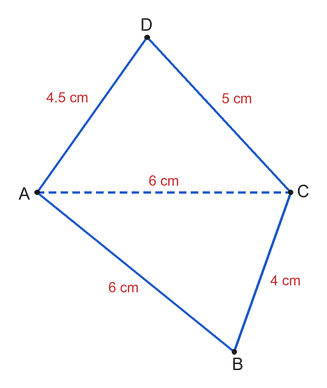
On measuring, BD ≈ 7.7 cm.
Watch out: B and D must be on OPPOSITE sides of AC.
Therefore, ABCD is the required quadrilateral.
- 233 marks
Question 23
Construct a quadrilateral ABCD; if:
(vi) AB = AD = 5 cm, BD = 7 cm and BC = DC = 5.5 cm
Solve with AIWritten solution
Solution:
Concept: A quadrilateral is constructed by splitting it into triangles: each triangle is fixed by three suitable measurements (three sides, two sides and the included angle, or two angles and a side), and the fourth vertex is then cut off by arcs or along a known direction.
Given: AB = 5 cm, AD = 5 cm, BD = 7 cm, BC = 5.5 cm and DC = 5.5 cm.
Step 1 — Plan.
The diagonal BD (7 cm) splits ABCD into triangle ABD (5, 5, 7 cm) and triangle CBD (5.5, 5.5, 7 cm). We construct both on BD, on opposite sides.
Step 2 — Draw BD.
Draw BD = 7 cm.
Step 3 — Locate A.
With B and D as centres and radius 5 cm, draw arcs meeting at A above BD. Join AB and AD.
Step 4 — Locate C.
With B and D as centres and radius 5.5 cm, draw arcs meeting at C below BD. Join BC and DC.
Step 5 — Look at the finished figure and check it.
The finished construction is shown below, with the given measurements marked on it.

On measuring, AC ≈ 7.8 cm. Since AB = AD and CB = CD, the figure is a kite.
Watch out: A and C must be on OPPOSITE sides of BD.
Therefore, ABCD is the required quadrilateral (a kite).
- 243 marks
Question 24
Construct a parallelogram ABCD, if :
(i) AB = 3.6 cm, BC = 4.5 cm and ∠ABC = 120°.
Solve with AIWritten solution
Solution:
Concept: In a parallelogram, opposite sides are equal and parallel and opposite angles are equal; the diagonals bisect each other.
Given: AB = 3.6 cm, BC = 4.5 cm and ∠ABC = 120°.
Step 1 — Use the properties.
Opposite sides are equal, so AD equals BC (4.5 cm) and DC equals AB (3.6 cm).
Step 2 — Draw BC.
Draw BC = 4.5 cm.
Step 3 — Construct 120° at B.
With B as centre and any convenient radius, draw an arc cutting BC. Keeping the same radius, step off two equal arcs along it from that point; each step turns through 60°. Join B to the second point and produce it to X. The angle is 60° + 60° = 120°.
Step 4 — Locate A.
With B as centre and radius 3.6 cm, cut BX at A.
Step 5 — Locate D.
With A as centre and radius 4.5 cm, and C as centre and radius 3.6 cm, draw arcs meeting at D.
Step 6 — Complete.
Join AD and CD.
Step 7 — Look at the finished figure and check it.
The finished construction is shown below, with the given measurements marked on it.
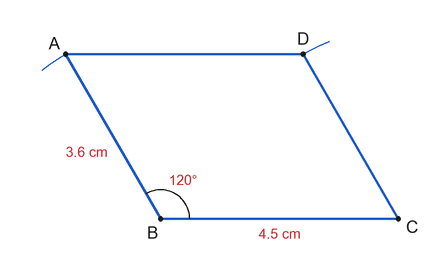
Both pairs of opposite sides are equal, so ABCD is a parallelogram.
Watch out: The arc from A has the length of BC, and the arc from C has the length of AB (opposite sides), not the other way round.
Therefore, ABCD is the required parallelogram.
- 253 marks
Question 25
Construct a parallelogram ABCD, if :
(ii) BC = 4.5 cm, CD = 5.2 cm and ∠ADC = 75°.
Solve with AIWritten solution
Solution:
Concept: In a parallelogram, opposite sides are equal and parallel and opposite angles are equal; the diagonals bisect each other.
Given: BC = 4.5 cm, CD = 5.2 cm and ∠ADC = 75°.
Step 1 — Use the properties.
Opposite sides are equal, so AB equals CD (5.2 cm). Opposite angles are equal, so ∠ABC equals ∠ADC (75°). Now we know two sides and the angle between them at B.
Step 2 — Draw BC.
Draw BC = 4.5 cm.
Step 3 — Construct 75° at B.
At B, construct a 60° line and a 90° line from BC (as above). Bisect the angle between them and produce the bisector to X. It lies half-way between 60° and 90°, so it makes 75° with BC.
Step 4 — Locate A.
With B as centre and radius 5.2 cm, cut BX at A.
Step 5 — Locate D.
With A as centre and radius 4.5 cm, and C as centre and radius 5.2 cm, draw arcs meeting at D.
Step 6 — Complete.
Join AD and CD.
Step 7 — Look at the finished figure and check it.
The finished construction is shown below, with the given measurements marked on it.
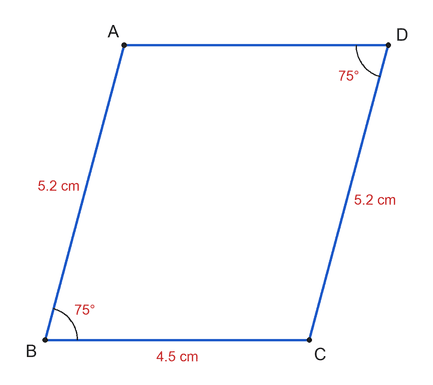
The figure marks ∠ABC = 75° and the given ∠ADC = 75°.
Watch out: The given angle is at D, so first move it to B using “opposite angles are equal”.
Note: One can also start from D: draw DC = 5.2 cm, construct ∠ADC = 75° at D and cut DA = 4.5 cm; the parallelogram is the same.
Therefore, ABCD is the required parallelogram, with ∠ADC = 75°.
- 263 marks
Question 26
Construct a parallelogram ABCD, if :
(iii) AD = 4 cm, DC = 5 cm and diagonal BD = 7 cm.
Solve with AIWritten solution
Solution:
Concept: In a parallelogram, opposite sides are equal and parallel and opposite angles are equal; the diagonals bisect each other.
Given: AD = 4 cm, DC = 5 cm and diagonal BD = 7 cm.
Step 1 — Use the properties.
Opposite sides are equal, so AB equals DC (5 cm) and BC equals AD (4 cm). The diagonal BD splits ABCD into two triangles with sides 5 cm, 4 cm and 7 cm.
Step 2 — Draw AB.
Draw AB = 5 cm.
Step 3 — Locate D.
With A as centre and radius 4 cm, and B as centre and radius 7 cm, draw arcs meeting at D. Join AD and BD.
Step 4 — Locate C.
With D as centre and radius 5 cm, and B as centre and radius 4 cm, draw arcs meeting at C.
Step 5 — Complete.
Join DC and BC.
Step 6 — Look at the finished figure and check it.
The finished construction is shown below, with the given measurements marked on it.
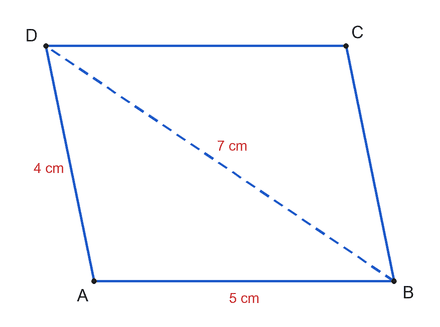
On measuring, the other diagonal AC ≈ 5.7 cm.
Watch out: C is 5 cm from D and 4 cm from B; swapping the radii gives a kite, not a parallelogram.
Therefore, ABCD is the required parallelogram.
- 273 marks
Question 27
Construct a parallelogram ABCD, if :
(iv) AB = 5.8 cm, AD = 4.6 cm and diagonal AC = 7.5 cm.
Solve with AIWritten solution
Solution:
Concept: In a parallelogram, opposite sides are equal and parallel and opposite angles are equal; the diagonals bisect each other.
Given: AB = 5.8 cm, AD = 4.6 cm and diagonal AC = 7.5 cm.
Step 1 — Use the properties.
BC equals AD (4.6 cm), so triangle ABC has sides 5.8 cm, 4.6 cm and 7.5 cm.
Step 2 — Draw AB.
Draw AB = 5.8 cm.
Step 3 — Locate C.
With A as centre and radius 7.5 cm, and B as centre and radius 4.6 cm, draw arcs meeting at C. Join AC and BC.
Step 4 — Locate D.
With A as centre and radius 4.6 cm, and C as centre and radius 5.8 cm, draw arcs meeting at D.
Step 5 — Complete.
Join AD and CD.
Step 6 — Look at the finished figure and check it.
The finished construction is shown below, with the given measurements marked on it.
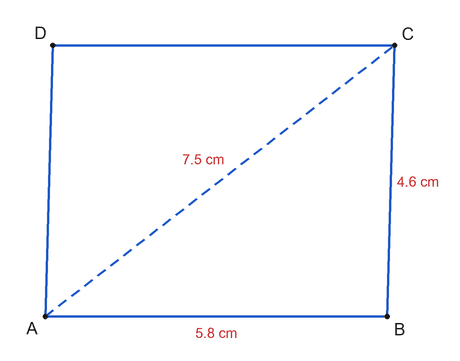
On measuring, the other diagonal BD ≈ 7.3 cm.
Watch out: D is 4.6 cm from A and 5.8 cm from C (opposite sides), on the side of AC away from B.
Therefore, ABCD is the required parallelogram.
- 283 marks
Question 28
Construct a parallelogram ABCD, if :
(v) diagonal AC = 6.4 cm, diagonal BD = 5.6 cm and angle between the diagonals is 75°.
Solve with AIWritten solution
Solution:
Concept: The diagonals of a parallelogram bisect each other. So we draw one diagonal, mark its mid-point O, draw a line through O at the given angle, and cut off half of the other diagonal on each side of O.
Given: Diagonal AC = 6.4 cm, diagonal BD = 5.6 cm and the angle between them = 75°.
Step 1 — Draw AC and find its mid-point.
Draw AC = 6.4 cm and draw its perpendicular bisector, cutting AC at O. Then OA and OC are both 3.2 cm.
Step 2 — Draw a line through O at 75°.
At O, construct ∠COX = 75° (construct 60° and 90° at O and bisect the angle between them), and produce XO backwards through O.
Step 3 — Cut off half of BD on each side.
Half of BD is 2.8 cm. With O as centre and radius 2.8 cm, cut this line at D on one side of O and at B on the other.
Step 4 — Complete.
Join AB, BC, CD and DA.
Step 5 — Look at the finished figure and check it.
The finished construction is shown below, with the given measurements marked on it.
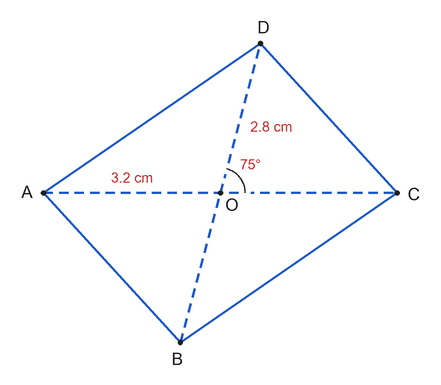
On measuring, AB ≈ 3.7 cm and BC ≈ 4.8 cm.
Watch out: Use HALF of each diagonal from O, not the whole diagonal.
Therefore, ABCD is the required parallelogram.
- 293 marks
Question 29
Construct a parallelogram ABCD, if :
(vi) lengths of diagonals AC and BD are 6.3 cm and 7.0 cm respectively, and the angle between them is 45°.
Solve with AIWritten solution
Solution:
Concept: The diagonals of a parallelogram bisect each other. So we draw one diagonal, mark its mid-point O, draw a line through O at the given angle, and cut off half of the other diagonal on each side of O.
Given: Diagonal AC = 6.3 cm, diagonal BD = 7 cm and the angle between them = 45°.
Step 1 — Draw AC and find its mid-point.
Draw AC = 6.3 cm and draw its perpendicular bisector, cutting AC at O. Then OA and OC are both 3.15 cm.
Step 2 — Draw a line through O at 45°.
At O, construct ∠COX = 45° by bisecting the right angle that the perpendicular bisector makes with AC, and produce XO backwards through O.
Step 3 — Cut off half of BD on each side.
Half of BD is 3.5 cm. With O as centre and radius 3.5 cm, cut this line at D on one side of O and at B on the other.
Step 4 — Complete.
Join AB, BC, CD and DA.
Step 5 — Look at the finished figure and check it.
The finished construction is shown below, with the given measurements marked on it.
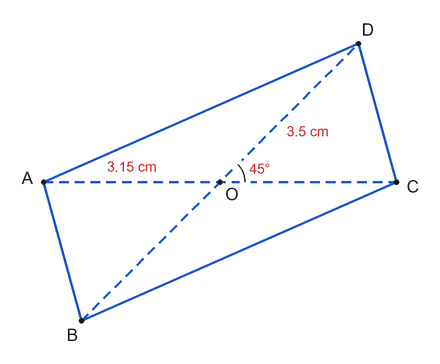
On measuring, AB ≈ 2.6 cm and BC ≈ 6.1 cm.
Watch out: Use HALF of each diagonal from O, not the whole diagonal.
Therefore, ABCD is the required parallelogram.
- 303 marks
Question 30
Construct a parallelogram ABCD, if :
(vii) lengths of diagonals AC and BD are 5.4 cm and 6.7 cm respectively and the angle between them is 60°.
Solve with AIWritten solution
Solution:
Concept: The diagonals of a parallelogram bisect each other. So we draw one diagonal, mark its mid-point O, draw a line through O at the given angle, and cut off half of the other diagonal on each side of O.
Given: Diagonal AC = 5.4 cm, diagonal BD = 6.7 cm and the angle between them = 60°.
Step 1 — Draw AC and find its mid-point.
Draw AC = 5.4 cm and draw its perpendicular bisector, cutting AC at O. Then OA and OC are both 2.7 cm.
Step 2 — Draw a line through O at 60°.
At O, construct ∠COX = 60° (arc about O, then the same radius stepped once along it), and produce XO backwards through O.
Step 3 — Cut off half of BD on each side.
Half of BD is 3.35 cm. With O as centre and radius 3.35 cm, cut this line at D on one side of O and at B on the other.
Step 4 — Complete.
Join AB, BC, CD and DA.
Step 5 — Look at the finished figure and check it.
The finished construction is shown below, with the given measurements marked on it.

On measuring, AB ≈ 3.1 cm and BC ≈ 5.2 cm.
Watch out: Use HALF of each diagonal from O, not the whole diagonal.
Therefore, ABCD is the required parallelogram.
- 313 marks
Question 31
Construct a rectangle ABCD; if :
(i) AB = 4.5 cm and BC = 5.5 cm.
Solve with AIWritten solution
Solution:
Concept: A rectangle is a parallelogram with every angle 90°; its diagonals are equal and bisect each other.
Given: AB = 4.5 cm and BC = 5.5 cm.
Step 1 — Use the properties.
Opposite sides of a rectangle are equal, so DC equals AB (4.5 cm) and AD equals BC (5.5 cm); every angle is 90°.
Step 2 — Draw AB.
Draw AB = 4.5 cm.
Step 3 — Construct 90° at B.
With B as centre draw an arc cutting BA; with the same radius step off the 60° point and the 120° point along the arc. With these two points as centres and any equal radius, draw arcs meeting at a point, and join it to B, producing it to X. This line bisects the angle between 60° and 120°, so the angle is 90°.
Step 4 — Locate C.
With B as centre and radius 5.5 cm, cut BX at C.
Step 5 — Locate D.
With A as centre and radius 5.5 cm, and C as centre and radius 4.5 cm, draw arcs meeting at D.
Step 6 — Complete.
Join AD and CD.
Step 7 — Look at the finished figure and check it.
The finished construction is shown below, with the given measurements marked on it.
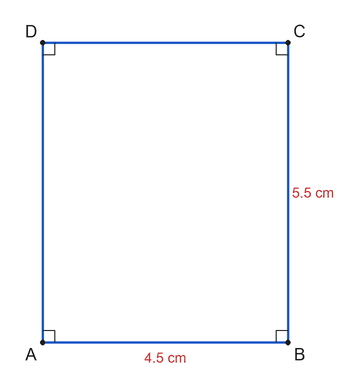
All four angles in the figure are right angles.
Watch out: The arc from A has the length of BC and the arc from C has the length of AB.
Therefore, ABCD is the required rectangle.
- 323 marks
Question 32
Construct a rectangle ABCD; if :
(ii) BC = 6.1 cm and CD = 6.8 cm.
Solve with AIWritten solution
Solution:
Concept: A rectangle is a parallelogram with every angle 90°; its diagonals are equal and bisect each other.
Given: BC = 6.1 cm and CD = 6.8 cm, so AB equals CD (6.8 cm).
Step 1 — Use the properties.
Opposite sides of a rectangle are equal, so DC equals AB (6.8 cm) and AD equals BC (6.1 cm); every angle is 90°.
Step 2 — Draw AB.
Draw AB = 6.8 cm.
Step 3 — Construct 90° at B.
With B as centre draw an arc cutting BA; with the same radius step off the 60° point and the 120° point along the arc. With these two points as centres and any equal radius, draw arcs meeting at a point, and join it to B, producing it to X. This line bisects the angle between 60° and 120°, so the angle is 90°.
Step 4 — Locate C.
With B as centre and radius 6.1 cm, cut BX at C.
Step 5 — Locate D.
With A as centre and radius 6.1 cm, and C as centre and radius 6.8 cm, draw arcs meeting at D.
Step 6 — Complete.
Join AD and CD.
Step 7 — Look at the finished figure and check it.
The finished construction is shown below, with the given measurements marked on it.
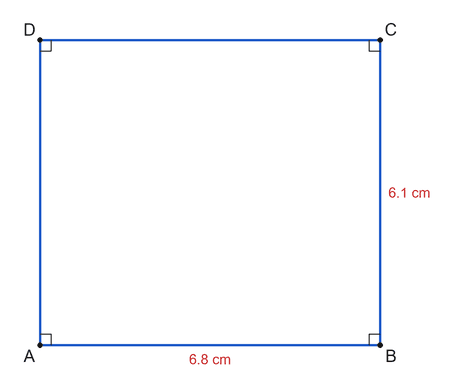
All four angles in the figure are right angles.
Watch out: The arc from A has the length of BC and the arc from C has the length of AB.
Therefore, ABCD is the required rectangle.
- 333 marks
Question 33
Construct a rectangle ABCD; if :
(iii) AB = 5.0 cm and diagonal AC = 6.7 cm.
Solve with AIWritten solution
Solution:
Concept: A rectangle is a parallelogram with every angle 90°; its diagonals are equal and bisect each other.
Given: AB = 5.0 cm and diagonal AC = 6.7 cm.
Step 1 — Plan.
∠B = 90°, so C lies on the perpendicular to AB at B, at 6.7 cm from A.
Step 2 — Draw AB.
Draw AB = 5.0 cm.
Step 3 — Construct 90° at B.
With B as centre draw an arc cutting BA; with the same radius step off the 60° point and the 120° point along the arc. With these two points as centres and any equal radius, draw arcs meeting at a point, and join it to B, producing it to X. This line bisects the angle between 60° and 120°, so the angle is 90°.
Step 4 — Locate C.
With A as centre and radius 6.7 cm, cut BX at C.
Step 5 — Locate D.
With A as centre and radius equal to BC, and C as centre and radius 5.0 cm, draw arcs meeting at D.
Step 6 — Complete.
Join AD and CD.
Step 7 — Look at the finished figure and check it.
The finished construction is shown below, with the given measurements marked on it.
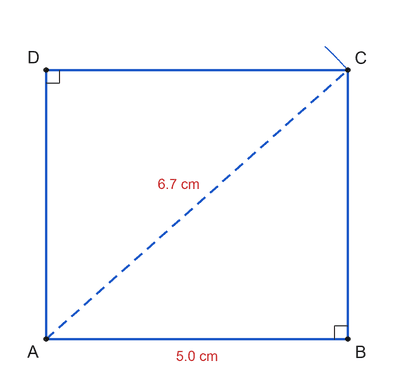
On measuring, BC ≈ 4.5 cm. Check with Pythagoras' theorem in the right triangle ABC:
Watch out: The 6.7 cm arc is drawn from A (the diagonal), not from B.
Therefore, ABCD is the required rectangle (BC ≈ 4.5 cm).
- 343 marks
Question 34
Construct a rectangle ABCD; if :
(iv) AD = 4.8 cm and diagonal AC = 6.4 cm.
Solve with AIWritten solution
Solution:
Concept: A rectangle is a parallelogram with every angle 90°; its diagonals are equal and bisect each other.
Given: AD = 4.8 cm and diagonal AC = 6.4 cm.
Step 1 — Plan.
∠D = 90°, so C lies on the perpendicular to AD at D, at 6.4 cm from A.
Step 2 — Draw AD.
Draw AD = 4.8 cm.
Step 3 — Construct 90° at D.
With D as centre draw an arc cutting DA; with the same radius step off the 60° point and the 120° point along the arc. With these two points as centres and any equal radius, draw arcs meeting at a point, and join it to D, producing it to X. This line bisects the angle between 60° and 120°, so the angle is 90°.
Step 4 — Locate C.
With A as centre and radius 6.4 cm, cut DX at C.
Step 5 — Locate B.
With A as centre and radius equal to DC, and C as centre and radius 4.8 cm, draw arcs meeting at B.
Step 6 — Complete.
Join AB and CB.
Step 7 — Look at the finished figure and check it.
The finished construction is shown below, with the given measurements marked on it.

On measuring, DC ≈ 4.2 cm. Check with Pythagoras' theorem in the right triangle ADC:
Watch out: The 6.4 cm arc is drawn from A (the diagonal), not from D.
Therefore, ABCD is the required rectangle (DC ≈ 4.2 cm).
- 353 marks
Question 35
Construct a rectangle ABCD; if :
(v) each diagonal is 6 cm and the angle between them is 45°.
Solve with AIWritten solution
Solution:
Concept: The diagonals of a rectangle are equal and bisect each other, so all four half-diagonals OA, OB, OC and OD are equal. Draw one diagonal, mark its mid-point O, draw a line through O at the given angle, and cut off the same half-length on each side of O.
Given: Each diagonal = 6 cm and the angle between them = 45°.
Step 1 — Draw AC and find its mid-point.
Draw AC = 6 cm and draw its perpendicular bisector, cutting AC at O. Then OA and OC are both 3 cm.
Step 2 — Draw a line through O at 45°.
At O, construct ∠COX = 45° by bisecting the right angle at O, and produce XO backwards through O.
Step 3 — Cut off half of BD on each side.
Half of BD is 3 cm. With O as centre and radius 3 cm, cut this line at D on one side of O and at B on the other.
Step 4 — Complete.
Join AB, BC, CD and DA.
Step 5 — Look at the finished figure and check it.
The finished construction is shown below, with the given measurements marked on it.

On measuring, AB ≈ 2.3 cm and BC ≈ 5.5 cm.
Watch out: Use HALF of each diagonal from O, not the whole diagonal.
Therefore, ABCD is the required rectangle.
- 363 marks
Question 36
Construct a rectangle ABCD; if :
(vi) each diagonal is 5.5 cm and the angle between them is 60°.
Solve with AIWritten solution
Solution:
Concept: The diagonals of a rectangle are equal and bisect each other, so all four half-diagonals OA, OB, OC and OD are equal. Draw one diagonal, mark its mid-point O, draw a line through O at the given angle, and cut off the same half-length on each side of O.
Given: Each diagonal = 5.5 cm and the angle between them = 60°.
Step 1 — Draw AC and find its mid-point.
Draw AC = 5.5 cm and draw its perpendicular bisector, cutting AC at O. Then OA and OC are both 2.75 cm.
Step 2 — Draw a line through O at 60°.
At O, construct ∠COX = 60° (arc about O, same radius stepped once), and produce XO backwards through O.
Step 3 — Cut off half of BD on each side.
Half of BD is 2.75 cm. With O as centre and radius 2.75 cm, cut this line at D on one side of O and at B on the other.
Step 4 — Complete.
Join AB, BC, CD and DA.
Step 5 — Look at the finished figure and check it.
The finished construction is shown below, with the given measurements marked on it.
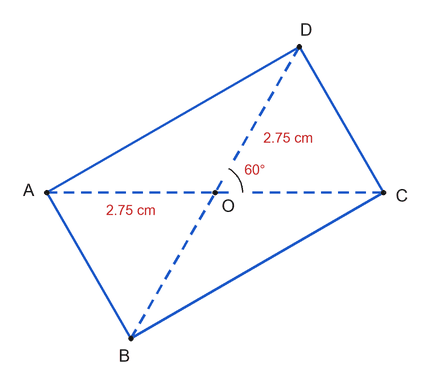
On measuring, AB ≈ 2.8 cm and BC ≈ 4.8 cm.
Notice that ∠AOB equals ∠COD (vertically opposite), so it is 60°, and OA and OB are both 2.75 cm, so triangle AOB is equilateral and AB is exactly 2.75 cm, which a ruler reads as about 2.8 cm.
Watch out: Use HALF of each diagonal from O, not the whole diagonal.
Therefore, ABCD is the required rectangle.
- 373 marks
Question 37
Construct a rhombus ABCD, if ;
(i) AB = 4 cm and ∠B = 120°.
Solve with AIWritten solution
Solution:
Concept: All four sides of a rhombus are equal, so one side and one angle fix it: two sides and the included angle fix triangle ABC.
Given: Side = 4 cm and ∠B = 120°.
Step 1 — Use the properties.
Every side of the rhombus is 4 cm.
Step 2 — Draw BC.
Draw BC = 4 cm.
Step 3 — Construct 120° at B.
With B as centre and any convenient radius, draw an arc cutting BC. Keeping the same radius, step off two equal arcs along it from that point; each step turns through 60°. Join B to the second point and produce it to X. The angle is 60° + 60° = 120°.
Step 4 — Locate A.
With B as centre and radius 4 cm, cut BX at A.
Step 5 — Locate D.
With A and C as centres and radius 4 cm, draw arcs meeting at D.
Step 6 — Complete.
Join AD and CD.
Step 7 — Look at the finished figure and check it.
The finished construction is shown below, with the given measurements marked on it.

All four sides in the figure are equal.
Watch out: D is found with arcs of the SIDE length from A and C, not of a diagonal length.
Therefore, ABCD is the required rhombus.
- 383 marks
Question 38
Construct a rhombus ABCD, if ;
(ii) BC = 4.7 cm and ∠B = 75°.
Solve with AIWritten solution
Solution:
Concept: All four sides of a rhombus are equal, so one side and one angle fix it: two sides and the included angle fix triangle ABC.
Given: Side = 4.7 cm and ∠B = 75°.
Step 1 — Use the properties.
Every side of the rhombus is 4.7 cm.
Step 2 — Draw BC.
Draw BC = 4.7 cm.
Step 3 — Construct 75° at B.
At B, construct a 60° line and a 90° line from BC (as above). Bisect the angle between them and produce the bisector to X. It lies half-way between 60° and 90°, so it makes 75° with BC.
Step 4 — Locate A.
With B as centre and radius 4.7 cm, cut BX at A.
Step 5 — Locate D.
With A and C as centres and radius 4.7 cm, draw arcs meeting at D.
Step 6 — Complete.
Join AD and CD.
Step 7 — Look at the finished figure and check it.
The finished construction is shown below, with the given measurements marked on it.
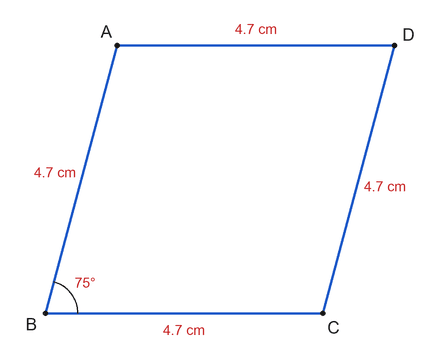
All four sides in the figure are equal.
Watch out: D is found with arcs of the SIDE length from A and C, not of a diagonal length.
Therefore, ABCD is the required rhombus.
- 393 marks
Question 39
Construct a rhombus ABCD, if ;
(iii) CD = 5 cm and diagonal BD = 8.5 cm.
Solve with AIWritten solution
Solution:
Concept: All four sides of a rhombus are equal, and its diagonals bisect each other at right angles.
Given: CD = 5 cm (so every side is 5 cm) and diagonal BD = 8.5 cm.
Step 1 — Plan.
A and C are each 5 cm from both B and D, on opposite sides of BD.
Step 2 — Draw BD.
Draw BD = 8.5 cm.
Step 3 — Locate C and A.
With B and D as centres and radius 5 cm, draw arcs meeting at C above BD and at A below BD.
Step 4 — Complete.
Join AB, BC, CD and DA.
Step 5 — Look at the finished figure and check it.
The finished construction is shown below, with the given measurements marked on it.
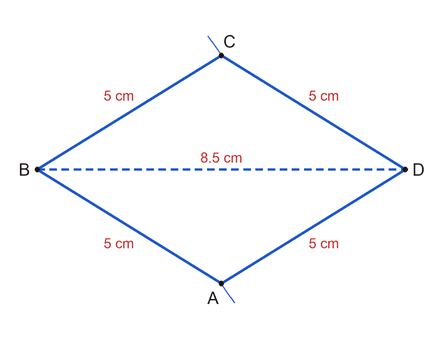
On measuring, AC ≈ 5.3 cm. Check: the diagonals bisect each other at right angles, so with O the mid-point, OD = 4.25 cm and triangle COD is right-angled at O:
Watch out: A and C must be on OPPOSITE sides of BD.
Therefore, ABCD is the required rhombus (AC ≈ 5.3 cm).
- 403 marks
Question 40
Construct a rhombus ABCD, if ;
(iv) BC = 4.8 cm, and diagonal AC = 7 cm.
Solve with AIWritten solution
Solution:
Concept: All four sides of a rhombus are equal, and its diagonals bisect each other at right angles.
Given: BC = 4.8 cm (so every side is 4.8 cm) and diagonal AC = 7 cm.
Step 1 — Plan.
B and D are each 4.8 cm from both A and C, on opposite sides of AC.
Step 2 — Draw AC.
Draw AC = 7 cm.
Step 3 — Locate B and D.
With A and C as centres and radius 4.8 cm, draw arcs meeting at B below AC and at D above AC.
Step 4 — Complete.
Join AB, BC, CD and DA.
Step 5 — Look at the finished figure and check it.
The finished construction is shown below, with the given measurements marked on it.
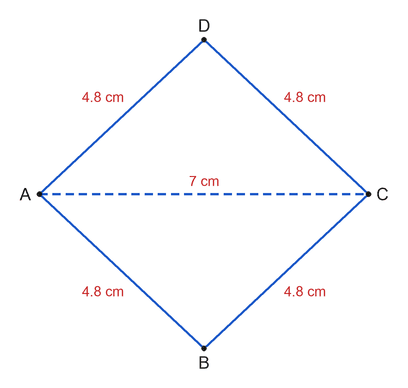
On measuring, BD ≈ 6.6 cm. Check: with O the mid-point, OA = 3.5 cm and triangle AOB is right-angled at O:
Watch out: B and D must be on OPPOSITE sides of AC.
Therefore, ABCD is the required rhombus (BD ≈ 6.6 cm).
- 413 marks
Question 41
Construct a rhombus ABCD, if ;
(v) diagonal AC = 6 cm and diagonal BD = 5.8 cm.
Solve with AIWritten solution
Solution:
Concept: The diagonals of a rhombus bisect each other at right angles, so the second diagonal lies along the perpendicular bisector of the first, with half of it on each side.
Given: Diagonal AC = 6 cm and diagonal BD = 5.8 cm.
Step 1 — Draw AC.
Draw AC = 6 cm.
Step 2 — Draw its perpendicular bisector.
With A and C as centres and equal radii (more than half of AC), draw arcs on both sides of AC; join their meeting points. This line cuts AC at its mid-point O, at right angles.
Step 3 — Cut off half of BD on each side.
With O as centre and radius 2.9 cm (half of 5.8 cm), cut the perpendicular bisector at B and D on either side of O.
Step 4 — Complete.
Join AB, BC, CD and DA.
Step 5 — Look at the finished figure and check it.
The finished construction is shown below, with the given measurements marked on it.
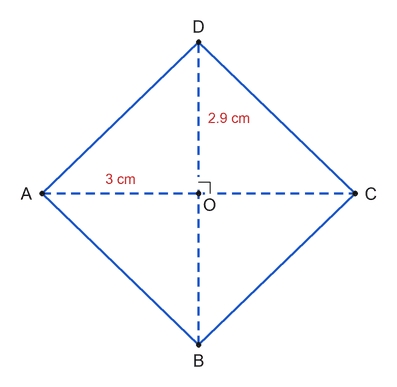
On measuring, each side ≈ 4.2 cm. Check with Pythagoras' theorem in the right triangle AOB (OA = 3 cm, OB = 2.9 cm):
Watch out: Cut off HALF of BD on each side of O, not the whole of BD.
Therefore, ABCD is the required rhombus (each side ≈ 4.2 cm).
- 423 marks
Question 42
Construct a rhombus ABCD, if ;
(vi) diagonal AC = 4.9 cm and diagonal BD = 6 cm.
Solve with AIWritten solution
Solution:
Concept: The diagonals of a rhombus bisect each other at right angles, so the second diagonal lies along the perpendicular bisector of the first, with half of it on each side.
Given: Diagonal AC = 4.9 cm and diagonal BD = 6 cm.
Step 1 — Draw AC.
Draw AC = 4.9 cm.
Step 2 — Draw its perpendicular bisector.
With A and C as centres and equal radii (more than half of AC), draw arcs on both sides of AC; join their meeting points. This line cuts AC at its mid-point O, at right angles.
Step 3 — Cut off half of BD on each side.
With O as centre and radius 3 cm (half of 6 cm), cut the perpendicular bisector at B and D on either side of O.
Step 4 — Complete.
Join AB, BC, CD and DA.
Step 5 — Look at the finished figure and check it.
The finished construction is shown below, with the given measurements marked on it.
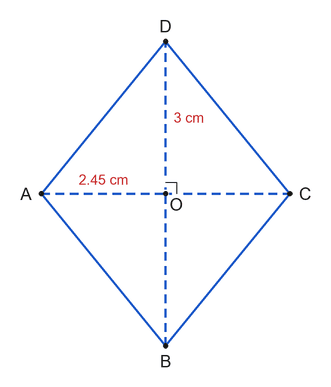
On measuring, each side ≈ 3.9 cm. Check with Pythagoras' theorem in the right triangle AOB (OA = 2.45 cm, OB = 3 cm):
Watch out: Cut off HALF of BD on each side of O, not the whole of BD.
Therefore, ABCD is the required rhombus (each side ≈ 3.9 cm).
- 433 marks
Question 43
Construct a rhombus ABCD, if ;
(vii) diagonal AC = 6.6 cm and diagonal BD = 5.3 cm.
Solve with AIWritten solution
Solution:
Concept: The diagonals of a rhombus bisect each other at right angles, so the second diagonal lies along the perpendicular bisector of the first, with half of it on each side.
Given: Diagonal AC = 6.6 cm and diagonal BD = 5.3 cm.
Step 1 — Draw AC.
Draw AC = 6.6 cm.
Step 2 — Draw its perpendicular bisector.
With A and C as centres and equal radii (more than half of AC), draw arcs on both sides of AC; join their meeting points. This line cuts AC at its mid-point O, at right angles.
Step 3 — Cut off half of BD on each side.
With O as centre and radius 2.65 cm (half of 5.3 cm), cut the perpendicular bisector at B and D on either side of O.
Step 4 — Complete.
Join AB, BC, CD and DA.
Step 5 — Look at the finished figure and check it.
The finished construction is shown below, with the given measurements marked on it.
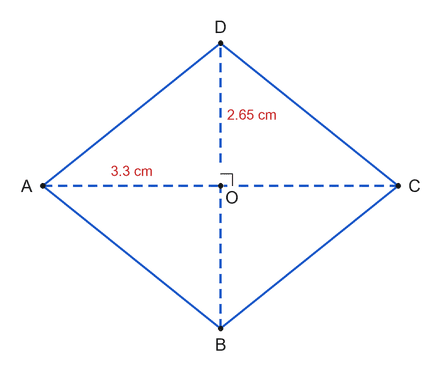
On measuring, each side ≈ 4.2 cm. Check with Pythagoras' theorem in the right triangle AOB (OA = 3.3 cm, OB = 2.65 cm):
Watch out: Cut off HALF of BD on each side of O, not the whole of BD.
Therefore, ABCD is the required rhombus (each side ≈ 4.2 cm).
- 443 marks
Question 44
Construct a square, if :
(i) it's one side is 3.8 cm.
Solve with AIWritten solution
Solution:
Concept: All four sides of a square are equal, every angle is 90°, and its diagonals are equal and bisect each other at right angles.
Given: Side = 3.8 cm.
Step 1 — Draw AB.
Draw AB = 3.8 cm.
Step 2 — Construct 90° at B.
With B as centre draw an arc cutting BA; with the same radius step off the 60° point and the 120° point along the arc. With these two points as centres and any equal radius, draw arcs meeting at a point, and join it to B, producing it to X. This line bisects the angle between 60° and 120°, so the angle is 90°.
Step 3 — Locate C.
With B as centre and radius 3.8 cm, cut BX at C.
Step 4 — Locate D.
With A and C as centres and radius 3.8 cm, draw arcs meeting at D.
Step 5 — Complete.
Join AD and CD.
Step 6 — Look at the finished figure and check it.
The finished construction is shown below, with the given measurements marked on it.
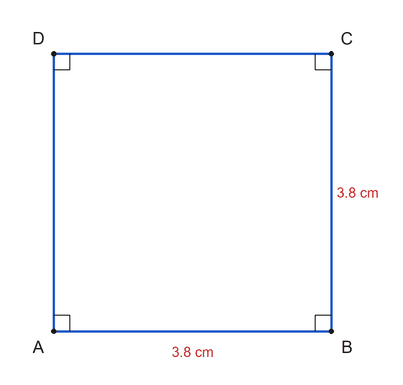
All four sides are equal and all four angles are right angles.
Watch out: A right angle at B is essential; four equal sides alone could give a rhombus.
Therefore, ABCD is the required square.
- 453 marks
Question 45
Construct a square, if :
(ii) its each side is 4.3 cm.
Solve with AIWritten solution
Solution:
Concept: All four sides of a square are equal, every angle is 90°, and its diagonals are equal and bisect each other at right angles.
Given: Side = 4.3 cm.
Step 1 — Draw AB.
Draw AB = 4.3 cm.
Step 2 — Construct 90° at B.
With B as centre draw an arc cutting BA; with the same radius step off the 60° point and the 120° point along the arc. With these two points as centres and any equal radius, draw arcs meeting at a point, and join it to B, producing it to X. This line bisects the angle between 60° and 120°, so the angle is 90°.
Step 3 — Locate C.
With B as centre and radius 4.3 cm, cut BX at C.
Step 4 — Locate D.
With A and C as centres and radius 4.3 cm, draw arcs meeting at D.
Step 5 — Complete.
Join AD and CD.
Step 6 — Look at the finished figure and check it.
The finished construction is shown below, with the given measurements marked on it.
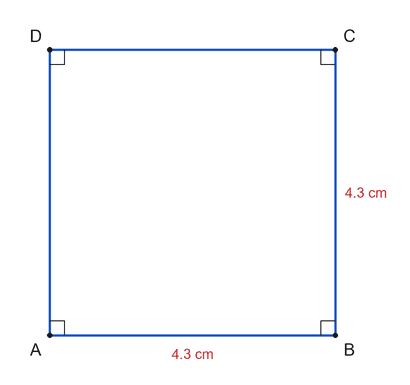
All four sides are equal and all four angles are right angles.
Watch out: A right angle at B is essential; four equal sides alone could give a rhombus.
Therefore, ABCD is the required square.
- 463 marks
Question 46
Construct a square, if :
(iii) one diagonal is 6.2 cm.
Solve with AIWritten solution
Solution:
Concept: All four sides of a square are equal, every angle is 90°, and its diagonals are equal and bisect each other at right angles.
Given: One diagonal = 6.2 cm (the other is equal to it).
Step 1 — Plan.
The diagonals are equal and bisect each other at right angles, so OA, OB, OC and OD are all 3.1 cm.
Step 2 — Draw AC.
Draw AC = 6.2 cm.
Step 3 — Draw its perpendicular bisector.
With A and C as centres and equal radii (more than half of AC), draw arcs on both sides of AC; join their meeting points, cutting AC at its mid-point O.
Step 4 — Locate B and D.
With O as centre and radius 3.1 cm, cut the perpendicular bisector at B and D.
Step 5 — Complete.
Join AB, BC, CD and DA.
Step 6 — Look at the finished figure and check it.
The finished construction is shown below, with the given measurements marked on it.
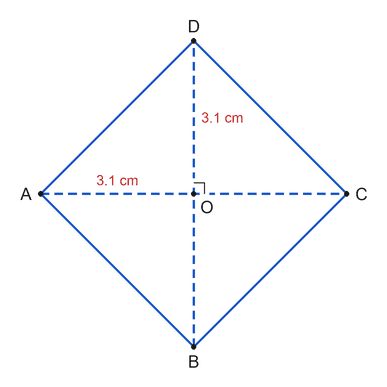
On measuring, each side ≈ 4.4 cm. Check with Pythagoras' theorem in the right triangle AOB:
Watch out: The second diagonal is as LONG as the first in a square; cut off half of it on each side of O.
Therefore, ABCD is the required square (each side ≈ 4.4 cm).
- 473 marks
Question 47
Construct a square, if :
(iv) each diagonal is 5.7 cm.
Solve with AIWritten solution
Solution:
Concept: All four sides of a square are equal, every angle is 90°, and its diagonals are equal and bisect each other at right angles.
Given: Each diagonal = 5.7 cm.
Step 1 — Plan.
The diagonals are equal and bisect each other at right angles, so OA, OB, OC and OD are all 2.85 cm.
Step 2 — Draw AC.
Draw AC = 5.7 cm.
Step 3 — Draw its perpendicular bisector.
With A and C as centres and equal radii (more than half of AC), draw arcs on both sides of AC; join their meeting points, cutting AC at its mid-point O.
Step 4 — Locate B and D.
With O as centre and radius 2.85 cm, cut the perpendicular bisector at B and D.
Step 5 — Complete.
Join AB, BC, CD and DA.
Step 6 — Look at the finished figure and check it.
The finished construction is shown below, with the given measurements marked on it.
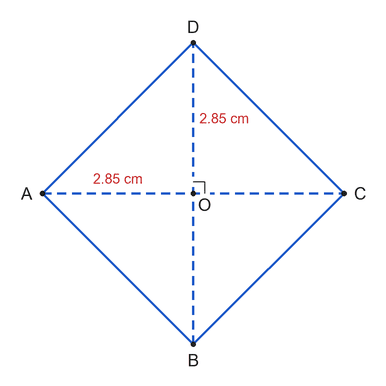
On measuring, each side ≈ 4.0 cm. Check with Pythagoras' theorem in the right triangle AOB:
Watch out: The second diagonal is as LONG as the first in a square; cut off half of it on each side of O.
Therefore, ABCD is the required square (each side ≈ 4.0 cm).
- 483 marks
Question 48
Construct a quadrilateral ABCD in which ; ∠A = 120°, ∠B = 60°, AB = 4 cm, BC = 4.5 cm and CD = 5 cm.
Solve with AIWritten solution
Solution:
Concept: A quadrilateral is constructed by splitting it into triangles: each triangle is fixed by three suitable measurements (three sides, two sides and the included angle, or two angles and a side), and the fourth vertex is then cut off by arcs or along a known direction.
Given: ∠A = 120°, ∠B = 60°, AB = 4 cm, BC = 4.5 cm and CD = 5 cm.
Step 1 — Plan.
AB with the angles at A and B gives the directions of AD and BC. BC = 4.5 cm fixes C, and an arc of radius 5 cm from C fixes D on the arm from A.
Step 2 — Draw AB.
Draw AB = 4 cm.
Step 3 — Construct 120° at A.
With A as centre and any convenient radius, draw an arc cutting AB. Keeping the same radius, step off two equal arcs along it from that point; each step turns through 60°. Join A to the second point and produce it to X. The angle is 60° + 60° = 120°.
Step 4 — Locate C.
Work on the same side of AB as the arm AX. With B as centre and any convenient radius, draw an arc cutting BA at L. With L as centre and the same radius, cut this arc at N. Join BN and produce it to Y. Then BL, BN and LN are all equal to the radius, so triangle BLN is equilateral and the angle at B is 60°. With B as centre and radius 4.5 cm, cut BY at C.
Step 5 — Locate D.
With C as centre and radius 5 cm, cut AX at D.
Step 6 — Complete.
Join CD.
Step 7 — Look at the finished figure and check it.
The finished construction is shown below, with the given measurements marked on it.
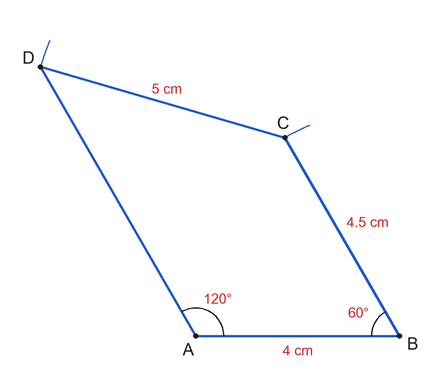
On measuring, AD ≈ 6.1 cm.
Watch out: The arc of radius 5 cm from C also meets the line XA produced BEHIND A; that point is not on the arm AX, so it is not D.
Note: ∠A and ∠B add up to 180° (120° and 60°). So AD ∥ BC and ABCD is a trapezium.
Therefore, ABCD is the required quadrilateral.
- 493 marks
Question 49
Construct a quadrilateral ABCD, such that AB = BC = CD = 4.4 cm, ∠B = 90° and ∠C = 120°.
Solve with AIWritten solution
Solution:
Concept: A quadrilateral is constructed by splitting it into triangles: each triangle is fixed by three suitable measurements (three sides, two sides and the included angle, or two angles and a side), and the fourth vertex is then cut off by arcs or along a known direction.
Given: AB = 4.4 cm, BC = 4.4 cm, CD = 4.4 cm, ∠B = 90° and ∠C = 120°.
Step 1 — Plan.
With BC as base, the right angle at B and the 120° angle at C give the directions of BA and CD; each is 4.4 cm long.
Step 2 — Draw BC.
Draw BC = 4.4 cm.
Step 3 — Locate A.
With B as centre draw an arc cutting BC; with the same radius step off the 60° point and the 120° point along the arc. With these two points as centres and any equal radius, draw arcs meeting at a point, and join it to B, producing it to X. This line bisects the angle between 60° and 120°, so the angle is 90°. With B as centre and radius 4.4 cm, cut BX at A.
Step 4 — Locate D.
Work on the same side of BC as A. With C as centre and any convenient radius, draw an arc cutting CB. Keeping the same radius, step off two equal arcs along it from that point; each step turns through 60°. Join C to the second point and produce it to Y. The angle is 60° + 60° = 120°. With C as centre and radius 4.4 cm, cut CY at D.
Step 5 — Complete.
Join AD.
Step 6 — Look at the finished figure and check it.
The finished construction is shown below, with the given measurements marked on it.

On measuring, AD ≈ 6.6 cm.
Watch out: Draw both angles on the SAME side of BC.
Therefore, ABCD is the required quadrilateral.
- 503 marks
Question 50
Using ruler and compasses only, construct a parallelogram ABCD, in which : AB = 6 cm, AD = 3 cm and ∠DAB = 60°. In the same figure draw the bisector of angle DAB and let it meet DC at point P. Measure angle APB.
Solve with AIWritten solution
Solution:
Concept: A parallelogram is fixed by two adjacent sides and the angle between them. The bisector of 60° makes two angles of 30°, and a line cutting two parallel lines makes equal alternate angles.
Given: Parallelogram ABCD with AB = 6 cm, AD = 3 cm and ∠DAB = 60°; AP bisects ∠DAB and meets DC at P.
Step 1 — Draw AB.
Draw AB = 6 cm.
Step 2 — Locate D.
With A as centre and any convenient radius, draw an arc cutting AB at L. With L as centre and the same radius, cut this arc at N. Join AN and produce it to X. Then AL, AN and LN are all equal to the radius, so triangle ALN is equilateral and the angle at A is 60°. With A as centre and radius 3 cm, cut AX at D.
Step 3 — Locate C.
With D as centre and radius 6 cm, and B as centre and radius 3 cm, draw arcs meeting at C. Join DC and BC.
Step 4 — Bisect ∠DAB.
With A as centre draw an arc cutting AD and AB. With the two cut points as centres and any equal radius (more than half the distance between them), draw arcs meeting at a point inside the angle. Join A to this point and produce it to meet DC at P. Every point of this line is equally far from both arms, so it bisects ∠DAB.
Step 5 — Measure ∠APB.
Join PB. On measuring, ∠APB = 90°.
Step 6 — See why ∠APB = 90°.
DC ∥ AB, so the alternate angles ∠DPA and ∠PAB are equal, and each is 30°. Also ∠DAP = 30°, so triangle ADP has two equal angles, and DP equals DA (3 cm). DC is 6 cm long, so PC is the remaining 3 cm, the same as CB. Opposite angles are equal, so ∠C is 60°, like ∠A. So triangle PCB is equilateral and ∠CPB = 60°. The angles at P on the straight line DC add up to 180°:
Step 7 — Look at the finished figure and check it.
The finished construction is shown below, with the given measurements marked on it.
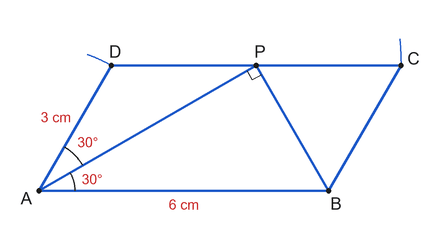
The figure marks the two 30° angles at A and the right angle at P.
Watch out: P is on DC (the side opposite AB), so the alternate angles are ∠DPA and ∠PAB.
Therefore, ∠APB = 90°.
- 513 marks
Question 51
Draw a parallelogram ABCD, with AB = 6 cm, AD = 4.8 cm and ∠DAB = 45°. Draw the perpendicular bisector of side AD and let it meet AD at point P. Also, draw the diagonals AC and BD; and let them intersect at point O. Join O and P. Measure OP.
Solve with AIWritten solution
Solution:
Concept: A parallelogram is fixed by two adjacent sides and the included angle. The perpendicular bisector of AD meets it at its mid-point P, and the diagonals of a parallelogram bisect each other, so O is the mid-point of BD.
Given: Parallelogram ABCD with AB = 6 cm, AD = 4.8 cm and ∠DAB = 45°.
Step 1 — Draw AB.
Draw AB = 6 cm.
Step 2 — Locate D.
At A, construct a 90° line from AB and bisect the right angle: with A as centre draw an arc cutting both arms, and with the two cut points as centres draw equal arcs meeting inside the angle. Join A to this point and produce it to X. It makes 90° ÷ 2 = 45° with AB. With A as centre and radius 4.8 cm, cut AX at D.
Step 3 — Locate C.
With D as centre and radius 6 cm, and B as centre and radius 4.8 cm, draw arcs meeting at C. Join DC and BC.
Step 4 — Draw the perpendicular bisector of AD.
With A and D as centres and equal radii (more than 2.4 cm), draw arcs on both sides of AD meeting at X and Y. Join XY, cutting AD at P.
Step 5 — Draw the diagonals.
Draw AC and BD, meeting at O. Join OP.
Step 6 — Measure OP.
On measuring, OP = 3.0 cm.
Step 7 — Look at the finished figure and check it.
The finished construction is shown below, with the given measurements marked on it.
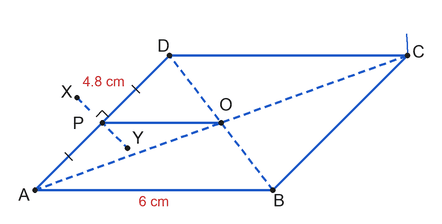
Check: in triangle ABD, P is the mid-point of AD and O is the mid-point of BD. The line joining the mid-points of two sides of a triangle is half the third side, so:
Watch out: The X and Y used here are the arc points of the perpendicular bisector, not the 45° arm.
Therefore, OP = 3.0 cm.
- 523 marks
Question 52
Using a ruler and compasses only, construct a rhombus whose diagonals are 8 cm and 6 cm. Measure the length of its one side.
Solve with AIWritten solution
Solution:
Concept: The diagonals of a rhombus bisect each other at right angles, so the second diagonal lies along the perpendicular bisector of the first, with half of it on each side.
Given: Diagonals AC = 8 cm and BD = 6 cm.
Step 1 — Draw AC.
Draw AC = 8 cm.
Step 2 — Draw its perpendicular bisector.
With A and C as centres and equal radii (more than 4 cm), draw arcs on both sides of AC; join their meeting points, cutting AC at O. Then OA and OC are both 4 cm.
Step 3 — Cut off half of BD on each side.
With O as centre and radius 3 cm, cut the perpendicular bisector at B and D.
Step 4 — Complete.
Join AB, BC, CD and DA.
Step 5 — Measure a side.
On measuring, each side = 5.0 cm.
Step 6 — Look at the finished figure and check it.
The finished construction is shown below, with the given measurements marked on it.
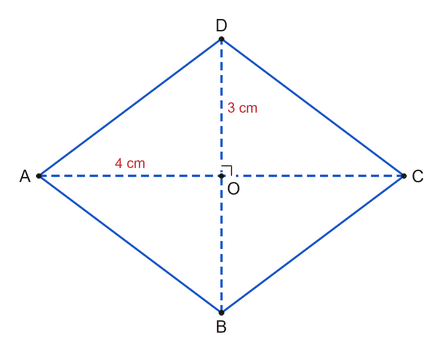
Check: triangle AOB is right-angled at O, with OA = 4 cm and OB = 3 cm:
Watch out: The right angle at O comes from the perpendicular bisector; do not draw BD at a guessed angle.
Therefore, ABCD is the required rhombus, and each side is 5.0 cm.
What Class 8 Maths Ch 18 covers
The sections of the chapter, in the order the book takes them. Every question above comes from one of these.
- 01Construction of Angles
- 02Bisecting a Line Segment and Drawing Perpendiculars
- 03Construction of Parallel Lines
- 04Construction of Quadrilaterals
More ways to study this chapter
The same chapter asked three other ways. Practise it, revise it, and see what the board has set on Ch 18 before.
Class 8 Maths Ch 18 questions students ask
How many questions are there in Class 8 Maths Ch 18?
52 questions. Every one is solved step by step on this page.
Are these Class 8 Maths solutions free?
Yes. Every question and its full working is free to read, with no account needed.
Can I download the Class 8 Maths Ch 18 solutions as a PDF?
There is no PDF to download. Every solution is on this page instead, which means it is searchable, always the current syllabus, and readable on a phone. Use your browser's print option if you want it on paper.