
Question 103 marksMedium
Draw a line segment AB = 5.5 cm. Mark a point P, such that PA = 6 cm and PB = 4.8 cm. From point P, draw a perpendicular to AB.
Confirming your payment
Sign up now and get 250 free tokens.
Constructions · Question 10 of 52
Draw a line segment AB = 5.5 cm. Mark a point P, such that PA = 6 cm and PB = 4.8 cm. From point P, draw a perpendicular to AB.
Solution:
Concept: A point is fixed by its distances from two known points (two arcs). The perpendicular from an outside point is then drawn with equal arcs, as the perpendicular bisector of a chord of the arc about P.
Given: AB = 5.5 cm, PA = 6 cm and PB = 4.8 cm.
Step 1 — Draw the base.
Draw AB = 5.5 cm.
Step 2 — Locate P.
With A as centre and radius 6 cm, and B as centre and radius 4.8 cm, draw two arcs meeting at P above AB.
Step 3 — Mark two points on AB equally far from P.
With P as centre and radius 4.6 cm, draw an arc cutting AB at X and Y.
Step 4 — Find a second point of the perpendicular.
With X and Y as centres and radius 3 cm, draw arcs meeting at Q below AB.
Step 5 — Draw the perpendicular.
Join PQ, cutting AB at M. PM is perpendicular to AB.
Step 6 — Look at the finished figure and check it.
The finished construction is shown below, with the given measurements marked on it.
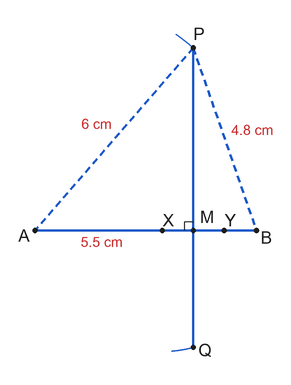
On measuring, PM ≈ 4.5 cm, and M is about 3.9 cm from A.
Watch out: P is about 4.5 cm from AB, so the arc from P needs a radius a little MORE than that (we used 4.6 cm) to cut AB twice between A and B; a much larger radius cuts the line beyond B.
Note: The radii 4.6 cm and 3 cm are our choice; any radius that cuts AB twice, and any equal radii from X and Y that meet, give the same line.
Therefore, PM is the required perpendicular from P to AB (PM ≈ 4.5 cm).