
Question 93 marksEasy
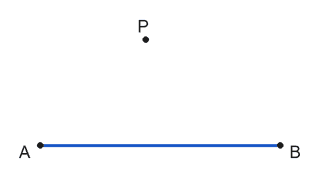
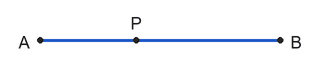
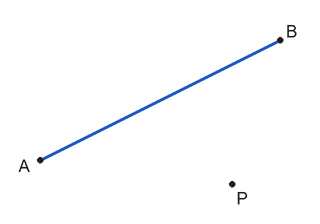
In each of the following, draw perpendicular through point P to the line segment AB :
(i)
(ii)
(iii)
Confirming your payment
Sign up now and get 250 free tokens.
Constructions · Question 9 of 52
In each of the following, draw perpendicular through point P to the line segment AB :
(i)
(ii)
(iii)
Solution:
Concept: A perpendicular to a line through a point P is the perpendicular bisector of a segment XY of the line whose ends are equally far from P.
Given: The line segment AB and the point P in each figure; a ruler and a pair of compasses (a protractor only where the step says so).
Step 1 — Know the idea used in every part.
Draw an arc about P to get two points X and Y on AB that are equally far from P. Any point equally far from X and Y lies on the perpendicular bisector of XY, and P is one such point. So the perpendicular bisector of XY passes through P and is perpendicular to AB.
Step 2 — Part (i): P outside AB.
With P as centre and a radius large enough, draw an arc cutting AB at X and Y. With X and Y as centres and the same radius, draw arcs meeting at Q on the other side of AB. Join PQ, meeting AB at M. Then PQ is perpendicular to AB.

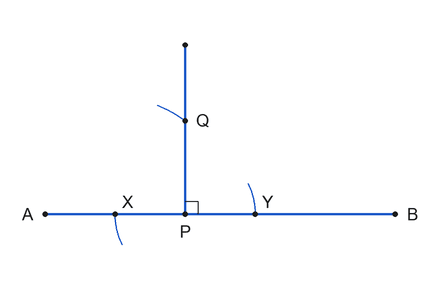
Step 3 — Part (ii): P on AB.
With P as centre and a small radius, draw arcs cutting AB at X and Y, one on each side of P. With X and Y as centres and a radius greater than PX, draw arcs meeting at Q. Join PQ; it is perpendicular to AB at P.
Step 4 — Part (iii): P outside a slanting AB.
Do exactly as in part (i): an arc about P cuts AB at X and Y, equal arcs from X and Y meet at Q on the other side of AB, and PQ meets AB at M. The method does not depend on how AB is tilted.
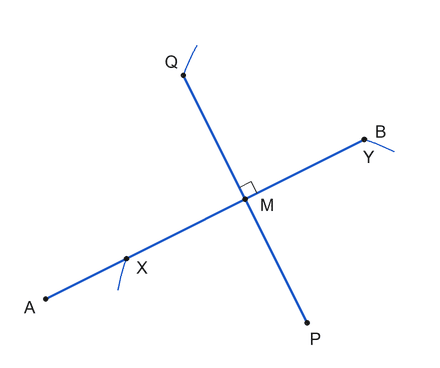
Watch out: In parts (i) and (iii) the arc about P must cut AB at TWO points; if it only touches AB, increase the radius.
Therefore, PQ is the required perpendicular through P to AB in each part (marked with a right angle).