Solution:
Concept: Bisecting an angle splits it into two equal halves; bisecting each half again splits the whole angle into four equal parts.
Given: ∠ABC of any suitable measure; BP bisects ∠ABC, BR bisects ∠PBC and BQ bisects ∠ABP.
Step 1 — Draw the angle.
Draw ∠ABC of any measure. We take ∠ABC = 120°, made with compasses. With B as centre and any convenient radius, draw an arc cutting BC. Keeping the same radius, step off two equal arcs along it from that point; each step turns through 60°. Join B to the second point and produce it to A. The angle is 60° + 60° = 120°.
Step 2 — Part (i): draw BP.
With B as centre draw an arc cutting BA and BC. With the two cut points as centres and any equal radius (more than half the distance between them), draw arcs meeting at a point inside the angle. Join B to this point and produce it to P. Every point of this line is equally far from both arms, so it bisects ∠ABC.
Step 3 — Part (ii): draw BR and BQ.
Bisect ∠PBC in the same way (arcs from the points where an arc about B cuts BP and BC) to get BR. Then bisect ∠ABP to get BQ.
Step 4 — Part (iii): compare the four angles.
BP makes the two halves equal: ∠ABP = ∠PBC. BQ halves ∠ABP and BR halves ∠PBC, and halves of equal angles are equal. So ∠ABQ, ∠QBP, ∠PBR and ∠RBC are all equal, each one quarter of ∠ABC. In our figure each is 120° ÷ 4 = 30°.
Step 5 — Part (iv): compare ∠ABR and ∠QBC.
∠ABR is made of ∠ABQ, ∠QBP and ∠PBR, three of the four equal parts. ∠QBC is made of ∠QBP, ∠PBR and ∠RBC, also three of the four equal parts. So ∠ABR = ∠QBC; in our figure each is 3 × 30° = 90°.
Step 6 — Look at the finished figure and check it.
The finished construction is shown below, with the given measurements marked on it.
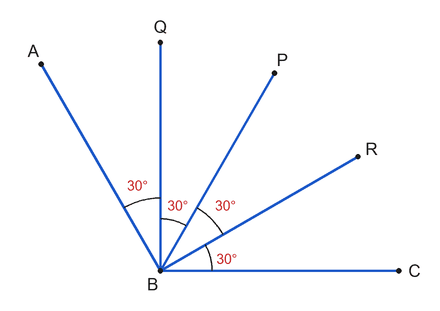
Each of the four marked angles in the figure is 30°.
Watch out: This holds for ANY starting angle, not only 120°: the four parts are always equal quarters.
Therefore, (iii) yes, ∠ABQ, ∠QBP, ∠PBR and ∠RBC are equal; (iv) yes, ∠ABR = ∠QBC.
