
Question 73 marksMedium
Draw a line segment AB of length 5.3 cm. Using two different methods bisect AB.
Confirming your payment
Sign up now and get 250 free tokens.
Constructions · Question 7 of 52
Draw a line segment AB of length 5.3 cm. Using two different methods bisect AB.
Solution:
Concept: Bisecting a line segment means dividing it into two equal parts at its mid-point. Every point that is equally far from A and B lies on the perpendicular bisector of AB.
Given: AB = 5.3 cm; a ruler and a pair of compasses (a protractor only where the step says so).
Step 1 — Understand the task.
To bisect AB means to find its mid-point M, so that AM and MB are both half of 5.3 cm.
Step 2 — Method 1: draw AB.
Draw AB = 5.3 cm.
Step 3 — Method 1: draw the perpendicular bisector.
With A as centre and radius 3.6 cm (more than half of AB), draw arcs above and below AB. With B as centre and the same radius, cut these arcs at P and Q. Join PQ, cutting AB at M.
P and Q are each the same distance from A as from B, so both lie on the perpendicular bisector of AB, and M is the mid-point of AB.

Step 4 — Method 2: draw AB and two equal angles.
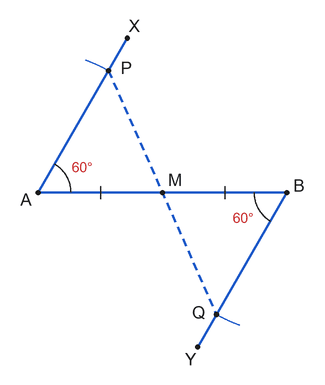
Draw AB = 5.3 cm again; then, at A, construct ∠BAX = 60° above AB, and at B construct ∠ABY = 60° below AB (each by the equilateral-triangle method with compasses).
Step 5 — Method 2: cut off equal lengths and join.
With the same compass opening (say 3 cm), cut off AP on AX and BQ on BY. Join PQ, cutting AB at M.
Step 6 — Method 2: why M is the mid-point.
∠PAB and ∠QBA are equal alternate angles, so AX is parallel to BY. In triangles AMP and BMQ: AP = BQ (same opening), ∠PAM = ∠QBM (both 60°) and ∠AMP = ∠BMQ (vertically opposite). So the triangles are congruent (AAS) and AM = MB.
Step 7 — Check by measuring.
In both figures a ruler reads AM ≈ 2.65 cm and MB ≈ 2.65 cm; the equal parts are marked with ticks.
Watch out: In Method 1 the radius must be MORE than half of AB (more than 2.65 cm), or the arcs from A and B do not meet.
Therefore, M is the mid-point of AB by both methods, with AM and MB both 2.65 cm.