Solution:
Concept: Bisecting 60° gives two angles of 30°. A line parallel to BC makes equal alternate angles with any transversal, and in a triangle the sides opposite equal angles are equal.
Given: ∠ABC = 60°, BD bisects it, and the line through P and Q is parallel to BC at a distance of 2.5 cm.
Step 1 — Construct 60° at B.
With B as centre and any convenient radius, draw an arc cutting BC at L. With L as centre and the same radius, cut this arc at N. Join BN and produce it to A. Then BL, BN and LN are all equal to the radius, so triangle BLN is equilateral and the angle at B is 60°.
Step 2 — Bisect the angle.
With B as centre draw an arc cutting BA and BC. With the two cut points as centres and any equal radius (more than half the distance between them), draw arcs meeting at a point inside the angle. Join B to this point and produce it to D. Every point of this line is equally far from both arms, so it bisects ∠ABC. Each half is 30°.
Step 3 — Draw the parallel line.
At two points of BC construct perpendiculars and cut off 2.5 cm on each, on the same side as A. Join these points and produce the line.
Step 4 — Mark P and Q.
Mark P where this line meets BA and Q where it meets the bisector BD.
Step 5 — Measure and compare.
On measuring, BP ≈ 2.9 cm and PQ ≈ 2.9 cm, so BP = PQ.
Step 6 — See why BP = PQ.
PQ ∥ BC and BQ is a transversal, so the alternate angles ∠PQB and ∠QBC are equal, and each is 30°. Also ∠PBQ = 30°. In triangle PBQ the angles at B and Q are equal, so the sides opposite them are equal: BP = PQ.
Step 7 — Look at the finished figure and check it.
The finished construction is shown below, with the given measurements marked on it.
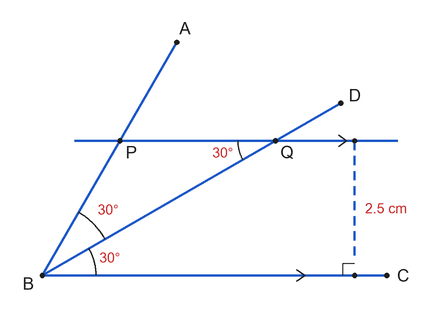
The figure marks the 30° angles at B and at Q, and the 2.5 cm gap.
Watch out: Measure the 2.5 cm along a PERPENDICULAR to BC, not along BA.
Therefore, BP ≈ 2.9 cm and PQ ≈ 2.9 cm, so yes, BP = PQ.
