
Question 23 marksMedium
Given below are the angles x, y, and z.

Without measuring these angles construct :
(i) ∠ABC = x + y + z
(ii) ∠ABC = 2x + y + z
(iii) ∠ABC = x + 2y + z
Confirming your payment
Sign up now and get 250 free tokens.
Constructions · Question 2 of 52
Given below are the angles x, y, and z.
Without measuring these angles construct :
(i) ∠ABC = x + y + z
(ii) ∠ABC = 2x + y + z
(iii) ∠ABC = x + 2y + z
Solution:
Concept: Angles can be added without measuring them by copying each angle with compasses at the same vertex, one after another, each copy starting on the arm of the previous one. To copy an angle: with its vertex as centre draw an arc cutting both arms; draw an arc of the same radius from the new vertex; then mark off on it the same chord (the distance between the two cut points). Equal chords on equal arcs give equal angles.
Given: The angles x, y and z shown in the figure; a ruler and a pair of compasses (a protractor only where the step says so).
Step 1 — Plan the construction.
Each required angle is a sum of the given angles, so we copy the given angles one after another at B. We use one compass radius for every arc, so all the copies can be stepped round a single arc drawn about B.
Step 2 — Part (i): draw the starting arm.
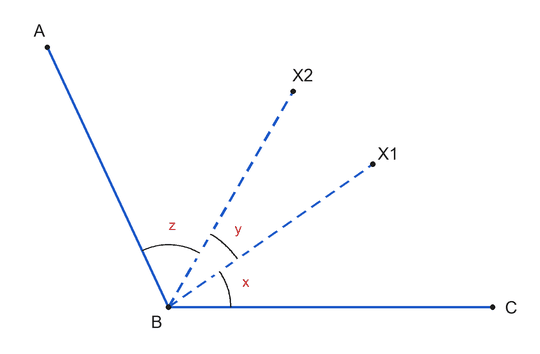
For ∠ABC = x + y + z, draw a ray BC. With B as centre and the same radius as used on the given angles, draw a long arc cutting BC.
Step 3 — Part (i): copy angle x next to BC, turning anticlockwise.
With the vertex of angle x as centre draw an arc cutting both its arms, and take the distance between the two cut points in the compasses. On the long arc about B, starting where it meets BC, cut off this same distance and join B to the new point, producing it to X1. Then ∠CBX1 = x.
Step 4 — Part (i): copy angle y next to BX1, turning anticlockwise.
With the vertex of angle y as centre draw an arc cutting both its arms, and take the distance between the two cut points in the compasses. On the long arc about B, starting where it meets BX1, cut off this same distance and join B to the new point, producing it to X2. Then ∠X1BX2 = y.
Step 5 — Part (i): copy angle z next to BX2, turning anticlockwise.
With the vertex of angle z as centre draw an arc cutting both its arms, and take the distance between the two cut points in the compasses. On the long arc about B, starting where it meets BX2, cut off this same distance and join B to the new point, producing it to A. Then ∠X2BA = z.
Step 6 — Part (i): name the angle.
The copies lie side by side with no gaps or overlaps, so ∠ABC = x + y + z.
Step 7 — Part (ii): draw the starting arm.
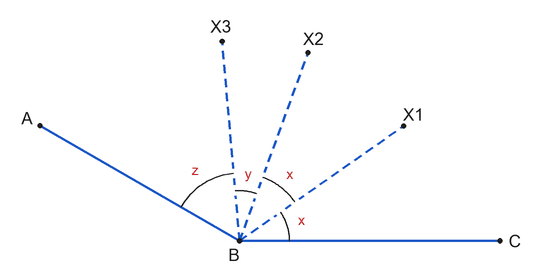
For ∠ABC = 2x + y + z, draw a ray BC. With B as centre and the same radius as used on the given angles, draw a long arc cutting BC.
Step 8 — Part (ii): copy angle x next to BC.
Copy angle x again in the same way (the same radius and the same chord as before), starting where the long arc meets BC, and draw BX1. Then ∠CBX1 = x.
Step 9 — Part (ii): copy angle x next to BX1.
Copy angle x again in the same way (the same radius and the same chord as before), starting where the long arc meets BX1, and draw BX2. Then ∠X1BX2 = x.
Step 10 — Part (ii): copy angle y next to BX2.
Copy angle y again in the same way (the same radius and the same chord as before), starting where the long arc meets BX2, and draw BX3. Then ∠X2BX3 = y.
Step 11 — Part (ii): copy angle z next to BX3.
Copy angle z again in the same way (the same radius and the same chord as before), starting where the long arc meets BX3, and draw BA. Then ∠X3BA = z.
Step 12 — Part (ii): name the angle.
The copies lie side by side with no gaps or overlaps, so ∠ABC = 2x + y + z.
Step 13 — Part (iii): draw the starting arm.
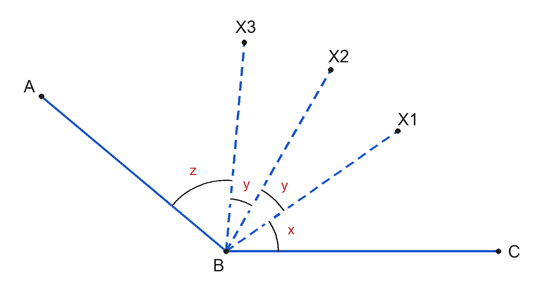
For ∠ABC = x + 2y + z, draw a ray BC. With B as centre and the same radius as used on the given angles, draw a long arc cutting BC.
Step 14 — Part (iii): copy angle x next to BC.
Copy angle x again in the same way (the same radius and the same chord as before), starting where the long arc meets BC, and draw BX1. Then ∠CBX1 = x.
Step 15 — Part (iii): copy angle y next to BX1.
Copy angle y again in the same way (the same radius and the same chord as before), starting where the long arc meets BX1, and draw BX2. Then ∠X1BX2 = y.
Step 16 — Part (iii): copy angle y next to BX2.
Copy angle y again in the same way (the same radius and the same chord as before), starting where the long arc meets BX2, and draw BX3. Then ∠X2BX3 = y.
Step 17 — Part (iii): copy angle z next to BX3.
Copy angle z again in the same way (the same radius and the same chord as before), starting where the long arc meets BX3, and draw BA. Then ∠X3BA = z.
Step 18 — Part (iii): name the angle.
The copies lie side by side with no gaps or overlaps, so ∠ABC = x + 2y + z.
Step 19 — Check with a protractor (optional).
In the figure the given angles are x = 35°, y = 25° and z = 55°, so a protractor reads about 115°, 150°, 140° for parts (i), (ii) and (iii). The construction itself never uses the protractor.
Watch out: Start each new copy on the arm of the PREVIOUS copy, not on BC again, or the angles overlap instead of adding.
Therefore, ∠ABC = x + y + z, 2x + y + z and x + 2y + z are the three required angles (shown in the figures).