
Question 503 marksMedium
Using ruler and compasses only, construct a parallelogram ABCD, in which : AB = 6 cm, AD = 3 cm and ∠DAB = 60°. In the same figure draw the bisector of angle DAB and let it meet DC at point P. Measure angle APB.
Confirming your payment
Sign up now and get 250 free tokens.
Constructions · Question 50 of 52
Using ruler and compasses only, construct a parallelogram ABCD, in which : AB = 6 cm, AD = 3 cm and ∠DAB = 60°. In the same figure draw the bisector of angle DAB and let it meet DC at point P. Measure angle APB.
Solution:
Concept: A parallelogram is fixed by two adjacent sides and the angle between them. The bisector of 60° makes two angles of 30°, and a line cutting two parallel lines makes equal alternate angles.
Given: Parallelogram ABCD with AB = 6 cm, AD = 3 cm and ∠DAB = 60°; AP bisects ∠DAB and meets DC at P.
Step 1 — Draw AB.
Draw AB = 6 cm.
Step 2 — Locate D.
With A as centre and any convenient radius, draw an arc cutting AB at L. With L as centre and the same radius, cut this arc at N. Join AN and produce it to X. Then AL, AN and LN are all equal to the radius, so triangle ALN is equilateral and the angle at A is 60°. With A as centre and radius 3 cm, cut AX at D.
Step 3 — Locate C.
With D as centre and radius 6 cm, and B as centre and radius 3 cm, draw arcs meeting at C. Join DC and BC.
Step 4 — Bisect ∠DAB.
With A as centre draw an arc cutting AD and AB. With the two cut points as centres and any equal radius (more than half the distance between them), draw arcs meeting at a point inside the angle. Join A to this point and produce it to meet DC at P. Every point of this line is equally far from both arms, so it bisects ∠DAB.
Step 5 — Measure ∠APB.
Join PB. On measuring, ∠APB = 90°.
Step 6 — See why ∠APB = 90°.
DC ∥ AB, so the alternate angles ∠DPA and ∠PAB are equal, and each is 30°. Also ∠DAP = 30°, so triangle ADP has two equal angles, and DP equals DA (3 cm). DC is 6 cm long, so PC is the remaining 3 cm, the same as CB. Opposite angles are equal, so ∠C is 60°, like ∠A. So triangle PCB is equilateral and ∠CPB = 60°. The angles at P on the straight line DC add up to 180°:
Step 7 — Look at the finished figure and check it.
The finished construction is shown below, with the given measurements marked on it.
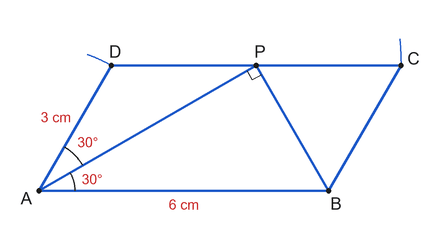
The figure marks the two 30° angles at A and the right angle at P.
Watch out: P is on DC (the side opposite AB), so the alternate angles are ∠DPA and ∠PAB.
Therefore, ∠APB = 90°.