Solution:
Concept: A parallelogram is fixed by two adjacent sides and the included angle. The perpendicular bisector of AD meets it at its mid-point P, and the diagonals of a parallelogram bisect each other, so O is the mid-point of BD.
Given: Parallelogram ABCD with AB = 6 cm, AD = 4.8 cm and ∠DAB = 45°.
Step 1 — Draw AB.
Draw AB = 6 cm.
Step 2 — Locate D.
At A, construct a 90° line from AB and bisect the right angle: with A as centre draw an arc cutting both arms, and with the two cut points as centres draw equal arcs meeting inside the angle. Join A to this point and produce it to X. It makes 90° ÷ 2 = 45° with AB. With A as centre and radius 4.8 cm, cut AX at D.
Step 3 — Locate C.
With D as centre and radius 6 cm, and B as centre and radius 4.8 cm, draw arcs meeting at C. Join DC and BC.
Step 4 — Draw the perpendicular bisector of AD.
With A and D as centres and equal radii (more than 2.4 cm), draw arcs on both sides of AD meeting at X and Y. Join XY, cutting AD at P.
Step 5 — Draw the diagonals.
Draw AC and BD, meeting at O. Join OP.
Step 6 — Measure OP.
On measuring, OP = 3.0 cm.
Step 7 — Look at the finished figure and check it.
The finished construction is shown below, with the given measurements marked on it.
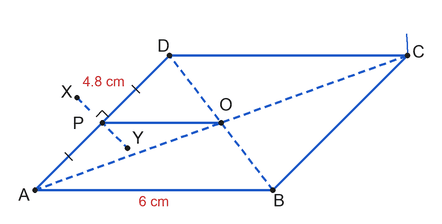
Check: in triangle ABD, P is the mid-point of AD and O is the mid-point of BD. The line joining the mid-points of two sides of a triangle is half the third side, so:
OP=21×6=3cm
Watch out: The X and Y used here are the arc points of the perpendicular bisector, not the 45° arm.
Therefore, OP = 3.0 cm.
