
Question 483 marksMedium
Construct a quadrilateral ABCD in which ; ∠A = 120°, ∠B = 60°, AB = 4 cm, BC = 4.5 cm and CD = 5 cm.
Confirming your payment
Sign up now and get 250 free tokens.
Constructions · Question 48 of 52
Construct a quadrilateral ABCD in which ; ∠A = 120°, ∠B = 60°, AB = 4 cm, BC = 4.5 cm and CD = 5 cm.
Solution:
Concept: A quadrilateral is constructed by splitting it into triangles: each triangle is fixed by three suitable measurements (three sides, two sides and the included angle, or two angles and a side), and the fourth vertex is then cut off by arcs or along a known direction.
Given: ∠A = 120°, ∠B = 60°, AB = 4 cm, BC = 4.5 cm and CD = 5 cm.
Step 1 — Plan.
AB with the angles at A and B gives the directions of AD and BC. BC = 4.5 cm fixes C, and an arc of radius 5 cm from C fixes D on the arm from A.
Step 2 — Draw AB.
Draw AB = 4 cm.
Step 3 — Construct 120° at A.
With A as centre and any convenient radius, draw an arc cutting AB. Keeping the same radius, step off two equal arcs along it from that point; each step turns through 60°. Join A to the second point and produce it to X. The angle is 60° + 60° = 120°.
Step 4 — Locate C.
Work on the same side of AB as the arm AX. With B as centre and any convenient radius, draw an arc cutting BA at L. With L as centre and the same radius, cut this arc at N. Join BN and produce it to Y. Then BL, BN and LN are all equal to the radius, so triangle BLN is equilateral and the angle at B is 60°. With B as centre and radius 4.5 cm, cut BY at C.
Step 5 — Locate D.
With C as centre and radius 5 cm, cut AX at D.
Step 6 — Complete.
Join CD.
Step 7 — Look at the finished figure and check it.
The finished construction is shown below, with the given measurements marked on it.
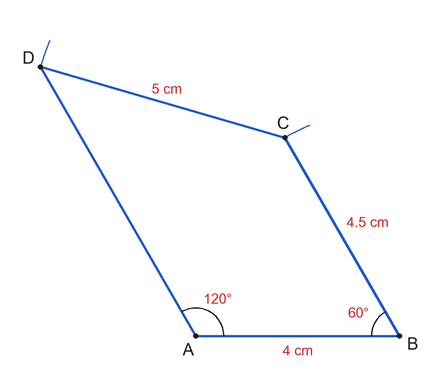
On measuring, AD ≈ 6.1 cm.
Watch out: The arc of radius 5 cm from C also meets the line XA produced BEHIND A; that point is not on the arm AX, so it is not D.
Note: ∠A and ∠B add up to 180° (120° and 60°). So AD ∥ BC and ABCD is a trapezium.
Therefore, ABCD is the required quadrilateral.