
Question 123 marksMedium
Draw a line AB = 6 cm. Mark a point P anywhere outside the line AB. Through point P, construct a line parallel to AB.
Confirming your payment
Sign up now and get 250 free tokens.
Constructions · Question 12 of 52
Draw a line AB = 6 cm. Mark a point P anywhere outside the line AB. Through point P, construct a line parallel to AB.
Solution:
Concept: If a transversal makes a pair of equal alternate angles with two lines, the two lines are parallel. So a line through a point parallel to a given line is drawn by copying an angle on the other side of a transversal.
Given: AB = 6 cm and a point P outside AB.
Step 1 — Draw AB and P.
Draw AB = 6 cm and mark a point P outside it.
Step 2 — Draw a transversal.
Take any point Q on AB and join PQ. ∠PQA is the angle PQ makes with AB.
Step 3 — Copy ∠PQA at P.
With Q as centre and a small radius, draw an arc cutting QA and QP. With P as centre and the same radius, draw an arc cutting PQ, on the side of PQ towards B. Take the distance between the two cuts on the first arc in the compasses and, from the point where the second arc meets PQ, cut the second arc at R.
Step 4 — Draw the parallel line.
Join PR and produce it both ways to get XY. Then ∠QPR = ∠PQA (marked α), and these are alternate angles.
Step 5 — Look at the finished figure and check it.
The finished construction is shown below, with the given measurements marked on it.
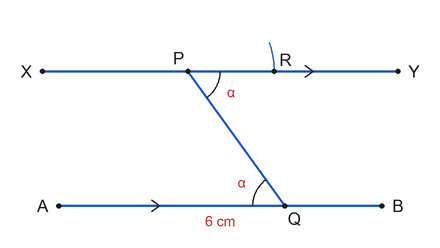
The two equal angles α are marked, and the arrows show the parallel lines.
Watch out: Copy the angle on the OTHER side of PQ (alternate angles); copying it on the same side gives a line that is not parallel.
Therefore, XY is the required line through P parallel to AB.