
Question 143 marksEasy
Draw a straight line AB = 6.5 cm. Draw another line which is parallel to AB at a distance of 2.8 cm from it.
Confirming your payment
Sign up now and get 250 free tokens.
Constructions · Question 14 of 52
Draw a straight line AB = 6.5 cm. Draw another line which is parallel to AB at a distance of 2.8 cm from it.
Solution:
Concept: The distance between two parallel lines is measured along a perpendicular. Two points, each 2.8 cm from AB along perpendiculars on the same side, fix the parallel line.
Given: AB = 6.5 cm; the parallel line is to be 2.8 cm from AB.
Step 1 — Draw AB.
Draw AB = 6.5 cm and take two points L and M on it, well apart.
Step 2 — Draw perpendiculars.
Construct perpendiculars to AB at L and at M (equal arcs from two points on either side, as in Exercise 18(B)).
Step 3 — Cut off 2.8 cm on each.
With L as centre and radius 2.8 cm, cut the perpendicular at L at P. With M as centre and radius 2.8 cm, cut the perpendicular at M at Q, on the same side of AB.
Step 4 — Draw the line.
Join PQ and produce it both ways. P and Q are both 2.8 cm from AB, so PQ is parallel to AB.
Step 5 — Look at the finished figure and check it.
The finished construction is shown below, with the given measurements marked on it.
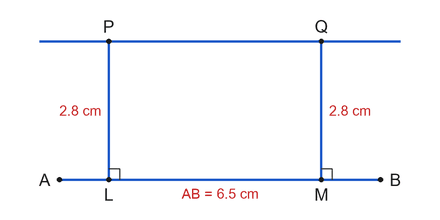
LP and MQ are both 2.8 cm and both perpendicular to AB.
Watch out: Cut off both 2.8 cm lengths on the SAME side of AB.
Note: A second such line can be drawn on the other side of AB in the same way.
Therefore, PQ is the required line, parallel to AB at a distance of 2.8 cm.