
Question 243 marksEasy
Construct a parallelogram ABCD, if :
(i) AB = 3.6 cm, BC = 4.5 cm and ∠ABC = 120°.
Confirming your payment
Sign up now and get 250 free tokens.
Constructions · Question 24 of 52
Construct a parallelogram ABCD, if :
(i) AB = 3.6 cm, BC = 4.5 cm and ∠ABC = 120°.
Solution:
Concept: In a parallelogram, opposite sides are equal and parallel and opposite angles are equal; the diagonals bisect each other.
Given: AB = 3.6 cm, BC = 4.5 cm and ∠ABC = 120°.
Step 1 — Use the properties.
Opposite sides are equal, so AD equals BC (4.5 cm) and DC equals AB (3.6 cm).
Step 2 — Draw BC.
Draw BC = 4.5 cm.
Step 3 — Construct 120° at B.
With B as centre and any convenient radius, draw an arc cutting BC. Keeping the same radius, step off two equal arcs along it from that point; each step turns through 60°. Join B to the second point and produce it to X. The angle is 60° + 60° = 120°.
Step 4 — Locate A.
With B as centre and radius 3.6 cm, cut BX at A.
Step 5 — Locate D.
With A as centre and radius 4.5 cm, and C as centre and radius 3.6 cm, draw arcs meeting at D.
Step 6 — Complete.
Join AD and CD.
Step 7 — Look at the finished figure and check it.
The finished construction is shown below, with the given measurements marked on it.
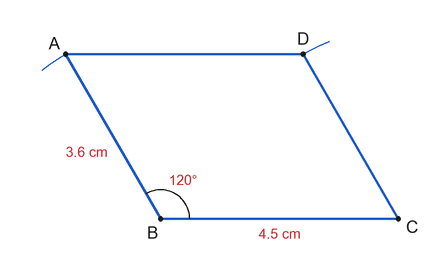
Both pairs of opposite sides are equal, so ABCD is a parallelogram.
Watch out: The arc from A has the length of BC, and the arc from C has the length of AB (opposite sides), not the other way round.
Therefore, ABCD is the required parallelogram.