
Opening your dashboard
Class 8 Maths Chapter 18 Constructions: Practice Questions
41 questions on Chapter 18, each worked through on its own page with the AI tutor. Class 8 Maths, ICSE 2026-27.
41 questions
1–5 marks · Mixed difficulty
- 11 mark
Question 1
Bloom's level: Remember
When a question says "using ruler and compasses only", which instrument must not be used to make the angles?
- 21 mark
Question 2
Bloom's level: Remember
With B as centre, an arc is drawn cutting the ray BC at P. With P as centre and the same radius, the arc is cut at Q.

The angle QBC is
- 31 mark
Question 3
Bloom's level: Understand
To construct an angle of 75° with ruler and compasses, we should bisect the angle between the arms of
- 41 mark
Question 4
Bloom's level: Understand
XY is the perpendicular bisector of the line segment AB.
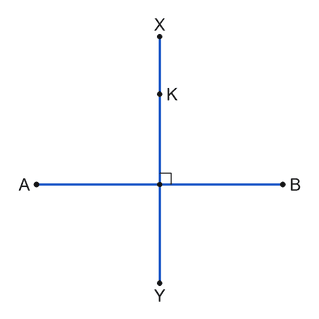
Which statement is true for every point K on XY?
- 51 mark
Question 5
Bloom's level: Apply
An angle of 120° is constructed and bisected. One of the two halves is then bisected again. Each of the smallest angles so formed measures
- 61 mark
Question 6
Bloom's level: Apply
Line l is drawn parallel to a line AB at a distance of 3 cm above it. Line m is drawn parallel to AB at a distance of 2.4 cm below it. The distance between l and m is
- 71 mark
Question 7
Bloom's level: Analyse
Which of the following sets of data does not fix a unique quadrilateral ABCD?
- 81 mark
Question 8
Bloom's level: Analyse
Sonu tries to construct a quadrilateral PQRS with PQ = 3 cm, QR = 4 cm and diagonal PR = 8 cm (and suitable other measures). What will happen?
- 91 mark
Question 9
Bloom's level: Apply
Meera draws a rectangle PQRS whose side PQ is 6 cm and whose diagonal PR is 10 cm.
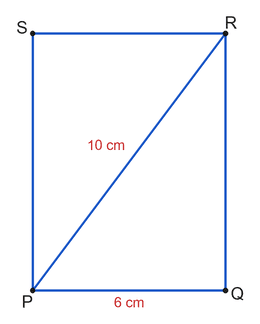
When she measures side QR, she should get
- 101 mark
Question 10
Bloom's level: Understand
Assertion (A): The perpendicular bisector of a line segment AB passes through the mid-point of AB.
Reason (R): To draw the perpendicular bisector of AB, the radius of the arcs drawn from A and B must be more than half of AB.
- 111 mark
Question 11
Bloom's level: Evaluate
Assertion (A): If P is a point outside line AB, Q is a point on AB, and ∠RPQ is made equal to ∠PQA on the other side of PQ, then the line PR is parallel to AB.
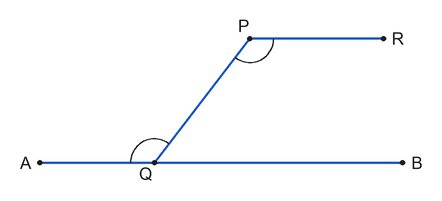
Reason (R): When a transversal cuts two lines and makes a pair of alternate angles equal, the two lines are parallel.
- 121 mark
Question 12
Bloom's level: Analyse
Assertion (A): An angle of ° can be constructed using ruler and compasses only.
Reason (R): Every angle which is a whole number of degrees can be constructed using ruler and compasses only.
- 131 mark
Question 13
Bloom's level: Remember
Name the instrument used to (a) draw an arc of a given radius, (b) draw a line segment of a given length.
- 141 mark
Question 14
Bloom's level: Remember
How many independent measurements are needed to construct a unique quadrilateral?
- 152 marks
Question 15
Bloom's level: Understand
P is a point outside the line segment AB. To draw the perpendicular from P to AB, an arc with centre P cuts AB at X and Y. Then arcs of equal radius from X and Y meet at Q on the other side of AB, and PQ is joined.
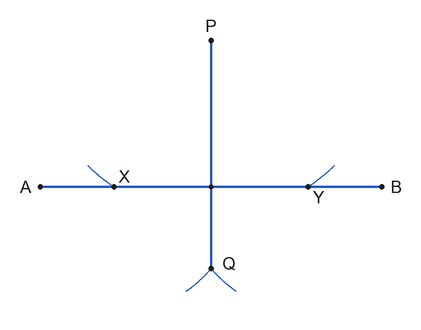
Explain why PQ is perpendicular to AB.
- 162 marks
Question 16
Bloom's level: Understand
To draw a line parallel to AB at a distance of 2.5 cm, Kiran draws perpendiculars to AB at two points L and M, cuts LP = MQ = 2.5 cm on the same side of AB, and joins PQ.

Explain why PQ is parallel to AB.
- 172 marks
Question 17
Bloom's level: Understand
Before starting a construction, why is it a good idea to draw a rough sketch and mark the given measurements on it? Give two reasons.
- 182 marks
Question 18
Bloom's level: Understand
Name the special quadrilateral you get when you construct a parallelogram whose diagonals
(a) bisect each other at right angles but are not equal,
(b) are equal and bisect each other but not at right angles.
- 192 marks
Question 19
Bloom's level: Apply
Without a protractor, make an angle ABC of 105° whose arm BC is 4.5 cm long and whose arm BA is 3.8 cm long. Join A to C and find AC by measuring.
- 202 marks
Question 20
Bloom's level: Apply
Draw a line segment AB = 7 cm. Using ruler and compasses only, divide AB into four equal parts. What is the length of each part?
- 212 marks
Question 21
Bloom's level: Apply
Draw a line segment AB = 5.5 cm. Construct ∠BAX = 60° and mark C on AX so that AC = 3 cm. Through C construct a line parallel to AB by making a corresponding angle at C. Measure the distance between the two parallel lines.
- 222 marks
Question 22
Bloom's level: Analyse
Data for quadrilateral ABCD: AB = 5 cm, BC = 4 cm, CD = 3.5 cm, DA = 4.5 cm and ∠A = 70°.
Which triangle should be constructed first, and why can't the construction start with triangle BCD?
- 233 marks
Question 23
Bloom's level: Apply
Using ruler and compasses only, draw BC = 6 cm. At B construct ∠CBX = 75° and at C construct ∠BCY = 45°, on the same side of BC. Let BX and CY meet at A.
(a) Measure AB and AC.
(b) Find ∠BAC by measuring, and check your answer using the angle sum of a triangle.
- 244 marks
Question 24
Bloom's level: Apply
Construct a trapezium ABCD in which AB ∥ DC, AB = 6.5 cm, ∠ABC = 60°, BC = 4 cm and CD = 3.5 cm. Use ruler and compasses only.
(a) Write the steps of construction.
(b) Measure AD and ∠DAB.
- 254 marks
Question 25
Bloom's level: Apply
Construct a quadrilateral PQRS in which PQ = 5 cm, QR = 4.2 cm, RS = 4.6 cm, SP = 3.8 cm and diagonal PR = 6.2 cm.
(a) Write the steps of construction.
(b) Measure the other diagonal QS.
- 264 marks
Question 26
Bloom's level: Analyse
Case study — The garden bench
Two lamp posts A and B in a park are 80 m apart. On a plan drawn to the scale 1 cm = 10 m, a bench P is to be placed so that it is at the same distance from both lamp posts and 30 m from the straight path joining them.
(a) On which line must P lie? Give a reason.
(b) Construct the plan: draw AB, the line in (a), and locate P.
(c) Find the actual distance of the bench from each lamp post. How many such positions are possible?
- 274 marks
Question 27
Bloom's level: Evaluate
Case study — Riya's floor tiles
Riya cuts cardboard tiles with all four sides 5 cm. She says, "Any tile with four equal sides is a square."
(a) Is Riya right? Justify your answer by constructing a rhombus ABCD with each side 5 cm and ∠A = 60°.
(b) Measure both diagonals of your rhombus and ∠ABC.
(c) Suggest two different single extra conditions, either of which would make her tile a square.
- 283 marks
Question 28
Bloom's level: Evaluate
Aman wants to construct ∠ABC = 45°. He draws an arc from B cutting BC at P, steps off Q (60°) and R (120°) along the arc, and then bisects ∠QBC, saying "45° is half of 90°."
(a) What angle does Aman's method actually give? Explain.
(b) Correct his method and construct ∠ABC = 45°.
- 295 marks
Question 29
Bloom's level: Create
A kite ABCD has AB = AD, CB = CD and AB ≠ CB.
(a) Choose your own lengths for a kite in which diagonal BD = 6 cm. State the rule your lengths must obey so that the kite can be drawn.
(b) Construct your kite using ruler and compasses only.
(c) Draw diagonal AC. Measure AC and check by measurement that AC bisects BD at right angles.
- 305 marks
Question 30
Bloom's level: Create
Case study — The house badge
Neha is designing a badge: a square of side 5 cm with a second square inside it whose corners are the mid-points of the sides of the first square. Only ruler and compasses may be used — no protractor and no set square.
(a) Plan the construction: write, in order, which constructions you will use to make the right angles and to find the mid-points.
(b) Construct the badge.
(c) Measure a side of the inner square. What fraction of the area of the outer square does the inner square cover?
- 314 marks
Question 31
Construct an angle ABC of 45° with AB = 5 cm and BC = 4 cm.
- 321 mark
Question 32
Starting from the angles 60° and 90°, which of the following angles can not be constructed with a ruler and compasses by bisecting angles and adding the angles obtained ?
- 331 mark
Question 33
PQ is a line segment of length 8.6 cm and M is its mid-point. X is a point on the perpendicular bisector of PQ such that XP = 6.2 cm.
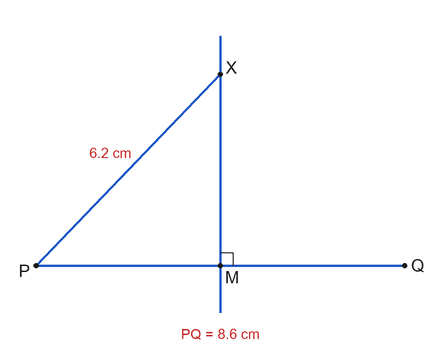
Then :
- 341 mark
Question 34
To draw a line parallel to a line AB at a distance of 3.4 cm, Isha raises perpendiculars to AB at two points L and M. She marks P on the perpendicular at L and Q on the perpendicular at M and joins PQ. For PQ to be the required line, she must take :
- 352 marks
Question 35
A plot of land has four sides measuring 4.8 m, 5.2 m, 3.9 m and 4.4 m in order, and the diagonal joining the first and third corners is 6.1 m. On a plan with 1 cm for every metre, construct the plot as ABCD (AB = 4.8 cm, BC = 5.2 cm, CD = 3.9 cm, DA = 4.4 cm, AC = 6.1 cm), write the steps and measure the diagonal BD.
- 362 marks
Question 36
Using a ruler and compasses only, construct ∠PQR = 150°. Bisect it and state the measure of each of the two angles formed.
- 372 marks
Question 37
A school S and a bus stop B are shown on a map 6.8 cm apart. A water tap T is to be placed so that it is the same distance from S and from B, and is 2.5 cm from the road SB on the map. Draw SB = 6.8 cm, construct the point T (on one side of SB) and measure TS.
- 382 marks
Question 38
Draw a line segment PQ = 5.6 cm. Construct two lines parallel to PQ, one on each side of it, each 2.3 cm from PQ. What is the distance between these two lines ?
- 394 marks
Question 39
Construct a rhombus ABCD in which each side is 4.2 cm and ∠ABC = 60°.
(a) Write the steps of construction.
(b) Measure the diagonals AC and BD. Which diagonal is longer, and what kind of triangle is ABC ?
- 404 marks
Question 40
Construct a quadrilateral PQRS in which PQ = 4.6 cm, QR = 5 cm, RS = 3.5 cm, ∠Q = 90° and ∠R = 105°.
(a) Write the steps of construction, showing how the angle 105° is made without a protractor.
(b) Measure the side PS and the angles at P and S. Check that the four angles add up to 360°.
- 413 marks
Question 41
(a) Draw AB = 6.4 cm. At A construct a perpendicular to AB and cut AD = 3.9 cm on it.
(b) Through D draw a line parallel to AB and through B draw a line perpendicular to AB. Let these two lines meet at C.
(c) Name the figure ABCD and measure its diagonal AC.