
Opening your dashboard
Class 8 Maths Chapter 18 Constructions: Competency-Based Questions (CBQ)
40 questions on Chapter 18, each worked through on its own page with the AI tutor. Class 8 Maths, ICSE 2026-27.
40 questions
1–5 marks · Mixed difficulty
- 11 mark
Question 1
Competency: Application
A carpenter needs a corner brace with an angle of 135°. He has only a ruler and a pair of compasses.
Which plan gives him exactly 135°?
- 21 mark
Question 2
Competency: Application
A designer constructs a rectangular label ABCD from its diagonals. Each diagonal is 6 cm long and the diagonals cross at an angle of 60°.
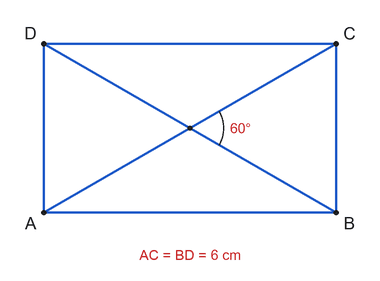
Without measuring, what is the length of the shorter side of the label?
- 31 mark
Question 3
Competency: Application
The two straight edges of a road are parallel and 7 m apart. An engineer draws the road on a plan to the scale 1 cm = 2 m.
At what distance from the first edge must she draw the parallel line for the second edge?
- 41 mark
Question 4
Competency: Analysis
Asha wants the perpendicular bisector of a line segment AB. By mistake she draws arcs of radius 5 cm with centre A and arcs of radius 6 cm with centre B. The arcs meet at X above AB and at Y below AB. She joins XY.
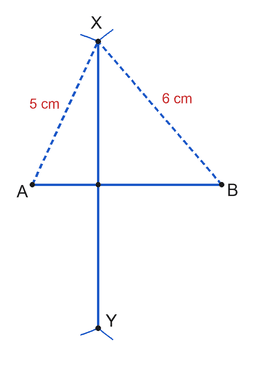
Which statement about the line XY is correct?
- 51 mark
Question 5
Competency: Understanding
A tile maker wants every worker to construct a rhombus-shaped tile of exactly the same shape and size.
Which information alone is enough for this?
- 61 mark
Question 6
Competency: Understanding
Assertion (A) : On a plan, two lines drawn perpendicular to the same line AB are parallel to each other.
Reason (R) : The perpendicular distance between two parallel lines is the same everywhere.
- 72 marks
Question 7
Competency: Application
Riya is drawing a clock face with centre O. She has drawn the minute hand OA pointing to 12. She now wants to draw the hour hand OB for exactly 1 o'clock, using ruler and compasses only.
Find the angle AOB she needs. Write the steps to construct it.
- 82 marks
Question 8
Competency: Analysis
There are two ways to construct a line parallel to a given line AB.
Method 1: Draw perpendiculars at two points of AB, cut off equal lengths on them, and join the two points.
Method 2: Take a point Q on AB, join it to a point P, and make an angle at P equal to the alternate angle at Q.
Which method suits each task better? Give a reason.
(a) Draw the second rail of a railway track 4 cm away from the first rail AB.
(b) Draw a line parallel to AB through a nail P fixed on the board, when the distance of P from AB is not known.
- 92 marks
Question 9
Competency: Evaluation
A worksheet says: "Construct a parallelogram ABCD in which AB = 5 cm, BC = 3.5 cm, ∠A = 70° and ∠B = 100°."
Kiran says that this parallelogram cannot be drawn. Is Kiran right? If ∠A is correct, what should ∠B be?
- 102 marks
Question 10
Competency: Application
A straight canal AB runs past a hut P. A pipe is to be laid from the hut to the canal. On a plan drawn to the scale 1 cm = 50 m, the perpendicular PN from P to AB measures 3.4 cm and the slanting line PA measures 4.1 cm.
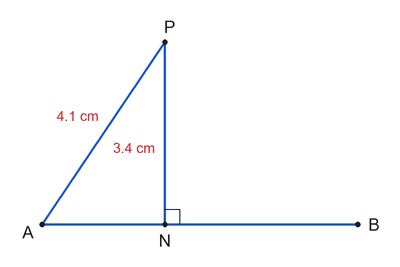
(a) Which construction of this chapter gives the point N on the plan?
(b) How many metres of pipe are saved by laying it along PN instead of PA?
- 113 marks
Question 11
Competency: Analysis
The steps for constructing a parallelogram ABCD with AB = 5.5 cm, AD = 3.5 cm and diagonal BD = 6.5 cm are given below in a jumbled order.
Step What is done P With D as centre and radius 5.5 cm, and with B as centre and radius 3.5 cm, draw arcs meeting at C. Q Draw AB = 5.5 cm. R Join DC and BC. S With A as centre and radius 3.5 cm, and with B as centre and radius 6.5 cm, draw arcs meeting at D. T Join AD and BD. (a) Write the steps in the correct order.
(b) Why can triangle ABD be constructed before anything else?
(c) Which property of a parallelogram gives the two radii used in step P?
- 123 marks
Question 12
Competency: Creativity
The school wants a flower bed in the shape of a trapezium whose two parallel sides are 3 m apart.
Design the flower bed on a plan to the scale 1 cm = 1 m. Choose your own lengths for the two parallel sides. Write the steps to construct your plan using ruler and compasses only.
- 133 marks
Question 13
Competency: Analysis & Evaluation
Zoya draws AB = 5 cm. Using compasses she constructs an angle of 60° at A and an angle of 60° at B, on the same side of AB. The two arms meet at C. She measures and gets AC = 5.4 cm and BC = 5.0 cm.
(a) What should AC and BC measure in an exact construction? Give the reason.
(b) Is Zoya's construction accurate?
(c) Suggest one more measurement at C that she can use to check her figure.
- 145 marks
Question 14
Competency: Application & Analysis
Case study — Plan of a plot
A surveyor measures a plot of land ABCD. The corner at A is a right angle. Her notes are given below.
Side AB BC CD DA Actual length 40 m 35 m 25 m 30 m She wants to draw a plan of the plot to the scale 1 cm = 5 m.
(a) Find the length of each side on the plan.
(b) Write the steps to construct the plan ABCD using ruler and compasses only.
(c) Without measuring, find the length of the diagonal BD on the plan. A cable is laid straight from B to D instead of along the sides BA and AD. How many metres of cable are saved?
- 154 marks
Question 15
Competency: Analysis & Evaluation
Case study — Aarav's arcs
Aarav draws a line segment AB = 6 cm. With A as centre and radius 5 cm he draws arcs on both sides of AB. With B as centre and the same radius he cuts these arcs at X and Y. The line XY meets AB at M, as shown.
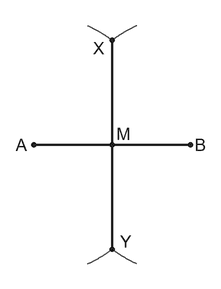
(a) What is the line XY called for the segment AB? Write the length of AM and the size of ∠AMX.
(b) Find the lengths of MX and XY without measuring.
(c) Aarav says, "AXBY is a rhombus. I would get a rhombus with any radius I choose." Examine both parts of his statement.
- 161 mark
Question 16
Competency: Application & Analysis
A carpenter fixes a bar BC to a straight beam AD at the point B, so that ∠ABC = 120°. He then fits two thin struts: BX along the bisector of ∠ABC, and BY along the bisector of ∠CBD.
What is the angle XBY between the two struts?
- 171 mark
Question 17
Competency: Analysis
On a town plan, a straight road is shown by the line l, and a bus stop B is a point on l. A tea kiosk K is to be placed 2 cm from the road, on either side of it, and 3 cm from the bus stop B.
How many positions are possible for K on the plan?
- 181 mark
Question 18
Competency: Evaluation
Assertion (A) : A rhombus can be constructed when its side and one diagonal are known.
Reason (R) : A diagonal cuts a rhombus into two triangles, and in each triangle two sides are equal to the given side and the third side is the given diagonal.
- 191 mark
Question 19
Competency: Evaluation
Assertion (A) : A parallelogram can be constructed uniquely when only the lengths of its two diagonals are given.
Reason (R) : The diagonals of a parallelogram bisect each other.
- 201 mark
Question 20
Competency: Application
Sunita has to construct a square ABCD whose diagonal AC is 8 cm. She draws AC = 8 cm and constructs its perpendicular bisector, which meets AC at O. She now has to mark B and D on this bisector, one on each side of AC.
How far from O must she mark B and D?
- 211 mark
Question 21
Competency: Understanding
Ravi's compasses can open to a radius of at most 3 cm. He has to bisect a line segment AB = 7 cm with the arc method: equal arcs are drawn from A and from B, above and below AB, and the points where the arcs cross are joined.
What happens?
- 221 mark
Question 22
Competency: Application & Analysis
Leena constructs ∠ABC = 90° with ruler and compasses. To check it without a protractor, she marks P on BA with BP = 4 cm and Q on BC with BQ = 7.5 cm, and then measures PQ.
If her angle is exactly 90°, what should PQ measure?
- 231 mark
Question 23
Competency: Analysis
Mohan constructs a quadrilateral ABCD with AB = 5 cm, ∠DAB = 60°, ∠ABC = 120° and AD = BC = 3 cm, with C and D on the same side of AB.
Which statement best describes ABCD?
- 241 mark
Question 24
Competency: Analysis
Meena makes a rough sketch of a quadrilateral PQRS before she constructs it. Her sketch is shown below.
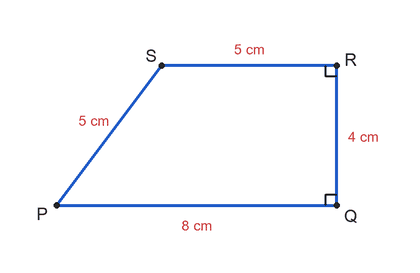
Her plan is: draw PQ, construct the right angle at Q and cut off QR, construct the right angle at R and cut off RS, and finally join S to P.
In her plan, which measurement marked in the sketch is not needed, and can be used only as a check?
- 251 mark
Question 25
Competency: Application
To draw the perpendicular from a point P to a line AB, Kunal draws an arc with centre P and radius 6.5 cm. The arc cuts AB at X and Y. The point P is 2.5 cm from the line AB.
What is the length of XY?
- 262 marks
Question 26
Competency: Evaluation
To construct an angle of 60° at B on the ray BC, Kavya draws an arc of radius 4 cm with centre B, cutting BC at P. By mistake, she then opens her compasses to 5 cm and draws an arc with centre P, cutting the first arc at Q. She joins BQ.
(a) Why must the radius be kept the same in the correct construction?
(b) Is Kavya's angle QBC exactly 60°? Give a reason.
- 272 marks
Question 27
Competency: Application
A telephone cable runs straight between two poles A and B. On a plan drawn to the scale 1 cm = 5 m, the cable AB measures 6.8 cm. A third pole is to be put up exactly half way between A and B.
(a) Which construction gives the position of the third pole on the plan?
(b) How far from A, in real metres, will the third pole stand?
- 282 marks
Question 28
Competency: Analysis
The ruled part of a notebook page is 12.8 cm tall. Parallel lines are ruled across it, 0.8 cm apart. The first line is at the top of the ruled part and the last line is at its bottom.
(a) How many lines are ruled on the page?
(b) How far is the 7th line from the 1st line?
- 292 marks
Question 29
Competency: Understanding
Sana has to draw a perpendicular to a line segment AB at its end point A. She finds that she cannot cut equal arcs on both sides of A on the segment, because the segment ends at A.
(a) What should she do first?
(b) Write the steps that follow.
- 302 marks
Question 30
Competency: Understanding
A general quadrilateral needs five independent measurements to be constructed. Yet a rectangle ABCD can be constructed when only its length and breadth are given, for example AB = 6 cm and BC = 4 cm.
(a) Which properties of a rectangle supply the other three measurements?
(b) How many measurements are enough to construct a square? Name one such measurement.
- 312 marks
Question 31
Competency: Evaluation
A teacher asks three students to construct an angle of 45° and checks each with a protractor. (Hypothetical data.)
Student Anil Bina Chitra Measured angle 44° 47° 45° (a) Find the error in each student's angle.
(b) The teacher accepts an angle if its error is at most 1°. Which students are accepted?
- 323 marks
Question 32
Competency: Application
A rectangular classroom floor ABCD is 7.2 m long and 5.4 m wide. Its plan is drawn to the scale 1 cm = 1.8 m.
(a) Find the length and the width of the floor on the plan.
(b) Without measuring, find the length of the diagonal AC on the plan.
(c) A pipe is to run along the diagonal AC. Find its real length.
- 333 marks
Question 33
Competency: Analysis
Isha wants to draw a line PR through a point P parallel to a line AB, by making equal alternate angles. She joins P to a point Q on AB and measures ∠PQB = 58°. She then draws the ray PR on the side of PQ that is away from B, and makes ∠QPR = 52°.
(a) What should ∠QPR be, so that PR is parallel to AB? Give the reason.
(b) Is Isha's line parallel to AB? Give a reason.
(c) By how many degrees must she change ∠QPR?
- 343 marks
Question 34
Competency: Application & Analysis
A potter has a broken piece of a round plate, as shown. To make a matching plate she needs the centre O of the full plate. The centre is the same distance from every point on the edge of the plate. She marks three points A, B and C on the curved edge.
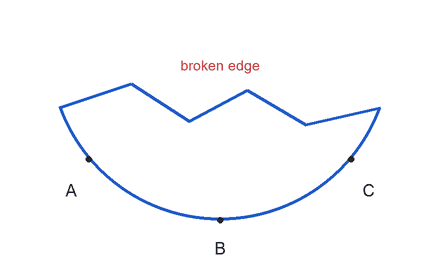
(a) Explain why O must lie on the perpendicular bisector of AB.
(b) Write the steps to locate O with ruler and compasses only.
(c) Her helper says that the perpendicular bisector of AB alone is enough to locate O. Is he right? Give a reason.
- 353 marks
Question 35
Competency: Application & Analysis
A circular rangoli of radius 6 cm is to be divided into 8 equal petals, each with the centre O as a corner.
(a) What is the angle of each petal at O?
(b) Write the steps to mark the 8 petals with ruler and compasses only.
(c) After the two perpendicular diameters are drawn, what is the least number of right angles that must be bisected? Give a reason.
- 363 marks
Question 36
Competency: Creativity
A shop wants a parallelogram-shaped door-mat. On the plan, 1 cm stands for 10 cm of the real mat.
Design the mat. Choose the lengths of its two different sides and one angle that can be constructed with ruler and compasses only. Write the real size of your mat and the steps to construct your plan.
- 375 marks
Question 37
Competency: Analysis & Evaluation
Case study: Two huts A and B are 6 cm apart on a plan. A surveyor lists the distances, in cm, of five marked points from A and from B on the plan. (Hypothetical data.)
Point P Q R S T Distance from A 5 6 4 3 2 Distance from B 5 5 4 3 2 (a) Which points are equally far from A and from B?
(b) One of these readings cannot be correct on any plan. Name it and give a reason.
(c) Find the distance of the point P from the line AB on the plan. If 1 cm stands for 20 m, how many metres is this on the ground?
- 384 marks
Question 38
Competency: Analysis & Evaluation
Case study: A kite maker plans a rhombus-shaped kite and writes down two plans.
Plan X: each side is 13 cm and one diagonal is 24 cm.
Plan Y: the two diagonals are 24 cm and 10 cm.
(a) Show that Plan X is possible.
(b) Find the other diagonal in Plan X.
(c) Do the two plans give the same kite? Find the length of the border ribbon needed round it.
- 395 marks
Question 39
Competency: Analysis & Application
Case study: A surveyor records the measurements of three four-sided plots ABCD. The diagonal AC was also measured. All lengths are in metres. (Hypothetical data.)
Plot AB BC CD DA AC I 48 36 42 30 60 II 48 36 24 30 90 III 48 36 24 30 54 (a) For each plot, can a plan ABCD be constructed from these measurements? Give a reason.
(b) For plot I, the plan is drawn to the scale 1 cm = 12 m. Find the five lengths on the plan, and say which of the two triangles is right-angled.
(c) In what order would you construct the plan of plot I with ruler and compasses?
- 404 marks
Question 40
Competency: Application & Evaluation
Case study: On a treasure map, two straight walls CP and CQ of an old fort meet at a right angle at C. The map says: "The treasure T is the same distance from both walls, and it is 3 cm from the wall CP."
Rohan finds T by drawing the bisector of ∠PCQ and a line parallel to CP at a distance of 3 cm. Neha finds T by drawing a line parallel to CP at 3 cm and a line parallel to CQ at 3 cm.
(a) Write the steps of each method, in brief.
(b) Explain why the two methods give the same point T.
(c) Find the distance CT, correct to one decimal place.