
Opening your dashboard
Class 12 Physics Chapter 26: Atoms - Energy Levels Solutions
92 textbook questions with step-by-step answers, free to read, for ISC 2026-27.
Get talked through Ch 26, not just shown the answer
Reading a finished solution is not the same as being able to do it. The AI tutor takes one question at a time and works it with you, in your own words, until you can.
- Ask it out loud, in your own words
- It gives you the next step, not the answer
- Stuck on part (ii)? Start there
92 questions with solutions
1–5 marks · Mixed difficulty
The first 33 solutions are on this page. This chapter is a long one, so the rest open on their own page to keep this one quick to load.
- 11 mark
Question 1
When an -particle of mass moving with velocity bombards on a heavy nucleus of charge , its distance of closest approach from the nucleus depends on as
Solve with AIAnswer
- Correct
(A)
(B)
(C)
(D)
Answer: (A) , the distance is inversely proportional to the mass
Concept: At the distance of closest approach (head-on), the -particle stops for an instant, so all its kinetic energy has become electrostatic potential energy.
Step 1 — Equate the two energies. The -particle has charge and the nucleus , so with :
Step 2 — Solve for . Rearranging gives:
Step 3 — Read off the dependence on . For a given velocity , everything except is fixed, so .
Step 4 — Check the other options. We test each of the other options in turn:
- (B) An inverse square-root dependence would arise only if appeared under a square root, but the kinetic energy contains to the first power.
- (C) This would need in the kinetic energy; has only .
- (D) A heavier particle with the same speed has more kinetic energy, so it gets closer, not farther; cannot grow with .
Therefore, the answer is (A).
- 21 mark
Question 2
An -particle of energy 5 MeV is scattered through 180° by gold nucleus. The distance of closest approach is of the order of
Solve with AIAnswer
- Correct
(A) cm
(B) cm
(C) cm
(D) cm
Answer: (A) cm
Concept: Scattering through 180° means a head-on approach. At the closest distance the kinetic energy has all become potential energy:
Step 1 — Write the data in SI units. We have for gold, , C, and the kinetic energy
Step 2 — Solve for . We rearrange the energy equation and substitute:
Step 3 — Change to centimetres. One metre is 100 cm, so:
This is of the order of cm.
Step 4 — Check the other options. We test each of the other options in turn:
- (B) cm is m, far smaller than any nucleus; the particle could not get that close with only 5 MeV.
- (C) cm is m, about twenty times larger than the computed m.
- (D) cm is m; is the order of the answer in metres, so this option mixes up the unit.
Therefore, the answer is (A).
- 31 mark
Question 3
According to classical theory, the circular path of an electron in Rutherford atom is
Solve with AIAnswer
- Correct
(A) spiral
(B) circular
(C) parabolic
(D) straight line
Answer: (A) spiral
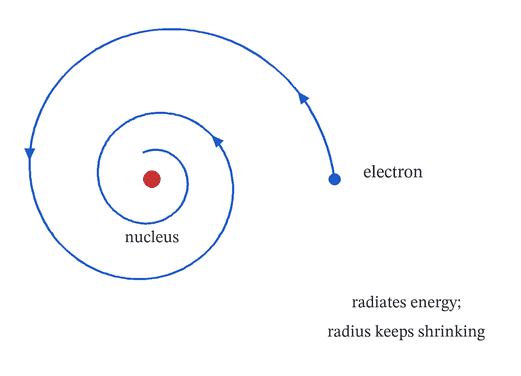
Concept: Classical electromagnetic theory says that an accelerated charge radiates electromagnetic energy. An electron moving in a circle is accelerated towards the centre all the time.
Step 1 — Apply the classical rule. The revolving electron should radiate energy continuously.
Step 2 — Follow what happens to the orbit. As it loses energy, its total energy becomes more negative, so the radius keeps decreasing. The electron moves along a path of shrinking radius, a spiral, and falls into the nucleus.
Step 3 — Check the other options. We test each of the other options in turn:
- (B) A steady circle needs constant energy, but classical theory makes the electron lose energy by radiation.
- (C) A parabola is the path of a body under a constant force in one direction, not under a central attraction with energy loss.
- (D) A straight line would mean no force at all, but the nucleus attracts the electron.
Therefore, the answer is (A).
- 41 mark
Question 4
According to Rutherford's atomic model, the electrons inside the atom are
Solve with AIAnswer
(A) stationary
- Correct
(B) not stationary
(C) centralised
(D) none of these
Answer: (B) not stationary
Concept: In Rutherford's model the electrons revolve round the nucleus, as planets revolve round the Sun.
Step 1 — Ask what keeps the electrons away from the nucleus. A stationary electron would be pulled straight into the positive nucleus by electrostatic attraction.
Step 2 — Give Rutherford's answer. The electrons revolve in orbits; the electrostatic attraction provides the centripetal force needed for this circular motion.
Step 3 — Check the other options. We test each of the other options in turn:
- (A) Stationary electrons would fall into the nucleus, so the atom could not be stable.
- (C) The positive charge, not the electrons, is centralised in the nucleus; the electrons are outside it.
- (D) Option (B) correctly describes the model, so "none of these" is wrong.
Therefore, the answer is (B).
- 51 mark
Question 5
In hydrogen atom, which quantity is an integral multiple of ?
Solve with AIAnswer
- Correct
(A) Angular momentum
(B) Angular velocity
(C) Angular acceleration
(D) Momentum
Answer: (A) Angular momentum
Concept: Bohr's quantisation postulate states that the electron can revolve only in those orbits in which its angular momentum is a whole-number multiple of .
Step 1 — Write the postulate. We write it for the th orbit:
Step 2 — Check the unit. has the unit J s, the same as angular momentum (kg m² s⁻¹), so only angular momentum can be a multiple of .
Step 3 — Check the other options. We test each of the other options in turn:
- (B) Angular velocity has unit rad s⁻¹, which does not match J s.
- (C) Angular acceleration has unit rad s⁻², which does not match J s.
- (D) Linear momentum has unit kg m s⁻¹, which differs from J s by a metre.
Therefore, the answer is (A).
- 61 mark
Question 6
Energy of an electron in the orbit of hydrogen atom is
Solve with AIAnswer
- Correct
(A)
(B)
(C)
(D)
Answer: (A)
Concept: For hydrogen, Bohr's theory combines the force condition and the quantisation condition . Together they give the radius of the th orbit:
The total energy of the electron in an orbit of radius is .
Step 1 — Write the total energy. The kinetic energy is and the potential energy , so:
Step 2 — Put in the radius. We substitute :
For this gives about eV.
Step 3 — Check the other options. We test each of the other options in turn:
- (B) This is , the reciprocal of the radius with a minus sign; its unit is m⁻¹, not J.
- (C) This has on top and below; its unit works out to m C⁻², so it is not an energy at all.
- (D) This is the radius with a minus sign put in front; it has the unit of length.
Therefore, the answer is (A).
- 71 mark
Question 7
If is the Rydberg's constant for hydrogen, the wave number of the first line in the Lyman series will be
Solve with AIAnswer
(A)
- Correct
(B)
(C)
(D)
Answer: (B)
Concept: When the electron of a hydrogen atom jumps from a level to a lower level , it emits a line whose wave number (the reciprocal of the wavelength) is
Here is the Rydberg constant. The series are named by the lower level:
- lower level 1: Lyman series (ultraviolet);
- lower level 2: Balmer series (its first four lines are visible; the higher ones lie in the near ultraviolet);
- lower levels 3, 4 and 5: Paschen, Brackett and Pfund series (all infrared).
Step 1 — Pick the levels. The Lyman series ends on , and its first line comes from the nearest level above, .
Step 2 — Substitute. The wave number is:
Step 3 — Check the other options. We test each of the other options in turn:
- (A) uses only the term and forgets the term.
- (C) comes from taking without squaring the quantum numbers.
- (D) is larger than the series limit of the Lyman series; no line can have it.
Therefore, the answer is (B).
- 81 mark
Question 8
Energy of the electron in an orbit of H atom is
Solve with AIAnswer
(A) positive
- Correct
(B) negative
(C) zero
(D) nothing can be said
Answer: (B) negative
Concept: The total energy of the electron in the th orbit of hydrogen is eV, taking the energy as zero when the electron is free and at rest far from the nucleus.
Step 1 — Add the two energies. The kinetic energy is positive, but the potential energy is negative and twice as large, so their sum is negative.
Step 2 — Interpret the sign. The negative value means the electron is bound to the nucleus.
Step 3 — Check the other options. We test each of the other options in turn:
- (A) A positive energy would mean the electron is free, not in an orbit.
- (C) Zero energy belongs to an electron just removed to infinity (), not to an orbit.
- (D) The sign can be found from the formula, so something definite can be said.
Therefore, the answer is (B).
- 91 mark
Question 9
If the energy of a hydrogen atom in the orbit is , then the energy in the orbit of a singly ionised helium atom will be
Solve with AIAnswer
- Correct
(A)
(B)
(C)
(D)
Answer: (A)
Concept: For a one-electron atom with nuclear charge , Bohr's theory gives eV, so the energy is proportional to .
Step 1 — Note the atomic numbers. Hydrogen has . Singly ionised helium, He⁺, has one electron and .
Step 2 — Take the ratio. We divide the two energies for the same :
Step 3 — Check the other options. We test each of the other options in turn:
- (B) divides by instead of multiplying by it.
- (C) treats the energy as proportional to , but it goes as .
- (D) both divides and uses instead of .
Therefore, the answer is (A).
- 101 mark
Question 10
Electrons in the atom are held to the nucleus by
Solve with AIAnswer
- Correct
(A) Coulomb's force
(B) Nuclear force
(C) Van der Waal's force
(D) Gravitational force
Answer: (A) Coulomb's force
Concept: The electron carries a negative charge and the nucleus a positive charge, so they attract each other by the electrostatic (Coulomb) force.
Step 1 — Identify the charges involved. The electron has charge and the nucleus has charge , so the two attract each other; the electron has no other force on it strong enough to matter.
Step 2 — Name the force. This Coulomb attraction, at distance , supplies the centripetal force that keeps the electron in its orbit.
Step 3 — Check the other options. We test each of the other options in turn:
- (B) The nuclear force acts only between nucleons (protons and neutrons) over about m; it does not act on electrons.
- (C) Van der Waals forces are weak forces between neutral molecules, not between an electron and a nucleus.
- (D) The gravitational attraction between an electron and a proton is about times weaker than the Coulomb attraction.
Therefore, the answer is (A).
- 111 mark
Question 11
According to Bohr's theory, the moment of momentum of an electron revolving in second orbit of the hydrogen atom will be
Solve with AIAnswer
(A)
(B)
- Correct
(C)
(D)
Answer: (C)
Concept: The term "moment of momentum" means angular momentum. By Bohr's postulate, in the th orbit.
Step 1 — Use the second orbit. We put into the formula, because the electron is in the second orbit:
Step 2 — Simplify. We cancel the common factor 2 from the top and the bottom:
Step 3 — Check the other options. We test each of the other options in turn:
- (A) needs two slips: it puts the factor on top () instead of below, and it also drops . It is about 20 times the correct value.
- (B) is the correct with multiplied instead of divided in the last step.
- (D) is the value for , not .
Therefore, the answer is (C).
- 121 mark
Question 12
Which of the following transition in Balmer series for hydrogen atom will have the longest wavelength?
Solve with AIAnswer
(A) to
(B) to
- Correct
(C) to
(D) to
Answer: (C) the jump from the third level to the second
Concept: When the electron of a hydrogen atom jumps from a level to a lower level , it emits a line whose wave number (the reciprocal of the wavelength) is
Here is the Rydberg constant. The series are named by the lower level:
- lower level 1: Lyman series (ultraviolet);
- lower level 2: Balmer series (its first four lines are visible; the higher ones lie in the near ultraviolet);
- lower levels 3, 4 and 5: Paschen, Brackett and Pfund series (all infrared).
Step 1 — Keep only Balmer transitions. Balmer lines end on , so only (C) and (D) belong to it.
Step 2 — Find the longest wavelength. The longest wavelength means the smallest energy jump, which is from the nearest level, :
The jump from 6 to 2 gives about 410 nm, which is shorter.
Step 3 — Check the other options. We test each of the other options in turn:
- (A) This transition ends on , so it belongs to the Lyman series.
- (B) This transition also ends on (Lyman series), and it has a very short wavelength, about 94 nm.
- (D) This is a Balmer line, but the larger energy jump gives a shorter wavelength, about 410 nm.
Therefore, the answer is (C).
- 131 mark
Question 13
The ratio of the kinetic energy to the total energy of the electron in the Bohr orbit is
Solve with AIAnswer
- Correct
(A)
(B)
(C)
(D) None of these
Answer: (A)
Concept: In a Bohr orbit the kinetic energy is and the potential energy is .
Step 1 — Find the total energy. We add the kinetic and potential energies:
So .
Step 2 — Take the ratio. We divide the kinetic energy by the total energy :
Step 3 — Check the other options. We test each of the other options in turn:
- (B) 2 is the ratio , potential to total energy, not kinetic to total.
- (C) is the size of with the sign dropped, not .
- (D) Option (A) is correct, so "none of these" is wrong.
Therefore, the answer is (A).
- 141 mark
Question 14
The radius of an electron orbit in a hydrogen atom is of the order of
Solve with AIAnswer
(A) m
(B) m
- Correct
(C) m
(D) m
Answer: (C) m
Concept: The radius of the first Bohr orbit of hydrogen is
Step 1 — Substitute. We substitute , , and (all in SI units):
Step 2 — Write its order. Written in this form, m is of the order of m (it is about 0.5 Å).
Step 3 — Check the other options. We test each of the other options in turn:
- (A) m is about two hundred times the first Bohr radius.
- (B) m (1 nm) is still about twenty times the first Bohr radius.
- (D) m is far smaller than the atom; it is closer to the size of a nucleus (about to m).
Therefore, the answer is (C).
- 151 mark
Question 15
The spectral series of the hydrogen spectrum that lies in the ultraviolet region is the
Solve with AIAnswer
(A) Balmer series
(B) Pfund series
(C) Paschen series
- Correct
(D) Lyman series
Answer: (D) Lyman series
Concept: When the electron of a hydrogen atom jumps from a level to a lower level , it emits a line whose wave number (the reciprocal of the wavelength) is
Here is the Rydberg constant. The series are named by the lower level:
- lower level 1: Lyman series (ultraviolet);
- lower level 2: Balmer series (its first four lines are visible; the higher ones lie in the near ultraviolet);
- lower levels 3, 4 and 5: Paschen, Brackett and Pfund series (all infrared).
Step 1 — Find the series with the largest energy jumps. Lines ending on the ground state have the largest energies (10.2 eV to 13.6 eV), and so the shortest wavelengths, 91 nm to 122 nm.
Step 2 — Compare with the visible range. Visible light runs from about 400 nm to about 700 nm. All the Lyman wavelengths are much shorter than 400 nm, so the Lyman series lies in the ultraviolet.
Step 3 — Check the other options. We test each of the other options in turn:
- (A) The Balmer series has its strongest lines in the visible region (656, 486, 434 and 410 nm); only its higher lines, crowding towards its limit at about 365 nm, reach the near ultraviolet, so it is not the ultraviolet series.
- (B) The Pfund series ends on and lies in the infrared.
- (C) The Paschen series ends on and lies in the infrared.
Therefore, the answer is (D).
- 161 mark
Question 16
If and are the wavelengths of the first members of the Lyman and Paschen series respectively, then is
Solve with AIAnswer
(A)
(B)
(C)
- Correct
(D)
Answer: (D)
Concept: When the electron of a hydrogen atom jumps from a level to a lower level , it emits a line whose wave number (the reciprocal of the wavelength) is
Here is the Rydberg constant. The series are named by the lower level:
- lower level 1: Lyman series (ultraviolet);
- lower level 2: Balmer series (its first four lines are visible; the higher ones lie in the near ultraviolet);
- lower levels 3, 4 and 5: Paschen, Brackett and Pfund series (all infrared).
Step 1 — First Lyman line. It is the jump from 2 to 1:
Step 2 — First Paschen line. It is the jump from 4 to 3:
Step 3 — Divide. The wavelengths are in the inverse ratio of the wave numbers:
Step 4 — Check the other options. We test each of the other options in turn:
- (A) is just the ratio of the lower quantum numbers 1 and 3; the wavelengths depend on the energy jumps, which give .
- (B) No choice of levels in the formula gives ; it is only about half the true ratio, since .
- (C) The 7 comes rightly from , but no choice of levels gives the 50; dividing by gives .
Therefore, the answer is (D).
- 171 mark
Question 17
The wave number of a photon in Brackett series of hydrogen atom is . The electron has transited from the orbit having quantum number
Solve with AIAnswer
- Correct
(A) 5
(B) 6
(C) 4
(D) 7
Answer: (A) 5
Concept: When the electron of a hydrogen atom jumps from a level to a lower level , it emits a line whose wave number (the reciprocal of the wavelength) is
Here is the Rydberg constant. The series are named by the lower level:
- lower level 1: Lyman series (ultraviolet);
- lower level 2: Balmer series (its first four lines are visible; the higher ones lie in the near ultraviolet);
- lower levels 3, 4 and 5: Paschen, Brackett and Pfund series (all infrared).
Step 1 — Write the Brackett formula. Brackett lines end on :
Step 2 — Put in the given wave number. We equate it to and cancel :
Step 3 — Check the other options. We test each of the other options in turn:
- (B) An upper level of 6 would make the bracket ; this equals (about 0.035), not (0.0225).
- (C) is the lower level of the Brackett series itself; a jump from 4 to 4 gives no photon.
- (D) An upper level of 7 would make the bracket ; this equals (about 0.042), not (0.0225).
Therefore, the answer is (A).
- 181 mark
Question 18
Who performed the alpha particle scattering experiment first?
Solve with AIWritten solution
Solution:
Concept: The -particle scattering experiment fired -particles at a thin gold foil and counted how many were turned through each angle.
Step 1 — Name the experimenters. The experiment was carried out in 1909–1913 by Hans Geiger and Ernest Marsden, working in Rutherford's laboratory at Manchester and under his direction.
Step 2 — Explain why it carries Rutherford's name. Rutherford planned the work and explained its results in 1911 with the nuclear model of the atom, so it is often called Rutherford's scattering experiment.
Therefore, the alpha-particle scattering experiment was first performed by Geiger and Marsden, under Rutherford's direction.
- 191 mark
Question 19
Why was gold foil used in -particle scattering experiment?
Solve with AIWritten solution
Solution:
Concept: For a clear result, each -particle should meet at most one nucleus closely, and that nucleus should repel it strongly.
Step 1 — Gold can be made very thin. Gold is the most malleable metal; it can be beaten into foils less than a micrometre thick, so most -particles pass through and those deflected are deflected by a single nucleus.
Step 2 — Gold has a heavy, highly charged nucleus. Its nucleus is heavy and carries a large charge (), so it produces large deflections of -particles that come close to it.
Therefore, gold was used because it can be made into very thin foils and its heavy, highly charged nucleus produces large deflections of -particles.
- 201 mark
Question 20
Define distance of closest approach.
Solve with AIWritten solution
Solution:
Concept: An -particle moving straight towards a nucleus slows down because of the repulsion, stops for an instant and then turns back.
Step 1 — State the definition. The distance of closest approach is the distance of the -particle from the centre of the nucleus at the point where all its initial kinetic energy has been converted into electrostatic potential energy, so that it stops for an instant.
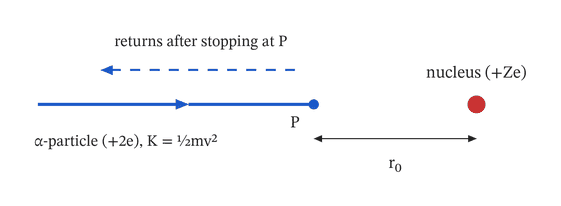
Step 2 — Write the condition. We equate the kinetic energy of an -particle (charge ) to its potential energy near a nucleus of charge :
Therefore, the distance of closest approach is the distance from the centre of the nucleus at which the -particle, moving head-on, momentarily stops because all its kinetic energy has become potential energy.
- 211 mark
Question 21
Which atomic part was discovered by Rutherford?
Solve with AIWritten solution
Solution:
Concept: Rutherford explained the large-angle scattering of -particles by a tiny, heavy, positively charged centre in each atom.
Step 1 — Name the part. From the scattering results he concluded (1911) that the positive charge and almost all the mass of an atom are concentrated in a tiny central core, which he named the nucleus.
Step 2 — Add a related fact. Later (1917–1919) Rutherford also identified the proton as a particle present in all nuclei.
Therefore, Rutherford discovered the nucleus of the atom.
- 221 mark
Question 22
What is impact parameter?
Solve with AIWritten solution
Solution:
Concept: An -particle far from the nucleus moves along a straight line. How strongly it is deflected depends on how far this line passes from the nucleus.
Step 1 — State the definition. The impact parameter is the perpendicular distance of the initial velocity vector of the -particle (its line of approach, when it is still far from the nucleus) from the centre of the nucleus.

Step 2 — Link the impact parameter to the deflection. A particle with a small impact parameter passes close to the nucleus, feels a strong repulsion and is turned through a large angle. A particle with a large impact parameter is hardly deflected, and means a head-on approach, which sends the particle straight back.
Therefore, the impact parameter is the perpendicular distance of the initial line of motion of the -particle from the centre of the nucleus.
- 231 mark
Question 23
What is the angle of scattering for impact parameter ?
Solve with AIWritten solution
Solution:
Concept: The impact parameter and the scattering angle of an -particle are related by
Here is the kinetic energy of the -particle and is the charge of the nucleus.
Step 1 — Put a zero impact parameter into the relation. For a head-on approach the left-hand side is zero. Since is finite, the cotangent must be zero:
Step 2 — Find the angle. The cotangent of an angle between 0° and 90° is zero only at 90°, so half the scattering angle is 90°:
Step 3 — Interpret the result. A particle aimed straight at the nucleus is slowed by the repulsion, stops for an instant at the distance of closest approach and is sent straight back along its own path.
Therefore, when the impact parameter is zero, the angle of scattering is 180°; the -particle retraces its path.
- 241 mark
Question 24
Write the conclusion of Rutherford's -particle scattering experiment.
Solve with AIWritten solution
Solution:
Concept: Most -particles passed straight through the foil, a few were deflected through large angles, and about one in several thousand came back.
Step 1 — Conclusion about the charge. The whole of the positive charge of the atom is concentrated in a small central core called the nucleus.
Step 2 — Conclusion about the mass. Almost the whole mass of the atom is in this small region.
Step 3 — Conclusion about the space. The space around the nucleus is almost empty; the electrons move in it.
Therefore, (i) the positive charge of an atom is concentrated in a tiny nucleus, (ii) nearly all the mass is in the nucleus, and (iii) the rest of the atom is almost empty space.
- 251 mark
Question 25
Write the order of magnitude of the radius of nucleus.
Solve with AIWritten solution
Solution:
Concept: Nuclear radii follow with m, where is the mass number.
Step 1 — Find the range of sizes. For hydrogen (), m. For gold ():
Step 2 — Compare with the atom. An atom is about m across, so its diameter is about to times the diameter of its nucleus (roughly 60,000 times for hydrogen and 20,000 times for gold).
Therefore, the radius of a nucleus is of the order of m (a few femtometres).
- 261 mark
Question 26
“Bohr's orbit are called stationary orbits.” Why?
Solve with AIWritten solution
Solution:
Concept: Bohr's second postulate says that the electron can revolve only in certain orbits (those with ), and in these orbits it does not radiate energy even though it is accelerated.
Step 1 — Explain the word "stationary". The orbit is not called stationary because the electron is at rest; it moves fast. It is called stationary because the energy of the electron stays constant while it is in that orbit.
Step 2 — Say when the energy changes. Classical theory says an accelerated charge must radiate, but Bohr postulated that in these allowed orbits it does not. The energy of the electron changes only when it jumps from one allowed orbit to another, and then it emits or absorbs a photon whose energy equals the difference between the two levels.
Therefore, they are called stationary orbits because an electron revolving in them does not radiate energy, even though it is accelerated, so its energy stays constant.
- 271 mark
Question 27
If electrons revolving around a nucleus comes to rest, what will happen?
Solve with AIWritten solution
Solution:
Concept: The electron is attracted by the positive nucleus. Only its revolution, which needs a centripetal force, keeps it from falling in.
Step 1 — Remove the motion. An electron at rest needs no centripetal force, so the electrostatic attraction is no longer balanced by the needs of circular motion.
Step 2 — Follow the result. The attraction pulls it straight towards the nucleus.
Therefore, due to the electrostatic attraction, the electron will fall into the nucleus and the atom will collapse.
- 281 mark
Question 28
Why is electron revolving around the nucleus of an atom?
Solve with AIWritten solution
Solution:
Concept: A body moves in a circle when a force towards the centre, the centripetal force, acts on it.
Step 1 — Identify the force. The electrostatic attraction between the nucleus and the electron acts towards the nucleus.
Step 2 — Explain the motion. When the electron revolves, this attraction is used up in providing the centripetal force , so the electron keeps moving in its orbit instead of falling in.

Therefore, the electron revolves so that the electrostatic attraction of the nucleus provides the centripetal force for its circular motion; this keeps the electron from falling into the nucleus and makes the atom stable.
- 291 mark
Question 29
What is Bohr's quantisation condition?
Solve with AIWritten solution
Solution:
Concept: Bohr's second postulate restricts the orbits in which an electron may revolve.
Step 1 — State the condition. The electron can revolve only in those orbits for which its angular momentum is a whole-number multiple of :
Here is the mass of the electron, its speed, the radius of the orbit, Planck's constant and a positive whole number (1, 2, 3 and so on).
Step 2 — Say what the condition means. Only orbits with angular momentum , , and so on are allowed. So the radii and energies of the electron's orbits can take only certain fixed values; they are quantised.
Therefore, Bohr's quantisation condition is , with a positive whole number.
- 301 mark
Question 30
Can a hydrogen atom absorb a photon having energy more than 13.6 eV?
Solve with AIWritten solution
Solution:
Concept: The ionisation energy of hydrogen in its ground state is 13.6 eV. Above this energy the electron is no longer bound, and a free electron can have any kinetic energy.
Step 1 — Use the photon. A photon of more than 13.6 eV can be absorbed by a hydrogen atom in its ground state: 13.6 eV removes the electron from the atom.
Step 2 — Account for the rest. The extra energy appears as kinetic energy of the freed electron, so there is no need for an exact match with a level.
Therefore, yes; the atom absorbs it and is ionised, and the energy above 13.6 eV becomes kinetic energy of the ejected electron.
- 311 mark
Question 31
In Bohr's atomic model, the radius of the first electron orbit of a hydrogen atom is metre. What is the radius of the second orbit?
Solve with AIWritten solution
Solution:
Concept: In Bohr's model the orbit radii are , so .
Step 1 — Take the ratio. For and :
Step 2 — Put in the given radius. Since is metre, the second radius is metre.
Therefore, the radius of the second orbit is metre.
- 321 mark
Question 32
Name the series of the hydrogen spectrum which lies in the visible region and U.V. region of the electromagnetic spectrum.
Solve with AIWritten solution
Solution:
Concept: When the electron of a hydrogen atom jumps from a level to a lower level , it emits a line whose wave number (the reciprocal of the wavelength) is
Here is the Rydberg constant. The series are named by the lower level:
- lower level 1: Lyman series (ultraviolet);
- lower level 2: Balmer series (its first four lines are visible; the higher ones lie in the near ultraviolet);
- lower levels 3, 4 and 5: Paschen, Brackett and Pfund series (all infrared).
Step 1 — Visible region. The Balmer series () has its first lines at 656, 486, 434 and 410 nm, inside the visible range.
Step 2 — Ultraviolet region. The Lyman series () has wavelengths from about 91 nm to 122 nm, in the ultraviolet.
Therefore, the Balmer series lies in the visible region and the Lyman series in the ultraviolet region.
- 331 mark
Question 33
Name the series of the hydrogen spectrum which has least wavelength.
Solve with AIWritten solution
Solution:
Concept: When the electron of a hydrogen atom jumps from a level to a lower level , it emits a line whose wave number (the reciprocal of the wavelength) is
Here is the Rydberg constant. The series are named by the lower level:
- lower level 1: Lyman series (ultraviolet);
- lower level 2: Balmer series (its first four lines are visible; the higher ones lie in the near ultraviolet);
- lower levels 3, 4 and 5: Paschen, Brackett and Pfund series (all infrared).
Step 1 — Link wavelength to energy. A shorter wavelength means a larger photon energy, .
Step 2 — Find the largest jumps. The largest energy jumps end on the ground state (up to 13.6 eV), which is the Lyman series, with wavelengths from about 91 nm to 122 nm.
Therefore, the Lyman series has the least wavelength.
- 341 mark
Question 34
Write two limitations of Bohr's atomic model.
- 351 mark
Question 35
What was the main conclusion of Rutherford's experiment on the scattering of alpha particles by thin foils?
- 361 mark
Question 36
What is the Bohr's quantisation condition of the angular momentum of an electron in the second orbit?
- 371 mark
Question 37
What is the angular momentum of an electron in the 3rd orbit of an atom?
- 381 mark
Question 38
The total electrical energy of an electron in the first excited state of hydrogen atom is about eV. What is the kinetic energy of the electron in this state?
- 391 mark
Question 39
The total energy of an electron in the first excited state of hydrogen atom is about eV. What is the potential energy of the electron in this state?
- 401 mark
Question 40
Write an empirical relation for Paschen series lines of hydrogen spectrum.
- 411 mark
Question 41
Name the series of hydrogen spectrum which has least wavelength.
- 421 mark
Question 42
Out of three radiations of wavelength 8000 Å, 5000 Å and 1000 Å, which one corresponds to Lyman series of hydrogen spectrum?
- 431 mark
Question 43
Name the spectral series of hydrogen spectrum which lies in the visible region of the e.m. spectrum.
- 442 marks
Question 44
How did Rutherford arrive at the conclusion that the whole positive charge of the nucleus is concentrated at the centre of the atom?
- 452 marks
Question 45
Draw a graph to show the variation of the impact parameter with the scattering angle.
- 462 marks
Question 46
What are the conclusions drawn from the alpha particle scattering experiment?
- 472 marks
Question 47
What are the drawbacks of Rutherford's atom model?
- 482 marks
Question 48
State the postulates of Bohr.
- 492 marks
Question 49
Which electron has high kinetic energy, an electron in the -shell or -shell?
- 502 marks
Question 50
What is Rydberg constant? What is its value?
- 512 marks
Question 51
Give the dimensional formula of the Rydberg constant.
- 522 marks
Question 52
To which region of the electromagnetic spectrum does the Lyman series belong?
- 532 marks
Question 53
Name the series of the hydrogen spectrum which lies in the visible region.
- 542 marks
Question 54
The wavelength of some of the spectral lines obtained in hydrogen spectrum are 1216 Å, 6463 Å and 9546 Å. Which one of these wavelengths belong to Paschen series?
- 552 marks
Question 55
“Bohr's orbits are called stationary orbits.” Why?
- 562 marks
Question 56
Draw bar graphs showing the radius and total energies of the orbits corresponding to and 4 shells.
- 572 marks
Question 57
According to electromagnetic theory, what path should an electron in Rutherford atom model follow? Why?
- 582 marks
Question 58
What is the significance of the impact parameter?
- 592 marks
Question 59
The total energy of an electron in the first excited state of the hydrogen atom is about eV. What is the kinetic energy of the electron in the state?
- 602 marks
Question 60
In a hydrogen atom, if the electron is replaced by a particle which is 200 times heavier but has the same charge, how would its radius change?
- 612 marks
Question 61
In the Rutherford scattering experiment, the distance of closest approach of an -particle is . If -particle is replaced by a proton, how much kinetic energy in comparison to -particle will it require to have the same distance of closest approach?
- 622 marks
Question 62
The energy of the electron in the ground state of hydrogen atom is eV.
(i) What does the negative sign signify?
(ii) How much energy is required to take an electron in this atom from the ground state to the first excited state?
- 632 marks
Question 63
Write down the equation for the total energy of an electron in the th orbit.
- 642 marks
Question 64
State Bohr's postulate for the 'permitted orbits' for the electron in a hydrogen atom. Use this postulate to prove that the circumference of the nth permitted orbit for the electron can 'contain' exactly wavelengths of the de Broglie wavelength associated with the electron in that orbit.
- 653 marks
Question 65
Obtain an expression for the kinetic energy of the electron in the Bohr's model of hydrogen atom (). Start from equating the electrostatic force with the centripetal force required and then use the quantisation condition for angular momentum.
- 663 marks
Question 66
For Bohr's model of the hydrogen atom, the energy of the electron in its ground state is found to be eV.
(i) Draw an energy level diagram for the hydrogen atom and mark the values of energy (in eV) at to .
(ii) Obtain the maximum energy of a photon emitted by the hydrogen atom in eV.
- 673 marks
Question 67
(i) Name a series of hydrogen spectrum which lies in (a) visible region and (b) ultraviolet region.
(ii) Write Bohr's formula to calculate wavelength of visible light emitted by hydrogen and explain the meaning of each and every symbol used.
- 683 marks
Question 68
On the basis of Bohr's theory, derive the expression for the radius of the th orbit of an electron of hydrogen atom.
- 693 marks
Question 69
Draw the energy level diagram of a hydrogen atom showing first four energy levels corresponding to and 4. Show transitions responsible for
(i) absorption spectrum of Lyman series.
(ii) emission spectrum of Balmer series.
- 705 marks
Question 70
(a) State the postulates of the Bohr's theory of the hydrogen atom.
(b) Derive expressions for (i) the radius of the electron orbit, (ii) the velocity of electron and (iii) its total energy in the th state.
- 715 marks
Question 71
(a) State Bohr's postulate of the stationary orbit for the theory of the hydrogen atom. Express this postulate in terms of the de Broglie wavelength of the electron.
(b) According to Bohr's model, the energy of the hydrogen atom in the nth state is expressed as, eV. Calculate the energy in the ground state and the first two excited states. Draw the energy level diagram approximate to scale. On this diagram, represent transitions corresponding to the various spectral lines which are obtained in emission and absorption spectra. Find the wavelength of the spectral line which is present in the emission spectrum but absent in the absorption spectrum. Name the spectral series to which the spectral line belongs.
- 725 marks
Question 72
(a) Describe the alpha particle scattering experiment.
(b) Explain the observations made by Rutherford.
(c) Define impact parameter and obtain an expression for it.
- 735 marks
Question 73
(a) Describe Geiger–Marsden experiment to verify the theory of alpha particle scattering.
(b) What are the conclusions drawn from the alpha particle experiment?
(c) Define distance of closest approach and obtain an expression for it.
- 745 marks
Question 74
(a) Describe Rutherford's atom model.
(b) Draw a graph to show the variation of kinetic energy, potential energy and total energy of the electron in an atom.
(c) Explain the drawbacks of the Rutherford atom model.
- 755 marks
Question 75
(a) Derive an expression for the total energy of an electron in the th state of an atom.
(b) Explain the formation of various series of spectral lines in the hydrogen spectrum.
(c) Draw the energy level diagram. On the diagram show the various transition leading to all the series.
- 763 marks
Question 76
An alpha particle having kinetic energy of 8 MeV is projected towards the nucleus of sodium (). Calculate the distance of closest approach.
- 773 marks
Question 77
An alpha particle having a kinetic energy of 10 MeV is projected towards the nucleus of a certain element. The distance of closest approach is m. What is the atomic number of the element?
- 783 marks
Question 78
An alpha particle of kinetic energy J approaches a gold nucleus having a charge C. Calculate the radius of the nucleus if at a distance of nearest approach, K.E. of the particle is equal to the P.E. Given, charge on alpha particle is C.
- 793 marks
Question 79
Alpha particles of energy 4 MeV are scattered back from a gold foil (). Calculate the maximum volume in which the positive charge of the atom is likely to be concentrated.
- 803 marks
Question 80
If the positive charge of the gold atom is supposed to be spread uniformly over a spherical surface of diameter, show that the alpha particles of energy greater than a certain value will not be reflected back. Calculate the value of .
- 814 marks
Question 81
A beam of proton and alpha particles each of energy 15 MeV is incident on a thin foil of tin (Z = 50). It is observed that the alpha particles are scattered backward but not the protons. Explain this observation and find the maximum and minimum possible values of the nuclear radius. Explain why electrons are not effective in scattering alpha particles and protons.
- 823 marks
Question 82
Find the value of the Rydberg constant. Also find its dimensional formula.
- 833 marks
Question 83
Find the radius and the total energy of the third orbit of hydrogen atom.
- 843 marks
Question 84
What is the binding energy of the electron in the first orbit of hydrogen?
- 853 marks
Question 85
What is the energy difference between the ground state and the first excited state of the hydrogen atom?
- 863 marks
Question 86
The electron in the hydrogen atom makes a transition from a state of energy eV to a state of energy eV. Find the wavelength of the spectral line emitted.
- 873 marks
Question 87
Calculate the excitation energy of the first two lines of the Balmer Series.
- 883 marks
Question 88
The electron in the hydrogen atom jumps from the fourth orbit to second. Find the frequency of the spectral line emitted. Given that the Rydberg constant is .
- 893 marks
Question 89
Calculate the excitation energies of the first two lines of the Balmer series.
- 903 marks
Question 90
Find the second ionisation potential of helium. Given, C, kg, J s, F/m.
- 913 marks
Question 91
Energy in a Bohr orbit is given to be equal to , where J. Calculate the frequency of radiation and also the wave number when the electron jumps from the third orbit to the second (Given, J s).
- 923 marks
Question 92
Calculate the ionisation potential of hydrogen from the following data. (Given, J s, C, kg.)
What Class 12 Physics Ch 26 covers
The sections of the chapter, in the order the book takes them. Every question above comes from one of these.
- 01Thomson's Model and Alpha Particle Scattering
- 02Rutherford's Nuclear Model and Distance of Closest Approach
- 03Bohr's Postulates
- 04Radius and Energy of Orbits in Hydrogen
- 05Line Spectra of Hydrogen
- 06Energy Level Diagram
More ways to study this chapter
The same chapter asked three other ways. Practise it, revise it, and see what the board has set on Ch 26 before.
- Competency-Based Questions (CBQ)Case study questions: a situation, and the part of the chapter that answers it.42questionsOpen
- Previous Year QuestionsQuestions that have actually appeared in board papers, each tagged with its year.23questionsOpen
- Practice QuestionsExtra questions per chapter, for when one attempt at a method is not enough.120questionsOpen
Ch 26 in past ISC papers
The same chapter as the board has actually asked it. These are worded differently from the textbook exercise, which is the point of reading them.
- 11 mark
Board paper question 1
If and represent potential energy and kinetic energy respectively, of an orbital electron, then, according to Bohr's theory:
Solve with AIAnswer
- Correct
(A)
(B)
(C)
(D)
Answer: (A)
Key idea: In Bohr's model the electrostatic attraction of the nucleus provides the centripetal force on the electron. This fixes the kinetic energy in terms of the potential energy.
Step 1 — Write the force balance.
For an electron of mass and speed in an orbit of radius round a proton, the Coulomb attraction equals the centripetal force. Here .
Step 2 — Find the kinetic energy.
Multiplying both sides by gives the kinetic energy .
Step 3 — Write the potential energy.
The potential energy of charges and a distance apart is negative.
Step 4 — Compare the two.
The kinetic energy is half the size of the potential energy and has the opposite sign.
Step 5 — Check the other options.
We test each of the other options in turn:
- (B) If were equal to , the total energy would be zero, but a bound electron has a negative total energy.
- (C) The value equals , which is four times the true kinetic energy .
- (D) The potential energy is negative, so is negative, but kinetic energy can never be negative.
Therefore, according to Bohr's theory E_k = −E_p/2, option (A).
- 21 mark
Board paper question 2
Wavelengths of the first lines of the Lyman series, Paschen series and Balmer series, in hydrogen spectrum are denoted by , , and , respectively. Arrange these wavelengths in increasing order.
Solve with AIWritten solution
Solution:
Key idea: Each line of the hydrogen spectrum obeys , where is the lower level and the upper level. A bigger energy jump means a shorter wavelength.
Step 1 — Identify the first line of each series.
The first line of a series comes from the smallest jump into its lower level. Lyman ends on , Balmer on and Paschen on , so the first lines are , and .
Step 2 — Compare the energy jumps.
Using , the three jumps are (Lyman), (Balmer) and (Paschen). The wavelength is inversely proportional to the photon energy.
Step 3 — Check with the Rydberg formula.
With the three wavelengths come out as about (ultraviolet), (red) and (infrared). The largest jump gives the shortest wavelength.
Therefore, in increasing order the wavelengths are λ_L < λ_B < λ_P.
- 33 marks
Board paper question 3
On the basis of Bohr's theory, derive an expression for the radius of the orbit of an electron of hydrogen atom.
Solve with AIWritten solution
Solution:
Key idea: Bohr's model combines two conditions for the electron's circular orbit: the Coulomb attraction supplies the centripetal force, and the angular momentum is quantised, . Eliminating the speed gives the radius.
Step 1 — Describe Bohr's picture of the hydrogen atom.
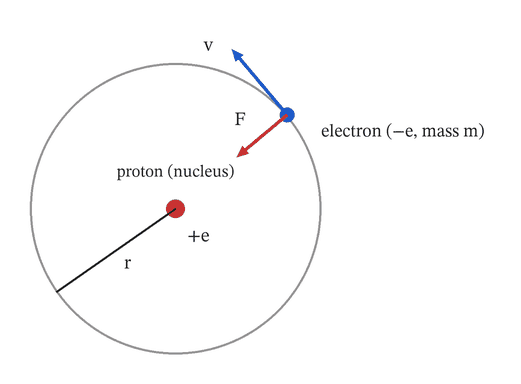
In Bohr's model the electron, of charge and mass , moves with speed in a circular orbit of radius round the nucleus. The nucleus of hydrogen is a single proton of charge . The proton is about 1836 times heavier than the electron, so we treat it as fixed at the centre.
Step 2 — Balance the forces on the electron.
The electrostatic attraction of the proton supplies the centripetal force needed for circular motion. By Coulomb's law this force is , where is the permittivity of free space.
Multiplying both sides by gives the first equation, which we call equation (1).
Step 3 — Apply Bohr's quantum condition.
Bohr's second postulate says that the angular momentum of the electron is a whole-number multiple of , where is Planck's constant and is the principal quantum number. We call this equation (2).
Step 4 — Eliminate the speed.
From equation (2) we write the speed in terms of .
We put this value of into equation (1).
Squaring the bracket and cancelling one gives the next line.
Step 5 — Solve for the radius.
We multiply both sides by , which leaves on the left and on the right. Then we divide both sides by , so only is left on the right.
So the radius of the th orbit is
Step 6 — Interpret the result.
Everything in the formula except is a constant, so the radius grows as the square of the principal quantum number.
For the first orbit () the formula gives the Bohr radius, about . The later orbits have radii , , times this value.
Therefore, the radius of the nth orbit of the hydrogen atom is r_n = ε₀n²h²/(πme²), so r_n is proportional to n².
- 41 mark
Board paper question 4
Total energy of an electron in the ground state of hydrogen atom is . Its total energy, when hydrogen atom is in the first excited state, is:
Solve with AIAnswer
(A)
(B)
- Correct
(C)
(D)
Answer: (C)
Key idea: In Bohr's theory the total energy of the electron in the th orbit of hydrogen is , where is the ground-state energy.
Step 1 — Identify the level.
The ground state is . The first excited state is the next level up, so .
Step 2 — Calculate the energy.
We divide the ground-state energy by .
The energy is still negative because the electron is still bound to the nucleus.
Step 3 — Check the other options.
We test each of the other options in turn:
- (A) A positive energy would mean the electron is no longer bound, and is the size of the ground-state energy, not of the level.
- (B) The size is right but the sign is wrong; every bound level of the atom has a negative energy.
- (D) This comes from multiplying by instead of dividing by it.
Therefore, the total energy in the first excited state is −3.4 eV, option (C).
- 51 mark
Board paper question 5
Calculate angular momentum of an electron in the third Bohr orbit of hydrogen atom.
Solve with AIWritten solution
Solution:
Key idea: Bohr's quantum condition says that the angular momentum of an electron in the th orbit is , where is Planck's constant.
Step 1 — Identify the orbit.
The third Bohr orbit has principal quantum number .
Step 2 — Substitute into the formula.
We put in the formula and use Planck's constant .
With the more precise value the result is .
Therefore, the angular momentum of the electron in the third orbit is 3h/2π ≈ 3.15 × 10⁻³⁴ J s.
- 63 marks
Board paper question 6
(i) How are various lines of Lyman series formed? Explain on the basis of Bohr's theory.
(ii) Calculate the shortest wavelength of electromagnetic radiation present in Balmer series of hydrogen spectrum.
Solve with AIWritten solution
Solution:
Key idea: In Bohr's theory an electron that jumps from a higher energy level to a lower level gives out one photon of energy . Each series of lines in the hydrogen spectrum ends on one particular lower level.
Step 1 — Part (i): state the levels involved.
An electron can stay only in certain stationary orbits, with energies . When hydrogen atoms are excited (for example in a discharge tube), their electrons are raised to higher levels and then fall back.
Step 2 — Part (i): explain how the Lyman lines form.
The Lyman series is formed when an excited electron falls from any higher level directly to the ground level . Each such jump releases one photon whose wavelength obeys the Rydberg formula.
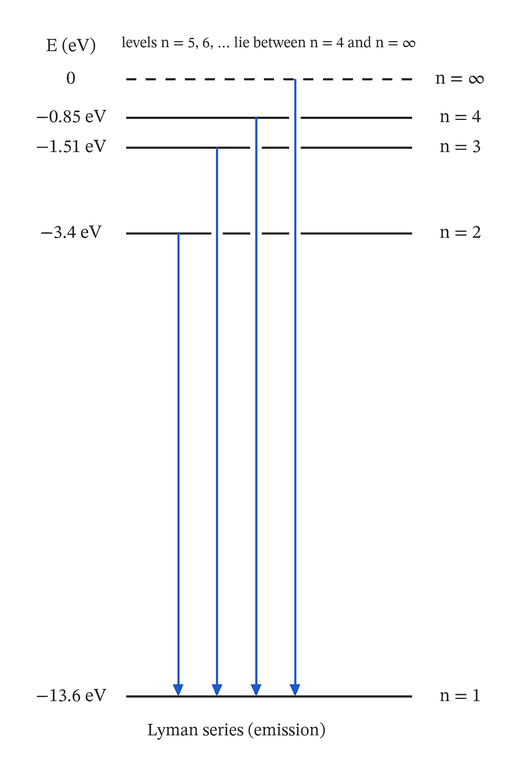
The jump releases and gives the longest Lyman line (about ). The jump from releases and gives the shortest line, the series limit (about ). All these photons have large energies, so the Lyman series lies in the ultraviolet region.
Step 3 — Part (ii): find the shortest Balmer wavelength.
The Balmer series contains the lines emitted when the electron falls to the level from a higher level, whose number can be 3, 4, 5 and so on. The wavelength of each line is given by the Rydberg formula, where is Rydberg's constant.
The shortest wavelength means the largest photon energy, which is the jump from the highest level, , down to . This line is called the series limit.
The term is zero, so only is left in the bracket.
We use Rydberg's constant .
To three significant figures this is (about ).
Therefore, (i) the Lyman lines are emitted when electrons fall from the levels n = 2, 3, 4, … to n = 1; (ii) the shortest wavelength in the Balmer series is 4/R ≈ 3.65 × 10⁻⁷ m.
All 23 board paper questions for this chapter, solved the same way.
Class 12 Physics Ch 26 questions students ask
How many questions are there in Class 12 Physics Ch 26?
92 questions. Every one is solved step by step on this page.
Are these Class 12 Physics solutions free?
Yes. Every question and its full working is free to read, with no account needed.
Can I download the Class 12 Physics Ch 26 solutions as a PDF?
There is no PDF to download. Every solution is on this page instead, which means it is searchable, always the current syllabus, and readable on a phone. Use your browser's print option if you want it on paper.