Solution:
Concept: A moving electron has a de Broglie wavelength λ=mvh, where mv is its momentum.
Step 1 — State the postulate. The electron can revolve only in those orbits in which its angular momentum is a whole-number multiple of 2πh:
mvr=2πnh
Here n=1,2,3,…
Step 2 — Rearrange for the circumference. Multiplying both sides by mv2π gives:
2πr=mvnh
Step 3 — Bring in the de Broglie wavelength. Since mvh=λ:
2πr=nλ
Step 4 — Interpret. The circumference of the nth orbit equals exactly n de Broglie wavelengths, so the electron wave closes on itself and forms a standing wave round the orbit. For n=4 it looks like this:
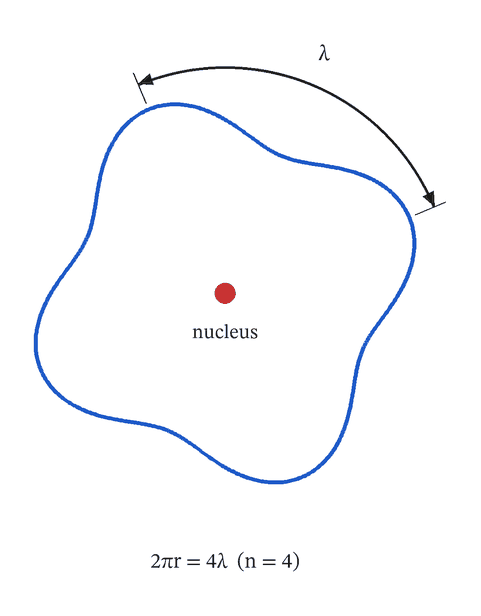
Therefore, Bohr's postulate, mvr=2πnh, leads to 2πr=nλ: the circumference of the nth permitted orbit contains exactly n de Broglie wavelengths of the electron.
