Solution:
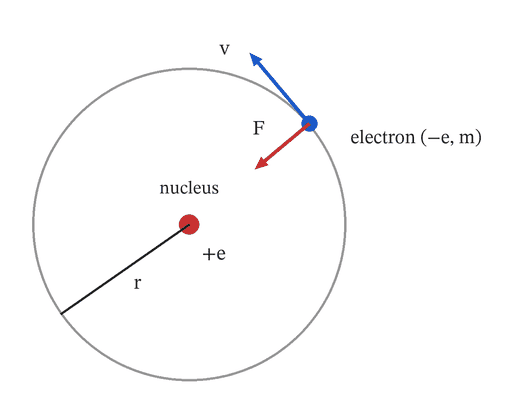
Concept: In Bohr's model the electron moves in a circle round the nucleus. The electrostatic attraction supplies the centripetal force, and the angular momentum can only be a whole-number multiple of 2πh:
mvr=2πnh
Step 1 — Write the force condition. The electron (mass m, charge −e) moves with speed v in a circle of radius r round the nucleus (charge +e, since Z=1). The electrostatic attraction provides the centripetal force:
rmv2=4πε01r2e2
Multiplying both sides by r gives:
mv2=4πε0re2(1)
Step 2 — Write the quantisation condition. By Bohr's postulate the angular momentum is a multiple of 2πh:
mvr=2πnh
Dividing by mr gives the speed:
v=2πmrnh(2)
Step 3 — Eliminate v to find the radius. We put (2) into (1):
m×4π2m2r2n2h2=4πε0re2
We multiply both sides by 4π2mr2ε0. This leaves ε0n2h2 on the left and πme2r on the right:
ε0n2h2=πme2r
We divide both sides by πme2, so that r stands alone:
rn=πme2ε0n2h2
Step 4 — Write the kinetic energy. From (1), the kinetic energy is:
K=21mv2
K=8πε0rne2
Step 5 — Put in the radius. We substitute rn=πme2ε0n2h2:
K=8πε0e2×ε0n2h2πme2
K=8ε02n2h2me4
Step 6 — Check with numbers. For n=1, with m=9.1×10⁻³¹ kg, e=1.6×10⁻¹⁹ C, ε0=8.85×10⁻¹² and h=6.63×10⁻³⁴ in SI units, this gives about 2.17×10⁻¹⁸ J, or about 13.5 eV (13.6 eV with more precise values of the constants).
Therefore, the kinetic energy of the electron in the nth orbit of hydrogen is K=8ε02n2h2me4 (about n213.6 eV).
