Solution:
Concept: In Bohr's model the energy of level n is En=n2E1, with E1=−13.6 eV, so
En=−n213.6 eV
Step 1 — Part (i): work out the energies. We put n=2,3,4,5,6 and ∞ into the formula:
- E2=−3.4 eV;
- E3≈−1.51 eV;
- E4=−0.85 eV;
- E5≈−0.54 eV;
- E6≈−0.38 eV;
- E∞=0.
Step 2 — Part (i): draw the diagram. The levels are drawn as horizontal lines at heights proportional to their energies (to scale). They crowd together just below zero as n grows:
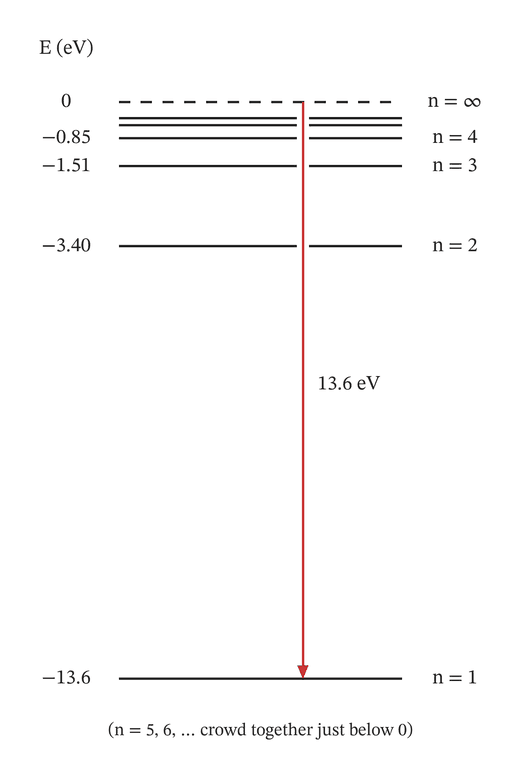
Step 3 — Part (ii): find the largest jump. The photon with the most energy is emitted when the electron falls from the highest level (where E=0) to the lowest level, n=1:
hνmax=E∞−E1
hνmax=0−(−13.6) eV
hνmax=13.6 eV
This is the series limit of the Lyman series (wavelength about 91 nm).
Therefore, (i) the energies are −3.4, −1.51, −0.85, −0.54, −0.38 eV, … and 0 at n=∞, as shown in the diagram; (ii) the maximum energy of an emitted photon is 13.6 eV.
