
Question 442 marksMedium
How did Rutherford arrive at the conclusion that the whole positive charge of the nucleus is concentrated at the centre of the atom?
Confirming your payment
Sign up now and get 250 free tokens.
Atoms - Energy Levels · Question 44 of 92
How did Rutherford arrive at the conclusion that the whole positive charge of the nucleus is concentrated at the centre of the atom?
Solution:
Concept: The force on an -particle from a positive charge is . A large deflection needs a very large force, so the particle must come very close to a large charge.
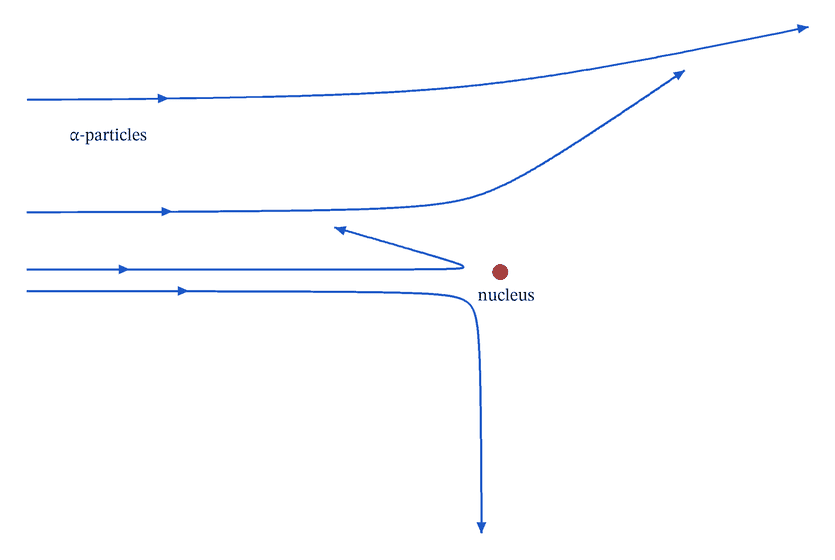
Step 1 — Recall the observations. In the experiment of Geiger and Marsden most -particles went through a thin gold foil almost undeflected, but a small fraction (about one in several thousand) were turned through more than 90°, and a few came straight back.
Step 2 — Test Thomson's picture. If the positive charge were spread through the whole atom (radius about m), the force on an -particle anywhere inside or outside the atom would be weak, and it could turn the fast, heavy particle through only a tiny angle. Such a model cannot send any particle back.
Step 3 — Draw Rutherford's conclusion. To turn an -particle back, the particle must come very close to a large positive charge, where the force is enormous. Rutherford concluded that the whole positive charge, with nearly all the mass, is packed into a tiny central region (the nucleus), about to m across, while the rest of the atom is nearly empty.
Step 4 — Confirm with numbers. His formula for a point-like nucleus correctly predicted how the number of scattered particles changes with angle, foil thickness and kinetic energy, which the experiments confirmed.
Therefore, Rutherford concluded that the positive charge is concentrated at the centre because a few -particles were scattered through large angles (some even backwards); only a tiny, heavy, concentrated positive charge can exert so strong a repulsion, while the undeflected majority show that most of the atom is empty.