
Opening your dashboard
Class 12 Physics Chapter 26 Atoms - Energy Levels: Practice Questions
120 questions on Chapter 26, each worked through on its own page with the AI tutor. Class 12 Physics, ICSE 2026-27.
120 questions
1–4 marks · Mixed difficulty
- 11 mark
Question 1
In Thomson's model, a hydrogen atom is a sphere of radius with a positive charge spread uniformly through its volume, and one electron inside it. When the electron is at a distance from the centre (), the electric force on it is
- 23 marks
Question 2
(Hypothetical data.) In Thomson's model, take a hydrogen atom to be a sphere of radius with a charge spread uniformly through its volume. An electron displaced a distance from the centre then feels a force directed towards the centre. Take , , electron mass and .
(i) Show that the displaced electron moves with simple harmonic motion, and find its frequency.
(ii) Thomson expected the atom to give out light of this frequency. Find the wavelength of this light and the region of the spectrum it lies in.
(iii) State one way in which this prediction disagrees with the observed spectrum of hydrogen.
- 31 mark
Question 3
α-particles of the same kinetic energy fall in turn on two foils of equal thickness, one of gold () and one of silver (). The two metals have almost the same number of atoms per unit volume (about ). The same number of α-particles strike each foil per second, and the detector is kept at the same scattering angle. The ratio of the number of α-particles counted per second with the gold foil to that with the silver foil is about
- 41 mark
Question 4
In an α-particle scattering experiment, the foil, the detector angle and the number of α-particles striking the foil per second are kept the same, but the α-particles are given twice the kinetic energy. The number of α-particles counted per second at that angle becomes
- 53 marks
Question 5
(Hypothetical data.) A gold foil is thick. Gold atoms are about apart, and a gold nucleus has a radius of about (). Treat each layer of atoms as a flat square grid in which every atom has a square of side to itself, with its nucleus at the centre.
(i) About how many layers of atoms does the foil contain?
(ii) In one layer, what fraction of the area is covered by nuclei, seen face on?
(iii) Estimate the fraction of the foil's area covered by nuclei, and explain how this supports Rutherford's nuclear model of the atom.
- 63 marks
Question 6
α-particles of kinetic energy , from a polonium-214 source, are fired head-on at (a) an aluminium nucleus (, mass number ) and (b) a gold nucleus (, ). The radius of a nucleus of mass number is about (), and the α-particle itself has a radius of about . Take , and .
(i) Assuming that only the electric repulsion acts, and that each nucleus stays at rest, find the distance of closest approach for each target.
(ii) For each target, find the distance between centres at which the α-particle and the nucleus would just touch. Hence say for which target Rutherford's scattering theory (pure electric repulsion) can be trusted at this energy.
- 71 mark
Question 7
An α-particle moves head-on towards a heavy nucleus, which stays at rest, and is turned back. At the point of closest approach,
- 83 marks
Question 8
An α-particle of kinetic energy , emitted by radium-226, moves head-on towards a gold nucleus (), which may be taken to stay at rest. Take , , , the mass of the α-particle as and .
(i) Find the distance of closest approach.
(ii) Find the electric force on the α-particle at that point, and show that it equals the initial kinetic energy divided by the distance of closest approach.
(iii) Find the acceleration of the α-particle there, and how many times it is.
- 91 mark
Question 9
The distance of closest approach of an α-particle in a head-on collision is used to estimate the size of a nucleus. Why does give only an upper limit to the nuclear radius?
- 103 marks
Question 10
In Rutherford's model, the electron of a hydrogen atom moves in a circle round the proton, the electric attraction providing the centripetal force. Take , and electron mass .
(i) Find the speed of the electron, and the number of revolutions it makes per second, when the radius of its circle is .
(ii) Classical electromagnetic theory says that the revolving electron gives out light whose frequency equals its number of revolutions per second, so that it loses energy and spirals inwards. Show that this frequency is proportional to , and find it when the radius has shrunk to .
(iii) Use your answers to explain why this model predicts a continuous spectrum, and not a line spectrum.
- 111 mark
Question 11
A student argues: "An electron in a Bohr stationary orbit does not radiate because it moves at constant speed, so it has no acceleration." Which statement correctly judges this argument?
- 121 mark
Question 12
In Bohr's model of the hydrogen atom, the electron jumps from the orbit to the orbit . Take . By how much does the magnitude of the electron's orbital angular momentum decrease?
- 133 marks
Question 13
The radius of the orbit of a hydrogen atom is . Take , electron mass , and .
(i) Use Bohr's quantisation condition to find the speed of the electron in this orbit.
(ii) Find the speed again, this time from the condition that the electric attraction of the proton provides the centripetal force.
(iii) What do the two results show about this radius?
- 143 marks
Question 14
In Bohr's model of the hydrogen atom, the electron in orbit has speed and radius , where and . Its energy is . Take and .
(i) Find the number of revolutions per second made by the electron in the orbit and in the orbit.
(ii) Find the frequency of the photon given out when the electron jumps from to .
(iii) Classical theory says that an atom gives out light whose frequency equals the electron's number of revolutions per second. Does Bohr's frequency condition agree with this for this jump? Comment.
- 151 mark
Question 15
In Bohr's model of the hydrogen atom, and are the speed and the radius of the electron in orbit . Which of the following has the same value in every orbit?
- 162 marks
Question 16
A student claims that the electron of a hydrogen atom could move steadily round the proton in a circular orbit of radius . In Bohr's model, the permitted radii are , with . Show that this orbit is not permitted, and give the radii of the permitted orbits just inside and just outside it.
- 171 mark
Question 17
The kinetic energy of the electron in a certain orbit of a hydrogen atom is . Taking the ground-state energy as and the ground-state radius as , the radius of this orbit is
- 183 marks
Question 18
The electron of a hydrogen atom is in the orbit, moving anticlockwise as seen from above, as shown in the figure.
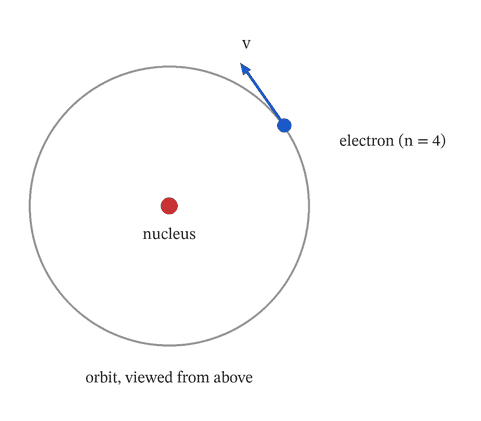
In Bohr's model, the speed in orbit is and the radius is , with and . Take and .
(i) Find the number of revolutions the electron makes per second, and the electric current that its motion is equivalent to.
(ii) Find the magnetic field this current produces at the nucleus, and state its direction.
- 193 marks
Question 19
Radio astronomers detect hydrogen atoms in very high orbits, such as , in thin gas clouds in space. Take the ground-state radius of hydrogen as and the ground-state energy as .
(i) Find the radius of the orbit, and compare it with the ground-state radius.
(ii) Find the energy needed to remove the electron from this orbit.
(iii) In a gas at room temperature, molecules collide with typical energies of about . Explain why such atoms can survive in thin clouds in space but not in a gas at room temperature and ordinary pressure.
- 201 mark
Question 20
Taking the radius of the first Bohr orbit of hydrogen as , the distance between the and orbits (that is, ) is
- 212 marks
Question 21
In Bohr's model of the hydrogen atom, the electron in orbit has speed and radius , where and .
(i) Find the centripetal acceleration of the electron in the orbit.
(ii) Show that the centripetal acceleration is proportional to , and find it in the orbit.
- 223 marks
Question 22
In the ground state of a hydrogen-like ion (a nucleus of charge with a single electron), the speed of the electron is . In Bohr's model, , and , where and are the values for hydrogen in its ground state.
(i) Find and name the ion.
(ii) Find the radius of the electron's orbit.
(iii) Find the energy needed to remove the electron from the ion.
- 232 marks
Question 23
For the hydrogen atom, Bohr's model gives the energy and the radius in orbit .
(i) Show that the product has the same value for every orbit, and find this value in eV Å.
(ii) Hence find the total energy of the electron when the radius of its orbit is .
- 241 mark
Question 24
In the hydrogen spectrum, the Lyman α line (the jump ) has a wavelength of , and the Hα line (the jump ) has a wavelength of . Without using the Rydberg constant, the wavelength of the Lyman β line (the jump ) is
- 253 marks
Question 25
A student photographs the visible spectrum of a hydrogen discharge tube and measures a blue-violet line at . The student knows that it belongs to the Balmer series. Take , and .
(a) Find the principal quantum number of the level from which the electron jumps.
(b) Find the energy of one photon of this line in eV, and check it against the energies of the two levels involved.
- 261 mark
Question 26
Take the visible range as to . Using , how many lines of the Balmer series of hydrogen lie in the visible range?
- 274 marks
Question 27
Using :
(a) Find the range of wavelengths, from the first line (longest wavelength) to the series limit (shortest wavelength), of the Lyman, Balmer, Paschen and Brackett series of hydrogen. (Their lower levels are and .)
(b) Hence show that the Lyman and Balmer series do not overlap, but the Paschen and Brackett series do, and state the range of the overlap.
- 282 marks
Question 28
(Idealised.) White light is passed through a tube of cold hydrogen gas at room temperature (about ), treated as a gas of free hydrogen atoms, and the light that comes through is examined with a spectrometer. Dark absorption lines are seen in the ultraviolet, but there is no dark line at . In the spectrum of sunlight, a dark line at is clearly seen; the surface of the Sun is at about . The average kinetic energy of a gas atom, , is about at and about at . Take .
Explain both observations.
- 291 mark
Question 29
The Balmer series of hydrogen has its series limit at , where the photon energy is . Which statement correctly describes how the lines of this series are arranged as the starting level increases? Take .
- 303 marks
Question 30
In the spectrum of a hydrogen lamp, the Balmer lines crowd towards a series limit at , and the Paschen lines crowd towards a series limit at . Take .
(a) Find the energy of a photon at each series limit.
(b) What does each of these energies represent for a hydrogen atom?
(c) Using only these two energies, find the wavelength of the line given out in the jump .
- 311 mark
Question 31
An infrared detector pointed at a hydrogen lamp records a line at . Using , the transition that gives this line is
- 323 marks
Question 32
A hydrogen lamp is viewed through a filter that lets through only light of wavelengths between and . A light sensor behind the filter receives a power of . (Hypothetical data.) Take , and .
(a) Which hydrogen line passes through the filter? Name the transition.
(b) How many photons reach the sensor each second?
- 331 mark
Question 33
A student draws the energy levels of hydrogen to scale, using . The student draws the levels and exactly apart, as in the figure. (Hypothetical data.)
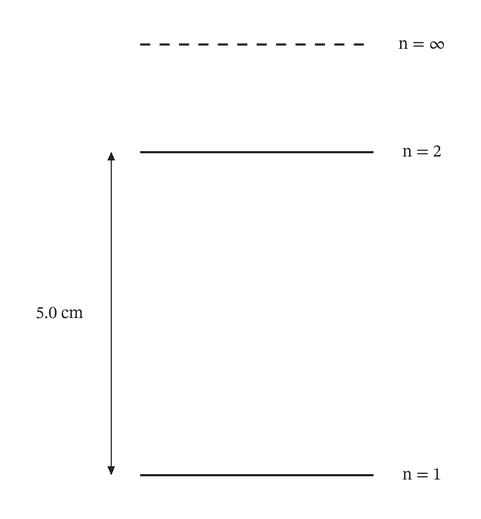
How far below the (zero) line must the student draw the level ?
- 341 mark
Question 34
A beam contains photons of four energies: , , and . (Hypothetical data.) It passes through a gas of free hydrogen atoms (an idealised picture: real hydrogen gas is made of molecules), all in the ground state, with . Which photons pass through the gas without being absorbed?
- 353 marks
Question 35
A single hydrogen atom is in the level . It returns to the ground state by giving out photons. Take .
(a) What is the largest number of photons it can give out on the way down, and through which levels must it pass?
(b) What is the smallest number of photons it can give out?
(c) Find the total energy given out as photons in case (a) and in case (b), and comment on the result.
- 363 marks
Question 36
Physicists first excite hydrogen atoms to very high levels and then study them by shining millimetre-wave radiation on them. In one such experiment an atom in the level absorbs a photon and moves up to the level . Take , and .
(a) Find the energy of the photon absorbed.
(b) Find its wavelength and frequency, and name the region of the electromagnetic spectrum.
(c) Compare this energy with the gap between the two lowest levels, and explain how this difference shows up on an energy level diagram.
- 373 marks
Question 37
A hydrogen atom is in the level . Take and .
(a) A photon of wavelength falls on the atom and is absorbed. Show that the atom is ionised, and find the kinetic energy of the freed electron.
(b) A photon of wavelength falls on another hydrogen atom in . Show that it can neither ionise the atom nor raise it to a higher level.
- 381 mark
Question 38
Each of the drawings A, B, C and D shows five energy levels of hydrogen: from bottom to top, , , , and (dashed). The bottom and top lines are the same distance apart in every drawing.
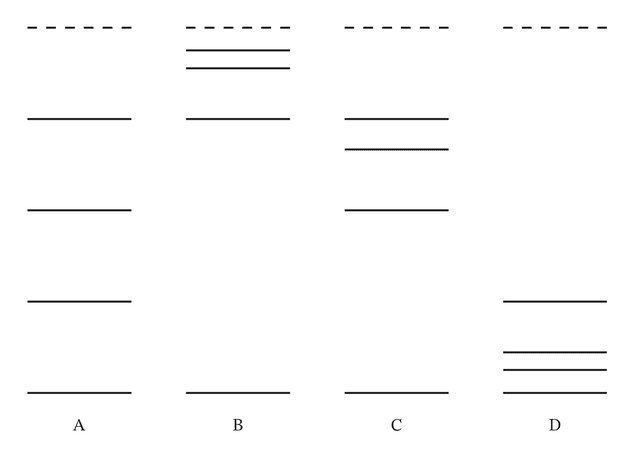
Which drawing is to scale for ?
- 391 mark
Question 39
In the usual energy level diagram of hydrogen, the zero of energy is taken at , so that . Suppose the zero is instead taken at the ground state , so that every level is raised by the same amount. What is then the energy of the level , and what happens to the wavelength of the Hα line ( to , )?
- 401 mark
Question 40
Seen through an ordinary school spectrometer, the Hα line of hydrogen () looks like a single red line. A spectrometer of very high resolving power shows that it is really made up of several components lying very close together. Bohr's model cannot account for these components because
- 413 marks
Question 41
In the light from a hydrogen discharge tube, a light meter finds that the power carried by the Hα line ( to ) is times the power carried by the Hβ line ( to ). (Hypothetical data.) Take .
(a) Find the energy of an Hα photon and of an Hβ photon.
(b) Find the ratio of the number of Hα photons to the number of Hβ photons given out per second.
(c) Can Bohr's model predict this ratio? Explain.
- 423 marks
Question 42
Two hydrogen atoms, each in its ground state, join to form a hydrogen molecule H₂. Measurements show that about must be supplied to split one H₂ molecule back into two separate hydrogen atoms. Take for one hydrogen atom, and .
(a) Using Bohr's model, find the total energy of the two separate atoms.
(b) Find the total energy of the H₂ molecule, and the energy needed to split one mole of H₂ molecules, in kJ mol⁻¹.
(c) Explain why Bohr's model cannot account for the formation of the H₂ molecule.
- 431 mark
Question 43
In Bohr's model the electron of a hydrogen atom moves only in circular orbits. Which statement correctly explains why this is regarded as a limitation of the model?
- 442 marks
Question 44
Bohr's model gives the electron in the ground state of hydrogen an angular momentum of . Quantum mechanics, confirmed by experiment, finds instead that the electron in the ground state of hydrogen has zero orbital angular momentum. Take .
(a) Find the ground-state angular momentum given by Bohr's model.
(b) Explain why this disagreement points to a limitation of Bohr's picture of the electron moving on a definite circular orbit.
- 453 marks
Question 45
The simple Bohr model treats the nucleus as fixed. If the motion of the nucleus is allowed for, the Rydberg constant for an atom whose nucleus has mass becomes , where is the electron mass and is the value for a fixed nucleus. The nucleus of ordinary hydrogen has a mass of , and the nucleus of deuterium (heavy hydrogen) has a mass of . The Hα line of ordinary hydrogen is at .
(a) What does the simple model (fixed nucleus) predict for the wavelength of the Hα line of deuterium?
(b) Allowing for the motion of the nucleus, find the wavelength of the Hα line of deuterium and its separation from the hydrogen line.
(c) In 1932 faint lines found just beside the Balmer lines of hydrogen, at the positions expected for a heavier isotope, led to the discovery of deuterium. What does this show about the simple model?
- 463 marks
Question 46
In Bohr's model the speed of the electron in the th orbit of a one-electron ion of atomic number is , and its kinetic energy is . Bohr's model uses ordinary (non-relativistic) mechanics, which is reliable only for speeds much less than . The rest energy of an electron is .
(a) Find the speed of the electron in the ground state of hydrogen as a fraction of .
(b) Uranium ions with only one electron left () are studied in accelerator laboratories. Find the ground-state speed and kinetic energy that Bohr's model gives for such an ion, and compare the kinetic energy with the rest energy of the electron.
(c) What would the model predict for the ground-state speed in a one-electron ion with ? What do (b) and (c) show about Bohr's model?
- 472 marks
Question 47
In Rutherford's scattering experiment, most of the -particles go unscattered, while some of them are scattered through large angles. What can be concluded from this?
- 481 mark
Question 48
Is the probability of backward scattering (i.e., scattering of -particles at angles greater than 90°) predicted by Thomson's model much less, about the same, or much greater than that predicted by Rutherford's model?
- 492 marks
Question 49
Keeping other factors fixed, it is found experimentally that for a small thickness t, the number of -particles scattered at moderate angles is proportional to t. What clue does this linear dependence on t provide?
- 501 mark
Question 50
What is frequency condition?
- 511 mark
Question 51
In atomic spectrum, only certain discrete lines are found why?
- 522 marks
Question 52
'The total energy of the hydrogen atom orbits are negative.' Why?
- 531 mark
Question 53
Can we see all the spectral lines of various series of hydrogen atom?
- 543 marks
Question 54
An alpha particle of initial kinetic energy 5 MeV approaches a gold nucleus with an impact parameter m. Through what angle will it be scattered ()?
- 553 marks
Question 55
The number of particles scattered at is 100 per minute in an -particle scattering experiment, using gold foil. Calculate the number of particles per minute scattered at angle.
- 563 marks
Question 56
Determine the impact parameter of a 5.286 MeV alpha-particle scattered through when it approaches a gold nucleus ().
- 573 marks
Question 57
The wavelength of the sodium line is 5890 Å. Find the difference in energy levels involved in the emission of this line.
- 583 marks
Question 58
What is the radius of the second orbit of hydrogen atom?
- 593 marks
Question 59
Calculate the value of the Rydberg constant, assuming that the wavelength of line is 6563 Å.
- 603 marks
Question 60
The wavelength of line of Balmer series is 4861 Å. Calculate the wavelength of line of the series.
- 611 mark
Question 61
Mention any one postulate of Bohr's theory of hydrogen atom.
- 622 marks
Question 62
The radius of the first orbit of the electron of a hydrogen atom is m. What is the radius of its second orbit?
- 632 marks
Question 63
The energy of an electron in the first orbit of an atom is eV. What will be energy in third orbit?
- 641 mark
Question 64
What is meant by a line spectrum?
- 652 marks
Question 65
If a hydrogen atom goes from 3rd excited state to 2nd excited state. What kind of radiation (visible, ultraviolet, infrared etc.) is emitted?
- 661 mark
Question 66
What will be the angular momentum of an electron in the second orbit of Bohr's model of hydrogen atom?
- 671 mark
Question 67
What conclusion was drawn by Rutherford based on Geiger–Marsden's experiment on scattering of alpha particles?
- 682 marks
Question 68
State the postulate of Bohr's theory regarding (i) angular momentum of an electron and (ii) emission of a photon.
- 692 marks
Question 69
Total energy of an electron orbiting around the nucleus of an atom is always negative. What is the significance of this?
- 702 marks
Question 70
Calculate the angular momentum of an electron in this third Bohr orbit of hydrogen atom.
- 711 mark
Question 71
Name the series of hydrogen spectrum lying in the ultraviolet region.
- 721 mark
Question 72
What conclusion is drawn from Rutherford's scattering experiment of -particles?
- 731 mark
Question 73
Rutherford's α-particle experiment showed that the atoms have
- 741 mark
Question 74
The distance of the closest approach of an alpha particle fired at a nucleus with kinetic energy is . The distance of the closest approach when the α-particle is fired at the same nucleus with kinetic energy will be
- 751 mark
Question 75
An α-particle of 5 MeV energy strikes with a nucleus of uranium at stationary at a scattering angle of 180°. The nearest distance up to which α-particle reaches the nucleus will be of the order of
- 761 mark
Question 76
The frequency of 1st line of Balmer series in H atom is . The frequency of the line emitted by singly ionised He atom is
- 771 mark
Question 77
Energy of an electron in an excited hydrogen atom is eV. Its angular momentum will be ( J s)
- 781 mark
Question 78
In Bohr's model of hydrogen atom, which of the following pairs of quantities are quantised?
- 791 mark
Question 79
Whenever a hydrogen atom emits a photon in the Balmer series,
- 801 mark
Question 80
In which of the following systems will the radius of the first orbit () be minimum?
- 811 mark
Question 81
The shortest wavelength in the Lyman series of hydrogen spectrum is 912 Å corresponding to a photon of energy 13.6 eV. The shortest wavelength of the Balmer series is about
- 821 mark
Question 82
Given the value of Rydberg constant is m, the wave number of the last line of Balmer series in the hydrogen spectrum will be
- 831 mark
Question 83
Radius of the first orbit of the electron in a hydrogen atom is 0.53 Å. So, the radius of the third orbit will be
- 841 mark
Question 84
The electron in a hydrogen atom makes a transition from an excited state to the ground state. Which of the following statement is true?
- 851 mark
Question 85
The radius of hydrogen atom in its ground state is m. After collision with an electron it is found to have a radius of m. What is the principal quantum number of the final state of the atom?
- 861 mark
Question 86
The ionisation energy of hydrogen atom is 13.6 eV. Following Bohr's theory, the energy corresponding to a transition between the 3rd and the 4th orbit is
- 871 mark
Question 87
To explain his theory, Bohr used
(A) Conservation of linear momentum
(B) Conservation of angular momentum
(C) Conservation of quantum frequency
(D) Conservation of energy
- 881 mark
Question 88
The magnetic moment () of a revolving electron around the nucleus varies with principal quantum number as
- 891 mark
Question 89
Bohr's atom model assumes
- 901 mark
Question 90
The energy of a hydrogen atom in its ground state is eV. The energy of the level corresponding to the quantum number (first excited state) in the hydrogen atom is
- 911 mark
Question 91
As the electron in Bohr orbit of Hydrogen atom passes from state to , the kinetic energy and potential energy change as
- 921 mark
Question 92
In Rutherford scattering experiment, what will be the correct angle for α-scattering for an impact parameter ?
- 931 mark
Question 93
The diagram shows the energy levels for an electron in a certain atom. Which transition represents the emission of a photon with the most energy?
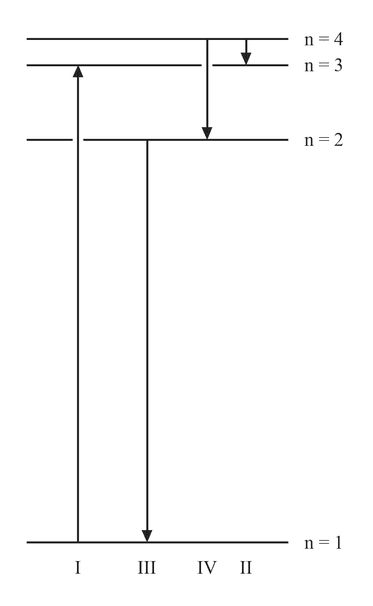
- 941 mark
Question 94
Energy required for the electron excitation in Li from the first to the third Bohr orbit is
- 951 mark
Question 95
The ground state energy of hydrogen atom is eV. What is the potential energy of the electron in this state?
- 961 mark
Question 96
The energy of the hydrogen atom in the ground state is eV. The energy of He ion in the first excited state will be
- 971 mark
Question 97
Electron in hydrogen atom first jumps from third excited state to second excited state and then from second excited state to the first excited state. The ratio of the wavelength emitted in the two cases is
- 981 mark
Question 98
Hydrogen atom excited from ground state to another state with principal quantum number equal to 4. Then the number of spectral lines in the emission spectra will be
- 991 mark
Question 99
As an electron makes a transition from an excited state to the ground state of a hydrogen like atom/ion,
- 1001 mark
Question 100
An electron of an atom transits from to . In which of the following maximum frequency of photon will be emitted?
- 1011 mark
Question 101
The shortest wavelength in hydrogen spectrum of Lyman series when cm is
- 1021 mark
Question 102
The wavelength of the first line of Lyman series for hydrogen atom is equal to that of the second line of Balmer series for a hydrogen like ion. The atomic number of hydrogen like ion is
- 1031 mark
Question 103
An electron jumps from the 4th orbit to the 2nd orbit of hydrogen atom. Given the Rydberg constant cm. The frequency in Hz of the emitted radiation will be
- 1041 mark
Question 104
Which of the following postulates of the Bohr model led to the quantisation of energy of the hydrogen atom?
- 1051 mark
Question 105
Which one of the series of hydrogen spectrum is in the visible region?
- 1061 mark
Question 106
First Bohr radius of an atom with is . Radius of its third orbit is
- 1071 mark
Question 107
In the Bohr's hydrogen atom model, the radius of the stationary orbit is directly proportional to ( is principal quantum number)
- 1081 mark
Question 108
In the th orbit, the energy of an electron eV for hydrogen atoms. The energy required to take the electron from first orbit to the second orbit will be
- 1091 mark
Question 109
In the spectrum of hydrogen, the ratio of the longest wavelength in the Lyman series to the longest wavelength in the Balmer series is
- 1101 mark
Question 110
If an electron in hydrogen atom jumps from an orbit of level to an orbit of level , the emitted radiation has a frequency ( – Rydberg constant, – velocity of light)
- 1111 mark
Question 111
The number of spectral line in hydrogen atom is
- 1121 mark
Question 112
The transition from the state to in a hydrogen like atom results in ultraviolet radiation. Infrared radiation will be obtained in the transition from
- 1131 mark
Question 113
The distance of closest approach of an α-particle fired towards a nucleus with momentum is . If the momentum of α-particle is , the corresponding distance of closest approach is
- 1141 mark
Question 114
Taking the wavelength of first Balmer line in hydrogen spectrum ( to ) as 660 nm, the wavelength of the 2nd Balmer line ( to ) will be
- 1151 mark
Question 115
The time period of revolution of electron in its ground state orbit in hydrogen atom is s. The frequency of revolution of the electron in its first excited state (m s) is
- 1161 mark
Question 116
For which one of the following, Bohr model is not valid?
- 1171 mark
Question 117
The wavelength of the photon emitted by a hydrogen atom when an electron makes a transition from to state is
- 1181 mark
Question 118
If and are the wavelengths of the 3rd member of Lyman and first member of the Paschen series respectively, then the value of is
- 1191 mark
Question 119
Which level of the single ionised carbon has the same energy as the ground state energy of the hydrogen atom?
- 1201 mark
Question 120
In the figure shown, the energy levels of hydrogen atom have been shown along with some transitions marked , , , and . The transitions , and respectively represent
