
Question 745 marksMedium
(a) Describe Rutherford's atom model.
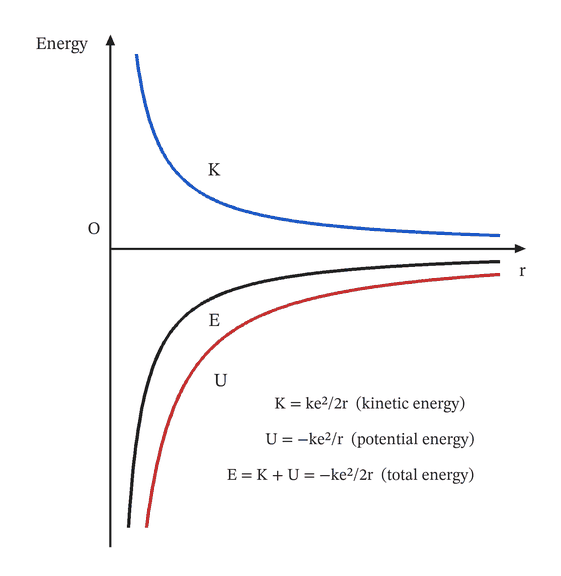
(b) Draw a graph to show the variation of kinetic energy, potential energy and total energy of the electron in an atom.
(c) Explain the drawbacks of the Rutherford atom model.
Confirming your payment
Sign up now and get 250 free tokens.
Atoms - Energy Levels · Question 74 of 92
(a) Describe Rutherford's atom model.
(b) Draw a graph to show the variation of kinetic energy, potential energy and total energy of the electron in an atom.
(c) Explain the drawbacks of the Rutherford atom model.
Solution:
Concept: In Rutherford's model an electron of charge revolves in a circle of radius round a nucleus of charge . With , its kinetic energy is and its potential energy is .
Step 1 — Part (a): describe the model. Every atom has a very small central nucleus (about to m across) that holds all its positive charge and almost all its mass. The electrons revolve round the nucleus in orbits, as planets revolve round the Sun; the electrostatic attraction of the nucleus provides the centripetal force. The total negative charge of the electrons equals the positive charge of the nucleus, so the atom is neutral, and most of the atom is empty space.

Step 2 — Part (b): find how each energy varies with . From , the kinetic energy is:
It is positive and falls as . The potential energy is:
It is negative and twice as large in size as . The total energy is:
It is negative and equal in size to .
Step 3 — Part (b): draw the graph. All three curves approach zero as grows; lies above the -axis, and and lie below it, with twice as far from the axis as . The graph is drawn for hydrogen (), so its labels show in place of :
Step 4 — Part (c): first drawback, stability. By classical electromagnetic theory, a revolving electron is accelerated and must radiate energy continuously. Its orbit would shrink and it would spiral into the nucleus within about s (classical estimate for hydrogen), so no atom would be stable. In fact atoms are stable.
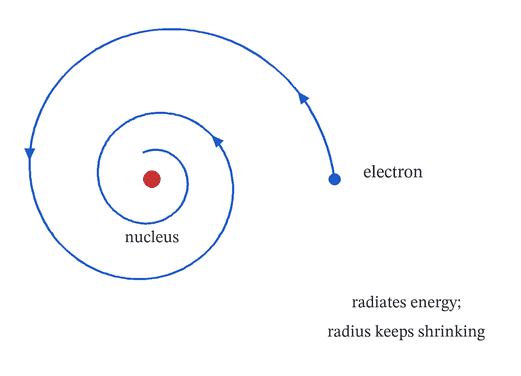
Step 5 — Part (c): second drawback, spectra. As the electron spirals in, its frequency of revolution changes continuously, so the atom should give a continuous spectrum. In fact atoms give line spectra of definite frequencies.
Therefore, (a) Rutherford's atom has a tiny positive nucleus holding almost all the mass, with electrons revolving round it under electrostatic attraction; (b) is positive, is negative and is negative, all tending to zero as increases, as in the graph; (c) the model cannot explain the stability of atoms or their line spectra.