Solution:
Concept: Rutherford's theory of a point-like nucleus predicts how many α-particles are scattered through each angle: the number N(θ) is proportional to sin4(θ/2)1, to the foil thickness t, to Z2 and to K21, where K is the kinetic energy of the α-particles.
Step 1 — Part (a): describe the apparatus. In a vacuum chamber, a narrow beam of α-particles (about 5.5 MeV, from a radioactive source such as polonium or radon kept inside a lead block) is made to pass through lead slits and fall on a very thin gold foil (less than 1 μm thick). The scattered α-particles strike a zinc sulphide (ZnS) screen, where each one produces a tiny flash of light (a scintillation). The flashes are counted through a microscope. The screen and microscope can be turned round the foil on a circular scale, so the number of particles scattered through each angle θ can be counted. The chamber is evacuated so that the α-particles are not stopped or deflected by air.
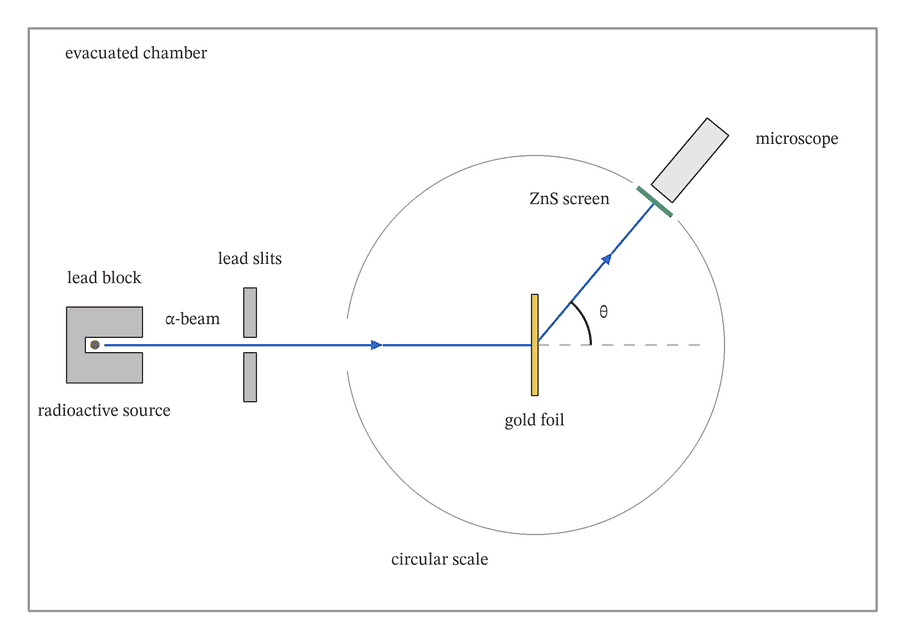
Step 2 — Part (a): describe the tests. Geiger and Marsden counted the scintillations at many angles, from a few degrees to about 150°, and found that N(θ)sin42θ stayed constant, as the theory predicts. They also found that the number scattered was proportional to the thickness of the foil, increased with the atomic number of the foil metal, and varied as K21 when the energy of the α-particles was changed. These results verified Rutherford's theory.
Step 3 — Part (b): state the conclusions. Most of the atom is empty space. The whole positive charge and almost the whole mass of the atom are concentrated in a tiny central nucleus, about 10−14 to 10−15 m across, while the atom itself is about 10−10 m across. The electrons move in the space round the nucleus.
Step 4 — Part (c): define the distance of closest approach. When an α-particle moves straight towards a nucleus, the repulsion slows it until it stops for an instant at a distance r0 from the centre of the nucleus and then turns back. This distance r0, at which all the kinetic energy has become electrostatic potential energy, is the distance of closest approach.
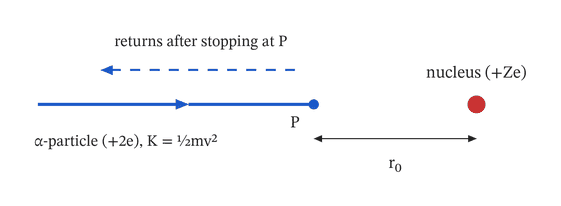
Step 5 — Part (c): equate the energies. The α-particle has charge 2e and kinetic energy K=21mv2; the nucleus has charge Ze. At r0:
21mv2=4πε01r0(Ze)(2e)
Step 6 — Part (c): solve for r0. Rearranging gives:
r0=4πε01K2Ze2
For a 5 MeV α-particle and gold (Z=79) this is about 4.5×10⁻¹⁴ m, so the nucleus must be smaller than this.
Therefore, (a) Geiger and Marsden counted, with a ZnS screen and microscope, the α-particles scattered by a thin gold foil at each angle and found N∝sin4(θ/2)1 as predicted; (b) the atom has a tiny nucleus holding its positive charge and nearly all its mass, with mostly empty space round it; (c) the distance of closest approach is the distance at which a head-on α-particle momentarily stops, and r0=4πε01K2Ze2.
