
Question 725 marksHard
(a) Describe the alpha particle scattering experiment.
(b) Explain the observations made by Rutherford.
(c) Define impact parameter and obtain an expression for it.
Confirming your payment
Sign up now and get 250 free tokens.
Atoms - Energy Levels · Question 72 of 92
(a) Describe the alpha particle scattering experiment.
(b) Explain the observations made by Rutherford.
(c) Define impact parameter and obtain an expression for it.
Solution:
Concept: The -particle scattering experiment probes the inside of atoms: the way -particles are deflected by a thin foil shows how the positive charge of each atom is arranged.
Step 1 — Part (a): describe the apparatus. In a vacuum chamber, a narrow beam of -particles (about 5.5 MeV, from a radioactive source such as polonium or radon kept inside a lead block) is made to pass through lead slits and fall on a very thin gold foil (less than 1 μm thick). The scattered -particles strike a zinc sulphide (ZnS) screen, where each one produces a tiny flash of light (a scintillation). The flashes are counted through a microscope. The screen and microscope can be turned round the foil on a circular scale, so the number of particles scattered through each angle can be counted. The chamber is evacuated so that the -particles are not stopped or deflected by air.
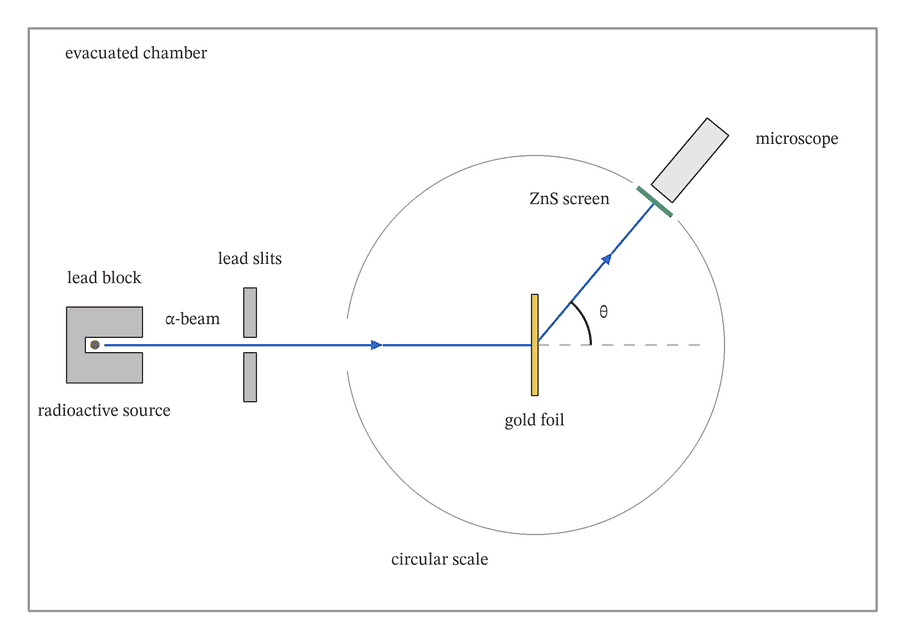
Step 2 — Part (b): state the observations. Most -particles passed through the foil undeflected or deflected through very small angles. A few were deflected through large angles, and a very small number (about one in several thousand) were deflected through more than 90°, some almost straight back.
Step 3 — Part (b): explain them. Since most particles go straight through, most of the atom is empty space. Since a few are turned through large angles, the positive charge and nearly all the mass of the atom must be concentrated in a tiny central nucleus, close to which the repulsion is very strong.
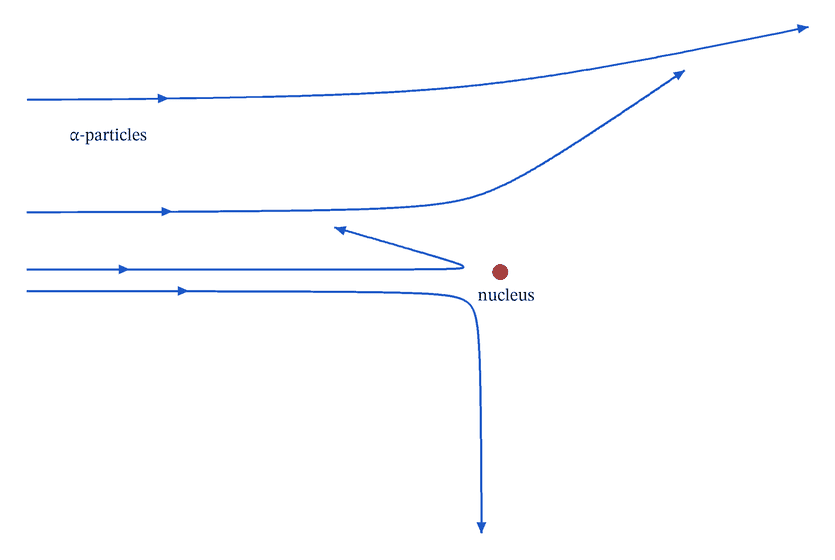
Step 4 — Part (c): define the impact parameter. The impact parameter is the perpendicular distance of the initial velocity vector of the -particle (far from the nucleus) from the centre of the nucleus:

Step 5 — Part (c): find the change in momentum. The nucleus (charge ) is taken as fixed, so the -particle (mass , charge , speed far away) leaves with the same speed . Its momentum turns through , so the change in momentum, along the line of symmetry of the path, has magnitude:
Step 6 — Part (c): find the impulse of the force. Let be the angle between the line from the nucleus to the particle and the line of symmetry. The repulsion has component along that line, so:
Angular momentum about the nucleus is conserved, so . Hence:
Step 7 — Part (c): do the integral. We put and into the integral, and cancels:
As the particle moves from far away to far away, goes from to , so the integral equals :
Step 8 — Part (c): equate and solve for . Setting the two expressions for equal:
With the kinetic energy :
A small impact parameter gives a large scattering angle, and a zero impact parameter gives .
Therefore, (a) -particles from a shielded source are directed at a thin gold foil in vacuum and the scattered particles are counted at each angle with a ZnS screen and microscope; (b) most pass undeflected but a few are scattered through large angles, showing a tiny, massive, positively charged nucleus; (c) the impact parameter is the perpendicular distance of the initial velocity of the -particle from the centre of the nucleus, and .