Solution:
Concept: In a stationary orbit the electron's angular momentum is mvr=2πnh, and a moving electron has de Broglie wavelength λ=mvh. Hydrogen atoms in a gas are normally in the ground state, so they absorb only from n=1, but excited atoms can emit from any higher level.
Step 1 — Part (a): state the postulate. The electron can revolve only in certain orbits, called stationary orbits, in which it does not radiate energy. In these orbits its angular momentum is a whole-number multiple of 2πh:
mvr=2πnh
Step 2 — Part (a): express it with the de Broglie wavelength. Multiplying both sides by mv2π gives:
2πr=mvnh
Since mvh=λ:
2πr=nλ
So a stationary orbit is one whose circumference holds a whole number of de Broglie wavelengths (a standing electron wave):
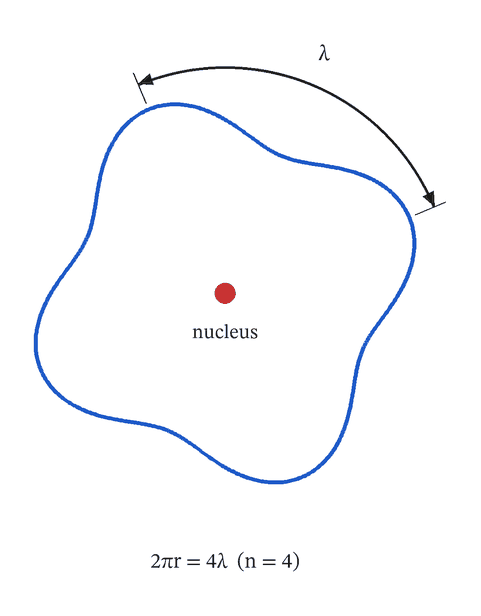
Step 3 — Part (b): find the three energies. We put the three values of n into the formula. For the ground state (n=1):
E1=−13.6 eV
The first excited state (n=2) has:
E2=−413.6 eV
E2=−3.4 eV
The second excited state (n=3) has:
E3=−913.6 eV
E3≈−1.51 eV
Step 4 — Part (b): draw the diagram and the transitions. The levels are drawn to scale. In emission the electron can fall 3→2, 3→1 and 2→1. In absorption, the atoms start in the ground state, so only 1→2 and 1→3 occur:

Step 5 — Part (b): pick the line seen only in emission. The lines 2→1 and 3→1 have absorption partners 1→2 and 1→3. The line 3→2 has no partner, because there are hardly any atoms in the n=2 state to absorb it.
Step 6 — Part (b): find its wavelength. Its energy is:
ΔE=E3−E2
ΔE=−1.51−(−3.4) eV
ΔE≈1.89 eV
The Rydberg formula with R=1.097×10⁷ m−1 gives its wavelength:
λ1=R(221−321)
λ1=365R
λ=5×1.097×10736 m
λ≈6.56×10⁻⁷ m
As a cross-check, the relation λ=ΔEhc, with hc taken as 1242 eV nm and the rounded 1.89 eV, gives about 657 nm for the same line.
Therefore, (a) the stationary-orbit postulate is mvr=2πnh, which in terms of the de Broglie wavelength is 2πr=nλ; (b) E1=−13.6 eV, E2=−3.4 eV, E3≈−1.51 eV, and the line present only in emission is the 3→2 line of wavelength about 656 nm (6563 Å), which belongs to the Balmer series.
