Solution:
Concept: In Bohr's model the electron moves in a circle round the nucleus. The electrostatic attraction supplies the centripetal force, and the angular momentum can only be a whole-number multiple of 2πh:
mvr=2πnh
Step 1 — Write the force condition. The electron (mass m, charge −e) moves with speed v in a circle of radius r round the nucleus (charge +Ze). The electrostatic attraction provides the centripetal force:

rmv2=4πε01r2Ze2
Multiplying both sides by r gives:
mv2=4πε0rZe2(1)
Step 2 — Write the quantisation condition. By Bohr's postulate the angular momentum is a multiple of 2πh:
mvr=2πnh
Dividing by mr gives the speed:
v=2πmrnh(2)
Step 3 — Eliminate v to find the radius. We put (2) into (1):
m×4π2m2r2n2h2=4πε0rZe2
We multiply both sides by 4π2mr2ε0. This leaves ε0n2h2 on the left and πmZe2r on the right:
ε0n2h2=πmZe2r
We divide both sides by πmZe2, so that r stands alone:
rn=πmZe2ε0n2h2
Step 4 — Part (a): write the two energies. From (1), the kinetic energy is:
K=8πε0rZe2
The potential energy of the electron (charge −e) in the field of the nucleus (charge Ze) is:
U=−4πε0rZe2
Step 5 — Part (a): add them. The total energy is:
E=K+U
E=−8πε0rZe2
Step 6 — Part (a): put in the radius. We substitute rn from Step 3:
En=−8πε0Ze2×ε0n2h2πmZe2
En=−8ε02n2h2mZ2e4
For hydrogen, with Z=1, the constants give En=−n213.6 eV.
Step 7 — Part (b): explain how a line is formed. When hydrogen is excited (for example in a discharge tube), electrons are raised to higher levels. When an electron falls from level ni to a lower level nf, it emits a photon of energy Eni−Enf:
λhc=8ε02h2me4(nf21−ni21)
Dividing both sides by hc gives the wave number of the line:
λ1=R(nf21−ni21)
Here R=8ε02ch3me4 is the Rydberg constant, about 1.097×10⁷ m−1.
Step 8 — Part (b): group the lines into series. All the jumps that end on the same lower level form one series:
- lower level 1 (upper levels 2, 3, …): Lyman series, ultraviolet;
- lower level 2 (upper levels 3, 4, …): Balmer series, visible (its higher members reach the near ultraviolet);
- lower level 3 (upper levels 4, 5, …): Paschen series, infrared;
- lower level 4 (upper levels 5, 6, …): Brackett series, infrared;
- lower level 5 (upper levels 6, 7, …): Pfund series, infrared.
Since a gas holds very many atoms, all these jumps happen at once, and all the series appear together.
Step 9 — Part (c): draw the diagram. The levels are drawn as horizontal lines (spaced for clarity, not to scale), and each series is a group of downward arrows ending on its lower level:
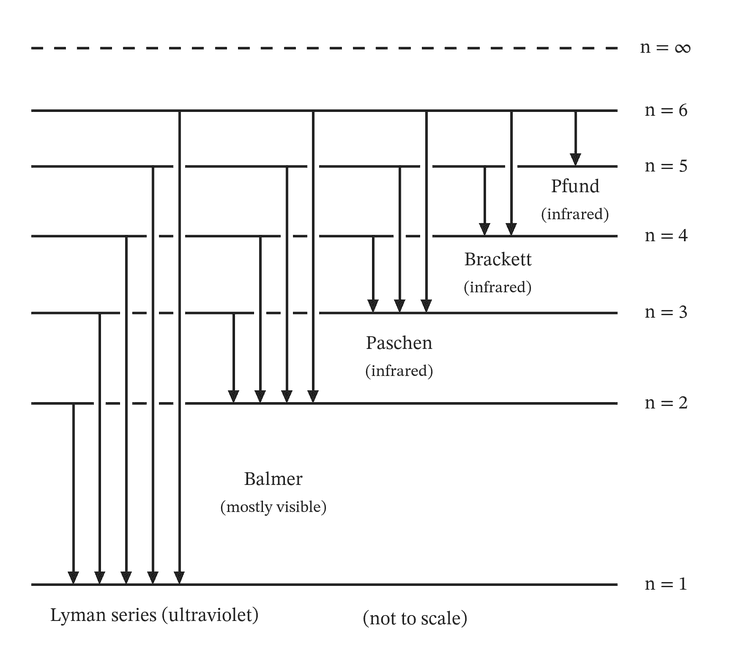
Therefore, (a) En=−8ε02n2h2mZ2e4 (for hydrogen −n213.6 eV); (b) each line is emitted when an electron falls from a higher level ni to a lower level nf, and lines ending on nf=1,2,3,4,5 form the Lyman, Balmer, Paschen, Brackett and Pfund series; (c) the energy level diagram shows these transitions.
