
Opening your dashboard
Class 12 Physics Chapter 26 Atoms - Energy Levels: Previous Year Questions
23 questions on Chapter 26, each solved step by step. Class 12 Physics, ICSE 2026-27.
23 questions with solutions
1–5 marks · Mixed difficulty
The first 16 solutions are on this page. This chapter is a long one, so the rest open on their own page to keep this one quick to load.
- 11 mark
Question 1
If and represent potential energy and kinetic energy respectively, of an orbital electron, then, according to Bohr's theory:
Solve with AIAnswer
- Correct
(A)
(B)
(C)
(D)
Answer: (A)
Key idea: In Bohr's model the electrostatic attraction of the nucleus provides the centripetal force on the electron. This fixes the kinetic energy in terms of the potential energy.
Step 1 — Write the force balance.
For an electron of mass and speed in an orbit of radius round a proton, the Coulomb attraction equals the centripetal force. Here .
Step 2 — Find the kinetic energy.
Multiplying both sides by gives the kinetic energy .
Step 3 — Write the potential energy.
The potential energy of charges and a distance apart is negative.
Step 4 — Compare the two.
The kinetic energy is half the size of the potential energy and has the opposite sign.
Step 5 — Check the other options.
We test each of the other options in turn:
- (B) If were equal to , the total energy would be zero, but a bound electron has a negative total energy.
- (C) The value equals , which is four times the true kinetic energy .
- (D) The potential energy is negative, so is negative, but kinetic energy can never be negative.
Therefore, according to Bohr's theory E_k = −E_p/2, option (A).
- 21 mark
Question 2
Wavelengths of the first lines of the Lyman series, Paschen series and Balmer series, in hydrogen spectrum are denoted by , , and , respectively. Arrange these wavelengths in increasing order.
Solve with AIWritten solution
Solution:
Key idea: Each line of the hydrogen spectrum obeys , where is the lower level and the upper level. A bigger energy jump means a shorter wavelength.
Step 1 — Identify the first line of each series.
The first line of a series comes from the smallest jump into its lower level. Lyman ends on , Balmer on and Paschen on , so the first lines are , and .
Step 2 — Compare the energy jumps.
Using , the three jumps are (Lyman), (Balmer) and (Paschen). The wavelength is inversely proportional to the photon energy.
Step 3 — Check with the Rydberg formula.
With the three wavelengths come out as about (ultraviolet), (red) and (infrared). The largest jump gives the shortest wavelength.
Therefore, in increasing order the wavelengths are λ_L < λ_B < λ_P.
- 33 marks
Question 3
On the basis of Bohr's theory, derive an expression for the radius of the orbit of an electron of hydrogen atom.
Solve with AIWritten solution
Solution:
Key idea: Bohr's model combines two conditions for the electron's circular orbit: the Coulomb attraction supplies the centripetal force, and the angular momentum is quantised, . Eliminating the speed gives the radius.
Step 1 — Describe Bohr's picture of the hydrogen atom.
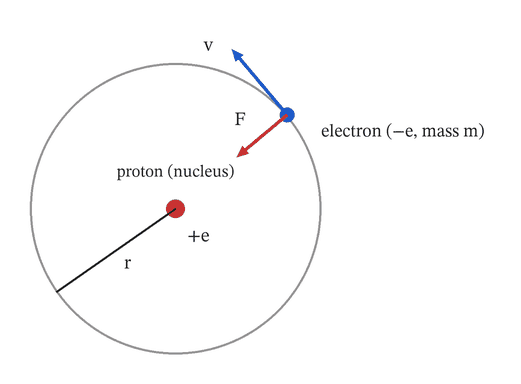
In Bohr's model the electron, of charge and mass , moves with speed in a circular orbit of radius round the nucleus. The nucleus of hydrogen is a single proton of charge . The proton is about 1836 times heavier than the electron, so we treat it as fixed at the centre.
Step 2 — Balance the forces on the electron.
The electrostatic attraction of the proton supplies the centripetal force needed for circular motion. By Coulomb's law this force is , where is the permittivity of free space.
Multiplying both sides by gives the first equation, which we call equation (1).
Step 3 — Apply Bohr's quantum condition.
Bohr's second postulate says that the angular momentum of the electron is a whole-number multiple of , where is Planck's constant and is the principal quantum number. We call this equation (2).
Step 4 — Eliminate the speed.
From equation (2) we write the speed in terms of .
We put this value of into equation (1).
Squaring the bracket and cancelling one gives the next line.
Step 5 — Solve for the radius.
We multiply both sides by , which leaves on the left and on the right. Then we divide both sides by , so only is left on the right.
So the radius of the th orbit is
Step 6 — Interpret the result.
Everything in the formula except is a constant, so the radius grows as the square of the principal quantum number.
For the first orbit () the formula gives the Bohr radius, about . The later orbits have radii , , times this value.
Therefore, the radius of the nth orbit of the hydrogen atom is r_n = ε₀n²h²/(πme²), so r_n is proportional to n².
- 41 mark
Question 4
Total energy of an electron in the ground state of hydrogen atom is . Its total energy, when hydrogen atom is in the first excited state, is:
Solve with AIAnswer
(A)
(B)
- Correct
(C)
(D)
Answer: (C)
Key idea: In Bohr's theory the total energy of the electron in the th orbit of hydrogen is , where is the ground-state energy.
Step 1 — Identify the level.
The ground state is . The first excited state is the next level up, so .
Step 2 — Calculate the energy.
We divide the ground-state energy by .
The energy is still negative because the electron is still bound to the nucleus.
Step 3 — Check the other options.
We test each of the other options in turn:
- (A) A positive energy would mean the electron is no longer bound, and is the size of the ground-state energy, not of the level.
- (B) The size is right but the sign is wrong; every bound level of the atom has a negative energy.
- (D) This comes from multiplying by instead of dividing by it.
Therefore, the total energy in the first excited state is −3.4 eV, option (C).
- 51 mark
Question 5
Calculate angular momentum of an electron in the third Bohr orbit of hydrogen atom.
Solve with AIWritten solution
Solution:
Key idea: Bohr's quantum condition says that the angular momentum of an electron in the th orbit is , where is Planck's constant.
Step 1 — Identify the orbit.
The third Bohr orbit has principal quantum number .
Step 2 — Substitute into the formula.
We put in the formula and use Planck's constant .
With the more precise value the result is .
Therefore, the angular momentum of the electron in the third orbit is 3h/2π ≈ 3.15 × 10⁻³⁴ J s.
- 63 marks
Question 6
(i) How are various lines of Lyman series formed? Explain on the basis of Bohr's theory.
(ii) Calculate the shortest wavelength of electromagnetic radiation present in Balmer series of hydrogen spectrum.
Solve with AIWritten solution
Solution:
Key idea: In Bohr's theory an electron that jumps from a higher energy level to a lower level gives out one photon of energy . Each series of lines in the hydrogen spectrum ends on one particular lower level.
Step 1 — Part (i): state the levels involved.
An electron can stay only in certain stationary orbits, with energies . When hydrogen atoms are excited (for example in a discharge tube), their electrons are raised to higher levels and then fall back.
Step 2 — Part (i): explain how the Lyman lines form.
The Lyman series is formed when an excited electron falls from any higher level directly to the ground level . Each such jump releases one photon whose wavelength obeys the Rydberg formula.
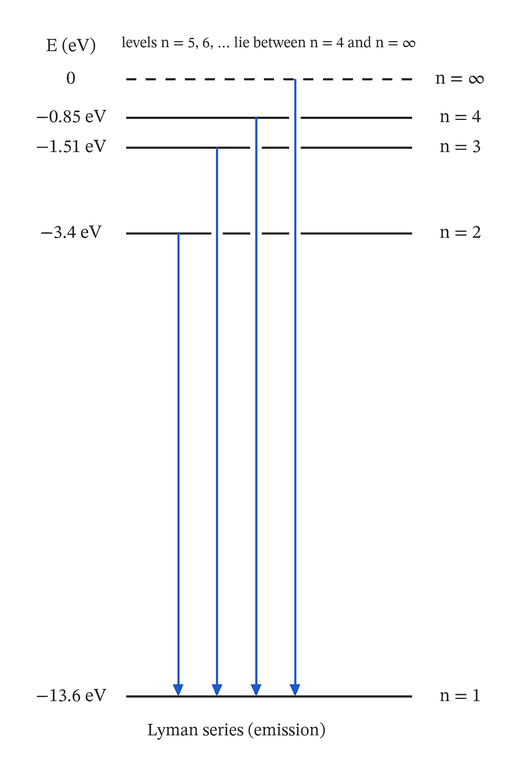
The jump releases and gives the longest Lyman line (about ). The jump from releases and gives the shortest line, the series limit (about ). All these photons have large energies, so the Lyman series lies in the ultraviolet region.
Step 3 — Part (ii): find the shortest Balmer wavelength.
The Balmer series contains the lines emitted when the electron falls to the level from a higher level, whose number can be 3, 4, 5 and so on. The wavelength of each line is given by the Rydberg formula, where is Rydberg's constant.
The shortest wavelength means the largest photon energy, which is the jump from the highest level, , down to . This line is called the series limit.
The term is zero, so only is left in the bracket.
We use Rydberg's constant .
To three significant figures this is (about ).
Therefore, (i) the Lyman lines are emitted when electrons fall from the levels n = 2, 3, 4, … to n = 1; (ii) the shortest wavelength in the Balmer series is 4/R ≈ 3.65 × 10⁻⁷ m.
- 71 mark
Question 7
'According to Bohr, Angular momentum of an orbiting electron is quantised.' What is meant by this statement ?
Solve with AIWritten solution
Solution:
Key idea: A quantity is called quantised when it can take only certain separate (discrete) values, not every value in a range.
Step 1 — State Bohr's condition.
Bohr's second postulate says that an electron can revolve only in those orbits in which its angular momentum is a whole-number multiple of , where is Planck's constant.
Here is a positive whole number (), the principal quantum number.
Step 2 — Explain what 'quantised' means here.
The angular momentum therefore cannot take any value it likes. It can only be , , and so on, never a value in between. Because of this, only certain orbits with definite radii and energies are allowed; these are the stationary orbits, in which the electron does not radiate energy.
Therefore, the statement means that the angular momentum of the electron can only be a whole-number multiple of h/2π, that is L = nh/2π, where n is a positive whole number, so only certain orbits are allowed.
- 83 marks
Question 8
Draw energy level diagram for hydrogen atom, showing first four energy levels corresponding to and . Show transitions responsible for :
(i) Absorption spectrum of Lyman series.
(ii) Emission spectrum of Balmer series.
Solve with AIWritten solution
Solution:
Key idea: In Bohr's theory the energy of the th level of hydrogen is . Absorption lines are upward jumps (a photon is taken in) and emission lines are downward jumps (a photon is given out). The Lyman series involves , and the Balmer series involves .
Step 1 — Find the energies of the first four levels.
In Bohr's theory the energy of the th level of hydrogen is . We put the values 1, 2, 3 and 4 for in turn to get the four levels.
Step 2 — Decide the direction of each set of arrows.
In absorption the atom takes in a photon, so the electron jumps UP from a lower level to a higher one. In emission the electron falls DOWN and gives out a photon. The Lyman series involves the level , and the Balmer series involves the level .
Step 3 — Draw the diagram.
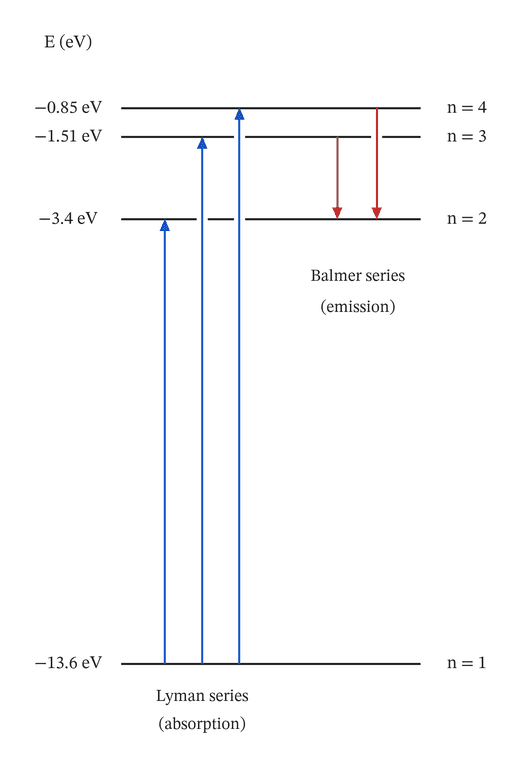
The levels are drawn as horizontal lines to scale, with the energy of each level on the left. The Lyman absorption lines are the upward arrows from the ground level to the levels 2, 3 and 4. The Balmer emission lines are the downward arrows from the levels 3 and 4 to the level 2.
Step 4 — Read the transitions from the diagram.
The Lyman absorption arrows all START on the ground level , because in cool atomic hydrogen almost all the atoms are in the ground state. (This is an idealised picture: real hydrogen gas at room temperature is made of molecules.) The Balmer emission arrows all END on ; these lines (for example and ) fall in the visible region.
Therefore, the diagram shows the levels −13.6, −3.4, −1.51 and −0.85 eV; (i) Lyman absorption is the set of upward jumps from the ground level to the levels 2, 3 and 4; (ii) Balmer emission is the set of downward jumps from the levels 3 and 4 to the level 2.
- 91 mark
Question 9
In Bohr's model of hydrogen atom, radius of the first orbit of an electron is . Then, radius of the third orbit is:
Solve with AIAnswer
(A)
(B)
(C)
- Correct
(D)
Answer: (D)
Key idea: In Bohr's model the radius of the th orbit is , so it is proportional to the square of the principal quantum number .
Step 1 — Write the ratio of the two radii.
All the constants cancel, leaving only the ratio of the squares of .
Step 2 — Calculate the radius of the third orbit.
The first orbit has radius , so we multiply it by 9.
Step 3 — Check the other options.
We test each of the other options in turn:
- (A) This uses , but the radius grows with ; it is the energy whose size falls as .
- (B) This would mean every orbit has the same radius, but higher orbits lie farther from the nucleus.
- (C) This uses instead of .
Therefore, the radius of the third orbit is 9r₀, option (D).
- 102 marks
Question 10
Calculate the minimum wavelength of the spectral line present in Balmer series of hydrogen.
Solve with AIWritten solution
Solution:
Key idea: The wavelengths of the Balmer lines obey . The minimum wavelength belongs to the largest energy jump, from .
Step 1 — Choose the transition.
The Balmer series contains the lines emitted when the electron falls to the level from a higher level, whose number can be 3, 4, 5 and so on. The wavelength of each line is given by the Rydberg formula, where is Rydberg's constant.
The shortest wavelength means the largest photon energy, which is the jump from the highest level, , down to . This line is called the series limit.
The term is zero, so only is left in the bracket.
Step 2 — Substitute the value of R.
The paper gives Rydberg's constant as .
We substitute .
This is about , just beyond the violet end of the visible spectrum (near ultraviolet).
Therefore, the minimum wavelength in the Balmer series is 3.646 × 10⁻⁷ m (about 365 nm).
- 111 mark
Question 11
Name the series in the atomic spectra of the hydrogen atom that falls in the ultraviolet region.
Solve with AIWritten solution
Solution:
Key idea: The series of the hydrogen spectrum are named by the lower level the electron falls to: Lyman (), Balmer (), Paschen (), Brackett () and Pfund ().
Step 1 — Compare the photon energies.
Jumps down to release the largest energies, from to . Such photons have wavelengths of about to , which lie in the ultraviolet region.
Step 2 — Name the series.
The Balmer series has its strongest lines in the visible region (656, 486, 434 and 410 nm), while its higher lines crowd towards its limit at 365 nm in the near ultraviolet. The Paschen, Brackett and Pfund lines are infrared. Only the series ending on lies wholly in the ultraviolet.
Therefore, the Lyman series falls in the ultraviolet region.
- 122 marks
Question 12
(i) What is meant by the mass defect?
(ii) What conclusion is drawn from Rutherford's scattering experiment of -particles?
Solve with AIWritten solution
Solution:
Key idea: The mass of a nucleus is a little less than the total mass of its separate protons and neutrons. In Rutherford's experiment a few alpha particles bounce back from a thin gold foil, which shows that the positive charge of an atom is concentrated in a tiny core.
Step 1 — Part (i): define the mass defect.
The mass defect of a nucleus is the difference between the total mass of its nucleons, taken separately, and the actual mass of the nucleus. For a nucleus with protons, neutrons and nuclear mass it is written as follows.
This missing mass has been converted into the binding energy of the nucleus, .
Step 2 — Part (ii): recall what was observed.
Most alpha particles passed straight through the gold foil, a few were deflected through large angles, and about 1 in 8000 was turned back through more than .
Step 3 — Part (ii): state the conclusions.
Most of the atom is empty space, because most alpha particles passed through undeflected. All the positive charge and almost all the mass of the atom are concentrated in a tiny central core, the nucleus, because only a very strong concentrated charge can turn a heavy alpha particle back. The nucleus is extremely small, of size about to , compared with about for the atom, and the electrons move round it.
Therefore, (i) mass defect is the total mass of the separate nucleons minus the mass of the nucleus; (ii) an atom is mostly empty space, with its positive charge and almost all its mass in a tiny central nucleus.
- 133 marks
Question 13
State any two Bohr's postulates and write the energy value of the ground state of the hydrogen atom.
Solve with AIWritten solution
Solution:
Key idea: Bohr kept Rutherford's nuclear atom but added quantum conditions, so that the atom is stable and gives a line spectrum.
Step 1 — State the first postulate (circular orbits).
The electron revolves round the nucleus in a circular orbit. The electrostatic (Coulomb) attraction of the nucleus provides the centripetal force needed for this motion.
Here is the mass of the electron, its charge, its speed, the radius of the orbit and the permittivity of free space.
Step 2 — State the second postulate (quantised angular momentum and stationary orbits).
The electron can revolve only in those orbits in which its angular momentum is a whole-number multiple of , where is Planck's constant.
Here is the principal quantum number. These allowed orbits are called stationary orbits: while the electron stays in one of them it does not radiate energy, although it is accelerating.
(A third postulate, the frequency condition, may be quoted instead: when an electron jumps from a level of energy to a lower level it emits one photon of frequency given by .)
Step 3 — Write the ground-state energy.
The energy of the th level of hydrogen is .
The ground state is the lowest level, , so we put this value in the formula.
The minus sign shows that the electron is bound; must be supplied to free it from the atom.
Therefore, two postulates are: the electron moves in a circular orbit held by the Coulomb attraction of the nucleus, and only orbits with mvr = nh/2π are allowed, in which it does not radiate (stationary orbits); the ground-state energy of hydrogen is −13.6 eV.
- 143 marks
Question 14
Draw the energy level diagram of hydrogen atom and show the transitions responsible for:
(I) absorption lines of Lyman series.
(II) emission lines of Balmer series.
Solve with AIWritten solution
Solution:
Key idea: In Bohr's theory the energy of the th level of hydrogen is . Absorption lines are upward jumps (a photon is taken in) and emission lines are downward jumps (a photon is given out). The Lyman series involves , and the Balmer series involves .
Step 1 — Find the energies of the first four levels.
In Bohr's theory the energy of the th level of hydrogen is . We put the values 1, 2, 3 and 4 for in turn to get the four levels.
Step 2 — Decide the direction of each set of arrows.
In absorption the atom takes in a photon, so the electron jumps UP from a lower level to a higher one. In emission the electron falls DOWN and gives out a photon. The Lyman series involves the level , and the Balmer series involves the level .
Step 3 — Draw the diagram.
The levels are drawn as horizontal lines to scale, with the energy of each level on the left. The Lyman absorption lines are the upward arrows from the ground level to the levels 2, 3 and 4. The Balmer emission lines are the downward arrows from the levels 3 and 4 to the level 2.
Step 4 — Read the transitions from the diagram.
The Lyman absorption arrows all START on the ground level , because in cool atomic hydrogen almost all the atoms are in the ground state. (This is an idealised picture: real hydrogen gas at room temperature is made of molecules.) The Balmer emission arrows all END on ; these lines (for example and ) fall in the visible region.
Therefore, (I) the Lyman absorption lines are the upward jumps from n = 1 to the higher levels; (II) the Balmer emission lines are the downward jumps from n = 3, 4, … to n = 2.
- 155 marks
Question 15
(a) Name the series of lines of hydrogen spectrum which lies in the (1) ultraviolet region. (2) visible region.
(b) How much is the angular momentum of an electron when it is orbiting in the second Bohr orbit of a hydrogen atom?
(c) With reference to Nuclear Physics, answer the following questions.
(1) What is meant by "Isotopes"?
(2) Define 1u (where u stands for unified atomic mass unit).
Solve with AIWritten solution
Solution:
Key idea: The series of the hydrogen spectrum are named by the level the electron falls to. Bohr's condition gives the angular momentum . Isotopes differ only in their number of neutrons, and the unified atomic mass unit is defined from the carbon-12 atom.
Step 1 — Part (a): name the two series.
Jumps down to release to and give ultraviolet light: this is the Lyman series. Jumps down to release to , and the main lines of this series (, , and ) are visible: this is the Balmer series.
Step 2 — Part (b): find the angular momentum in the second orbit.
The second Bohr orbit has .
We use Planck's constant .
With the value is .
Step 3 — Part (c)(1): define isotopes.
Isotopes are atoms of the same element that have the same atomic number (the same number of protons) but different mass numbers , because they have different numbers of neutrons. They have the same chemical properties. For example, , and are isotopes of hydrogen, and and are isotopes of carbon.
Step 4 — Part (c)(2): define 1 u.
One unified atomic mass unit is one-twelfth of the mass of one neutral atom of carbon-12.
Its energy equivalent is about .
Therefore, (a) (1) the Lyman series lies in the ultraviolet and (2) the Balmer series in the visible region; (b) the angular momentum is h/π, about 2.10 × 10⁻³⁴ J s; (c) (1) isotopes are atoms with the same Z but different A; (2) 1 u is one-twelfth of the mass of a carbon-12 atom, about 1.66 × 10⁻²⁷ kg.
- 165 marks
Question 16
a) Using Bohr's theory of hydrogen atom, obtain an expression for the velocity of an electron in nth orbit of an atom.
b) What is meant by Binding Energy per nucleon of a nucleus? State its physical significance.
Solve with AIWritten solution
Solution:
Key idea: In Bohr's model the Coulomb attraction supplies the centripetal force on the electron, and its angular momentum is quantised, . Dividing one condition by the other removes the radius and gives the speed. The binding energy per nucleon measures how firmly each nucleon is held in a nucleus.
Part a) — speed of the electron in the nth orbit
Step 1 — Describe Bohr's picture of the hydrogen atom.
In Bohr's model the electron, of charge and mass , moves with speed in a circular orbit of radius round the nucleus. The nucleus of hydrogen is a single proton of charge . The proton is about 1836 times heavier than the electron, so we treat it as fixed at the centre.
Step 2 — Balance the forces on the electron.
The electrostatic attraction of the proton supplies the centripetal force needed for circular motion. By Coulomb's law this force is , where is the permittivity of free space.
Multiplying both sides by gives the first equation, which we call equation (1).
Step 3 — Apply Bohr's quantum condition.
Bohr's second postulate says that the angular momentum of the electron is a whole-number multiple of , where is Planck's constant and is the principal quantum number. We call this equation (2).
Step 4 — Divide equation (1) by equation (2).
The left-hand sides give , so the mass cancels.
Step 5 — Simplify.
We multiply both sides by ; the on the right cancels and .
So the speed in the th orbit is
Step 6 — Interpret the result.
All the quantities except are constants, so : the electron moves more slowly in the outer orbits. With , and , the speed in the first orbit is about .
Part b) — binding energy per nucleon
Step 7 — Define it.
The binding energy of a nucleus is the energy needed to separate it completely into its protons and neutrons; it equals the mass defect times . The binding energy per nucleon is this energy divided by the mass number .
Step 8 — State its physical significance.
It measures the stability of a nucleus: the larger the binding energy per nucleon, the more firmly each nucleon is held and the more stable the nucleus. It is greatest, about , for nuclei near iron-56, so these are the most stable. Very light nuclei can release energy by fusing, and very heavy nuclei by splitting (fission), because both processes form nuclei with a larger binding energy per nucleon.
Therefore, a) v_n = e²/(2ε₀nh), so the speed is inversely proportional to n; b) binding energy per nucleon is the binding energy divided by the mass number, and a larger value means a more stable nucleus.
- 172 marks
Question 17
The figure below is the Energy level diagram for the Hydrogen atom. Study the transitions shown and answer the following question:
a. State the type of spectrum obtained.
b. Name the series of spectrum obtained.

- 185 marks
Question 18
(i) On the basis of Bohr's theory, derive an expression for the radius of the orbit of an electron of hydrogen atom.
(ii) Calculate the energy released in the following nuclear fusion reaction:
Mass of
Mass of
- 195 marks
Question 19
(i) Calculate mass defect and binding energy per nucleon of , given
Mass of
Mass of
Mass of
(ii) State the Bohr's postulate of angular momentum of an electron.
(iii)(1) What is the velocity of an electron in the 3rd orbit of hydrogen atom if its velocity in the orbit is ?
(iii)(2) Radius of the orbit of hydrogen atom is . What will be the radius of the orbit?
- 205 marks
Question 20
(a) Show that radius () of the Bohr orbit varies directly with square of the principal quantum number () of the orbit.
(b) (1) Where does nuclear fusion reaction take place continuously in the Universe?
(2) What is meant by "Mass defect" of a nucleus?
- 211 mark
Question 21
Radius of the first Bohr orbit of hydrogen atom is . Calculate the radius of the third orbit.
- 225 marks
Question 22
Answer either subparts (i) to (iii) or (iv) to (vii).
(i) Draw a labelled graph showing the variation of binding energy per nucleon with the mass number (A) of the nucleus. On it, mark the nucleus that is most stable.
(ii) What is meant by the following statement?
'Angular momentum of an orbiting electron is quantised.'
(iii) Calculate the shortest wavelength of Balmer series.
- 235 marks
Question 23
Answer either subparts (i) to (iii) or (iv) to (vii).
(iv) Calculate the minimum amount of energy which a gamma ray photon should possess in order to produce a proton and an anti-proton pair.
(v) Why is a nuclear fusion reaction also known as a thermonuclear reaction?
(vi) What is the physical significance of the fact that total energy of an orbiting electron is negative?
(vii) State any one limitation of Bohr's theory of hydrogen atom.