
Question 185 marksAsked 2024Medium
(i) On the basis of Bohr's theory, derive an expression for the radius of the orbit of an electron of hydrogen atom.
(ii) Calculate the energy released in the following nuclear fusion reaction:
Mass of
Mass of
Confirming your payment
Sign up now and get 250 free tokens.
Previous Year Questions · Question 18 of 23
(i) On the basis of Bohr's theory, derive an expression for the radius of the orbit of an electron of hydrogen atom.
(ii) Calculate the energy released in the following nuclear fusion reaction:
Mass of
Mass of
Solution:
Key idea: Part (i) combines Bohr's two conditions (Coulomb force = centripetal force, and ). In part (ii) the energy released in a nuclear reaction is the mass that disappears, , times ; with 1 u of mass equivalent to , the energy is .
Part (i) — radius of the nth orbit
Step 1 — Describe Bohr's picture of the hydrogen atom.
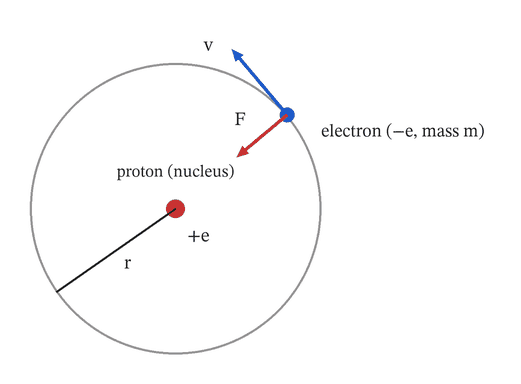
In Bohr's model the electron, of charge and mass , moves with speed in a circular orbit of radius round the nucleus. The nucleus of hydrogen is a single proton of charge . The proton is about 1836 times heavier than the electron, so we treat it as fixed at the centre.
Step 2 — Balance the forces on the electron.
The electrostatic attraction of the proton supplies the centripetal force needed for circular motion. By Coulomb's law this force is , where is the permittivity of free space.
Multiplying both sides by gives the first equation, which we call equation (1).
Step 3 — Apply Bohr's quantum condition.
Bohr's second postulate says that the angular momentum of the electron is a whole-number multiple of , where is Planck's constant and is the principal quantum number. We call this equation (2).
Step 4 — Eliminate the speed.
From equation (2) we write the speed in terms of .
We put this value of into equation (1).
Squaring the bracket and cancelling one gives the next line.
Step 5 — Solve for the radius.
We multiply both sides by , which leaves on the left and on the right. Then we divide both sides by , so only is left on the right.
So the radius of the th orbit is
Step 6 — Interpret the result.
Everything in the formula except is a constant, so the radius grows as the square of the principal quantum number.
For the first orbit () the formula gives the Bohr radius, about . The later orbits have radii , , times this value.
Part (ii) — energy released in the fusion reaction
Step 7 — Find the mass before and after the reaction.
Two deuterium nuclei go in and one helium-4 nucleus comes out.
Step 8 — Find the mass that disappears.
The mass defect of the reaction is the mass before minus the mass after.
Step 9 — Convert the mass into energy.
Each atomic mass unit is equivalent to (the value in the paper's list of constants).
So about is released in each reaction.
Therefore, (i) r_n = ε₀n²h²/(πme²); (ii) the energy released is about 23.8 MeV.