Solution:
Key idea: Bohr's two conditions (Coulomb force = centripetal force, and quantised angular momentum mvr=2πnh) fix the radius of each orbit. Nuclear fusion needs extremely high temperatures, which exist in the cores of stars. The mass defect is the mass "lost" when nucleons bind into a nucleus.
Part (a) — the radius varies as n²
Step 1 — Describe Bohr's picture of the hydrogen atom.
In Bohr's model the electron, of charge −e and mass m, moves with speed v in a circular orbit of radius r round the nucleus. The nucleus of hydrogen is a single proton of charge +e. The proton is about 1836 times heavier than the electron, so we treat it as fixed at the centre.
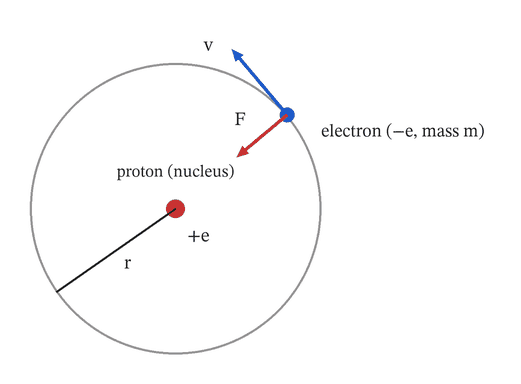
Step 2 — Balance the forces on the electron.
The electrostatic attraction of the proton supplies the centripetal force needed for circular motion. By Coulomb's law this force is 4πε01r2e2, where ε0 is the permittivity of free space.
rmv2=4πε01r2e2
Multiplying both sides by r gives the first equation, which we call equation (1).
mv2=4πε0re2
Step 3 — Apply Bohr's quantum condition.
Bohr's second postulate says that the angular momentum mvr of the electron is a whole-number multiple of 2πh, where h is Planck's constant and n=1,2,3,… is the principal quantum number. We call this equation (2).
mvr=2πnh
Step 4 — Eliminate the speed.
From equation (2) we write the speed in terms of r.
v=2πmrnh
We put this value of v into equation (1).
m(2πmrnh)2=4πε0re2
Squaring the bracket and cancelling one m gives the next line.
4π2mr2n2h2=4πε0re2
Step 5 — Solve for the radius.
We multiply both sides by 4π2mr2ε0, which leaves ε0n2h2 on the left and πme2r on the right. Then we divide both sides by πme2, so only r is left on the right.
πme2ε0n2h2=r
So the radius of the nth orbit is
rn=πme2ε0n2h2
Step 6 — Show the dependence on n.
In this formula ε0, h, π, m and e are all constants. Only n changes from one orbit to the next, so the radius is directly proportional to n2.
rn∝n2
For example, the 2nd, 3rd and 4th orbits are 4, 9 and 16 times as large as the first orbit (radius about 0.53×10⁻¹⁰ m).
Part (b) — fusion and mass defect
Step 7 — (b)(1): say where fusion goes on.
Nuclear fusion takes place continuously in the cores of the Sun and the other stars. There the temperature is about 107 K or more, so hydrogen nuclei move fast enough to fuse into helium, releasing the energy that the stars radiate.
Step 8 — (b)(2): define mass defect.
The mass defect of a nucleus is the difference between the total mass of its separate nucleons and the actual mass of the nucleus.
Δm=Zmp+(A−Z)mn−M
Here Z is the number of protons, A−Z the number of neutrons and M the mass of the nucleus. The missing mass appears as the binding energy Δmc2.
Therefore, (a) r_n = ε₀n²h²/(πme²), so r_n ∝ n²; (b) (1) fusion goes on continuously in the cores of the Sun and other stars; (2) mass defect is the total mass of the separate nucleons minus the mass of the nucleus.
