
Question 63 marksAsked 2016Medium
(i) How are various lines of Lyman series formed? Explain on the basis of Bohr's theory.
(ii) Calculate the shortest wavelength of electromagnetic radiation present in Balmer series of hydrogen spectrum.
Confirming your payment
Sign up now and get 250 free tokens.
Previous Year Questions · Question 6 of 23
(i) How are various lines of Lyman series formed? Explain on the basis of Bohr's theory.
(ii) Calculate the shortest wavelength of electromagnetic radiation present in Balmer series of hydrogen spectrum.
Solution:
Key idea: In Bohr's theory an electron that jumps from a higher energy level to a lower level gives out one photon of energy . Each series of lines in the hydrogen spectrum ends on one particular lower level.
Step 1 — Part (i): state the levels involved.
An electron can stay only in certain stationary orbits, with energies . When hydrogen atoms are excited (for example in a discharge tube), their electrons are raised to higher levels and then fall back.
Step 2 — Part (i): explain how the Lyman lines form.
The Lyman series is formed when an excited electron falls from any higher level directly to the ground level . Each such jump releases one photon whose wavelength obeys the Rydberg formula.
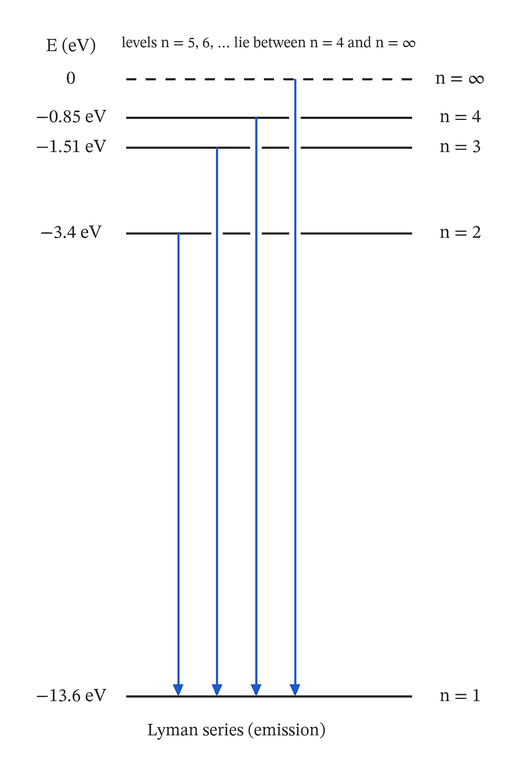
The jump releases and gives the longest Lyman line (about ). The jump from releases and gives the shortest line, the series limit (about ). All these photons have large energies, so the Lyman series lies in the ultraviolet region.
Step 3 — Part (ii): find the shortest Balmer wavelength.
The Balmer series contains the lines emitted when the electron falls to the level from a higher level, whose number can be 3, 4, 5 and so on. The wavelength of each line is given by the Rydberg formula, where is Rydberg's constant.
The shortest wavelength means the largest photon energy, which is the jump from the highest level, , down to . This line is called the series limit.
The term is zero, so only is left in the bracket.
We use Rydberg's constant .
To three significant figures this is (about ).
Therefore, (i) the Lyman lines are emitted when electrons fall from the levels n = 2, 3, 4, … to n = 1; (ii) the shortest wavelength in the Balmer series is 4/R ≈ 3.65 × 10⁻⁷ m.