Solution:
Key idea: The binding energy per nucleon, plotted against mass number A, rises quickly for light nuclei, reaches a broad maximum of about 8.8 MeV near iron-56 and then falls slowly. Bohr's quantum condition is L=2πnh. The shortest Balmer wavelength comes from the jump ∞→2.
Part (i) — binding energy per nucleon graph
Step 1 — Describe the shape of the curve.
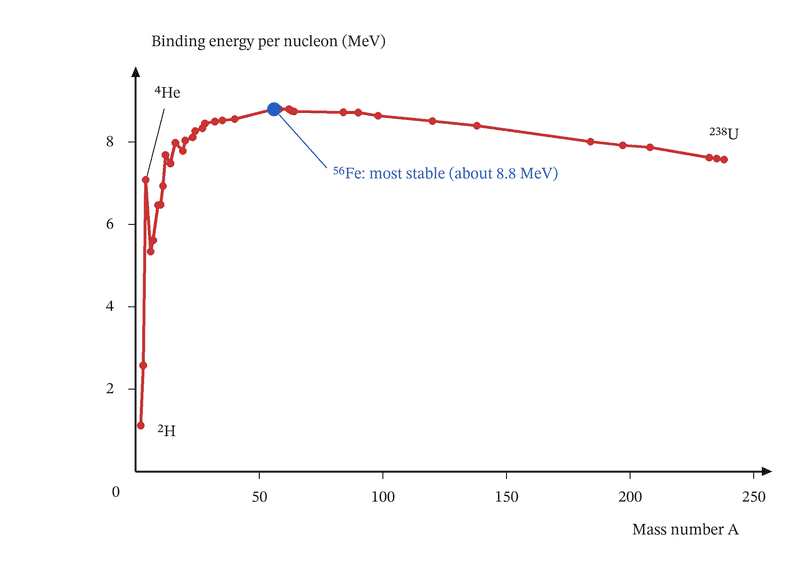
The graph below is plotted from measured nuclear masses. It rises steeply from about 1.1 MeV for 2H, with a sharp local peak at 4He (about 7.1 MeV). It reaches a broad maximum of about 8.8 MeV for A between about 50 and 80, and then falls slowly to about 7.6 MeV for 238U.
Step 2 — Mark the most stable nucleus.
The larger the binding energy per nucleon, the more tightly each nucleon is held, so the most stable nuclei sit at the top of the curve. Iron-56 (2656Fe, about 8.8 MeV) is marked as the most stable nucleus.
Strictly, nickel-62 has a very slightly higher binding energy per nucleon (8.795 MeV against 8.790 MeV), but iron-56 has the lowest mass per nucleon, and it is the nucleus usually marked at the peak.
Part (ii) — meaning of quantised angular momentum
Step 3 — Explain the statement.
Bohr's second postulate says that an electron can revolve only in those orbits in which its angular momentum L=mvr is a whole-number multiple of 2πh, where h is Planck's constant.
L=2πnh
Here n is a positive whole number (1,2,3,…), the principal quantum number. So the angular momentum cannot take any value it likes. It can only be 2πh, 2π2h, 2π3h and so on, never a value in between. Because of this, only certain orbits with definite radii and energies are allowed; these are the stationary orbits, in which the electron does not radiate energy.
Part (iii) — shortest wavelength of the Balmer series
Step 4 — Choose the transition.
The Balmer series contains the lines emitted when the electron falls to the level n1=2 from a higher level, whose number n2 can be 3, 4, 5 and so on. The wavelength of each line is given by the Rydberg formula, where R is Rydberg's constant.
λ1=R(n121−n221)
The shortest wavelength means the largest photon energy, which is the jump from the highest level, n2=∞, down to n1=2. This line is called the series limit.
λmin1=R(221−∞21)
The term ∞21 is zero, so only 41 is left in the bracket.
λmin1=4R
λmin=R4
Step 5 — Substitute the value of R.
The paper gives Rydberg's constant RH=1.097×10⁷ m−1.
We substitute R=1.097×10⁷ m−1.
λmin=1.097×1074 m
λmin=3.646×10⁻⁷ m
This is about 365 nm, just beyond the violet end of the visible spectrum (near ultraviolet).
Therefore, (i) the curve peaks at about 8.8 MeV near A = 56, with iron-56 the most stable nucleus; (ii) the angular momentum can only be nh/2π with n = 1, 2, 3, …; (iii) the shortest Balmer wavelength is 4/R ≈ 3.646 × 10⁻⁷ m (about 365 nm).
