
Question 462 marksEasy
What are the conclusions drawn from the alpha particle scattering experiment?
Confirming your payment
Sign up now and get 250 free tokens.
Atoms - Energy Levels · Question 46 of 92
What are the conclusions drawn from the alpha particle scattering experiment?
Solution:
Concept: Most -particles pass through a thin gold foil undeflected, a few are deflected through large angles, and a very few (about one in several thousand) bounce back.
Step 1 — Most of the atom is empty. Since most -particles pass straight through, most of the space inside an atom is empty.
Step 2 — The positive charge is concentrated. Since a few are turned through large angles, the whole positive charge of the atom must be concentrated in a very small central region, the nucleus, where the repulsion is very strong.
Step 3 — The mass is concentrated too. Since the heavy -particle can be turned back, nearly the whole mass of the atom must also be in the nucleus.
Step 4 — The nucleus is tiny. The distance of closest approach shows that the nucleus is only about to m across, compared with about m for the atom.
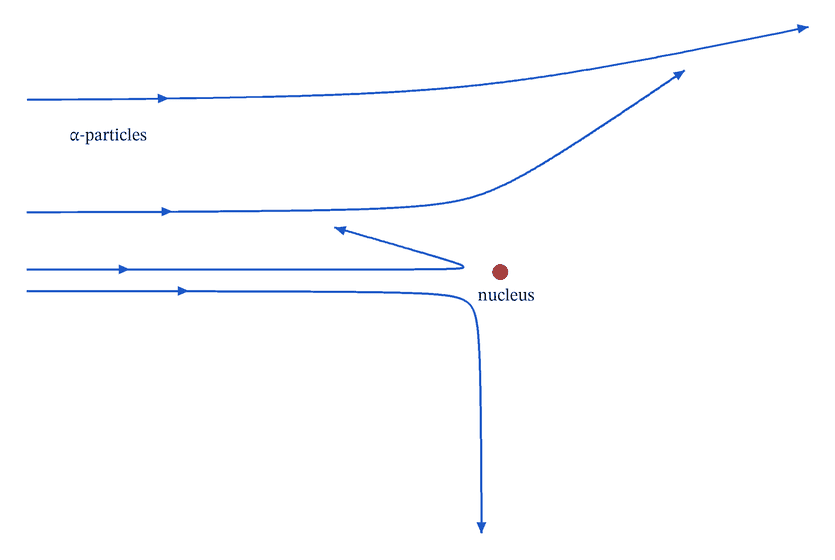
Therefore, an atom has a tiny central nucleus holding all its positive charge and almost all its mass, and the rest of the atom, where the electrons move, is mostly empty space.