
Opening your dashboard
Class 12 Physics Chapter 26 Atoms - Energy Levels: Competency-Based Questions (CBQ)
42 questions on Chapter 26, each worked through on its own page with the AI tutor. Class 12 Physics, ICSE 2026-27.
42 questions
1–4 marks · Mixed difficulty
- 13 marks
Question 1
Competency: Analysis & Evaluation
In 1913 Hans Geiger and Ernest Marsden tested Rutherford's new nuclear model. α-particles from a radioactive source struck a thin gold foil, and a small zinc sulphide screen, viewed through a microscope, was turned to different scattering angles . They counted the tiny flashes made on the screen in equal times. Some of the counts they reported for the gold foil are given below.
Scattering angle Relative count 33.1 69.5 477 7800 Rutherford's nuclear model predicts that, for the same source, foil and counting time, is proportional to .
(a) Find the value of at each angle.
(b) Explain how your results support Rutherford's nuclear model.
(c) In Thomson's model, the positive charge is spread through the whole atom, and one atom can turn an α-particle through only a small fraction of a degree. Explain why the count at is strong evidence against Thomson's model.
- 21 mark
Question 2
Competency: Analysis & Evaluation
In their 1913 experiments, Geiger and Marsden fired α-particles from a radioactive source at thin metal foils and counted the tiny flashes that the scattered α-particles made on a zinc sulphide screen, viewed through a microscope.
Assertion (A): The source, the foil and the screen were kept inside a metal box from which the air had been pumped out.
Reason (R): In air, α-particles lose their energy by ionising the gas molecules, and they travel only a few centimetres.
- 31 mark
Question 3
Competency: Application
A student compares two pictures of a gold atom. In Thomson's model, the positive charge of the atom is spread through a sphere of radius , the size of the atom. In Rutherford's model, the same charge is packed into a nucleus of radius (). Outside a uniformly charged sphere of charge , the electric field at distance from its centre is , so the strongest field outside the sphere is at its surface.
By about what factor is this strongest field larger in Rutherford's model than in Thomson's model?
- 43 marks
Question 4
Competency: Analysis & Evaluation
In 1919 Rutherford fired α-particles into nitrogen gas and found that a few nitrogen nuclei were changed and gave out protons, so some α-particles must have come very close to a nitrogen nucleus. A student estimates how close an α-particle of kinetic energy (from polonium-210) can come to a nitrogen nucleus () in a head-on collision.
A nitrogen nucleus is light, so it recoils. When the target nucleus is free to move, only the fraction of the α-particle's kinetic energy can be turned into electric potential energy at the closest approach, where is the mass of the α-particle and that of the target nucleus. Take the masses in the ratio of the mass numbers: 4 for the α-particle and 14 for nitrogen. Take , and .
(a) Find the distance of closest approach if the nitrogen nucleus is assumed to stay at rest.
(b) Find the distance of closest approach when the recoil of the nitrogen nucleus is allowed for.
(c) For a gold nucleus (mass number 197), by about what percentage does allowing for the recoil increase the distance of closest approach? Explain why Rutherford could treat the gold nucleus as fixed.
- 51 mark
Question 5
Competency: Application
A science museum is building a scale model of a hydrogen atom in which the proton is a table-tennis ball of radius . The proton has a radius of about (), and in Bohr's model the electron's ground-state orbit has a radius of ().
On the same scale, the electron's orbit would be a circle of radius about
- 61 mark
Question 6
Competency: Analysis & Evaluation
A student writes two statements in their notes on Rutherford's nuclear model of the atom.
Assertion (A): According to classical electromagnetic theory, the electron revolving round the nucleus in Rutherford's model should lose energy continuously and spiral into the nucleus.
Reason (R): The nucleus contains nearly all the mass of the atom.
- 73 marks
Question 7
Competency: Analysis & Evaluation
In 1914 James Franck and Gustav Hertz sent electrons through mercury vapour at low pressure. Electrons from a hot cathode were accelerated by a voltage towards a wire-mesh grid, passed through it, and reached a collecting plate against a small opposing voltage of ; the electrons that reached the plate formed the current. As was raised, the current rose but fell sharply just after , and , as the graph shows. At the same time the vapour gave out ultraviolet light. (Hypothetical data.) Take .
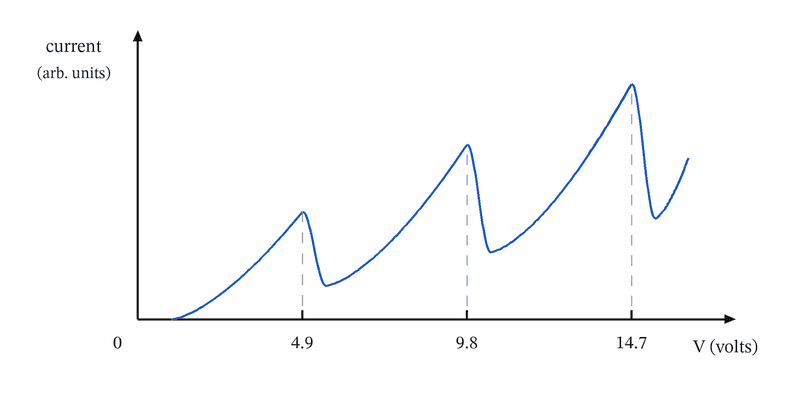
(a) Explain why the current falls sharply just after , and what this shows about the energies that a mercury atom can have.
(b) Each excited atom gives out one photon as it returns to its ground state. Find the wavelength of the ultraviolet light.
(c) An electron is accelerated through . What is the largest number of mercury atoms it can excite on its way to the grid? If it excites that many, can it still reach the plate?
- 81 mark
Question 8
Competency: Analysis & Evaluation
A student looks at a red-orange neon sign through a diffraction grating.
Assertion (A): The light from the sign is seen as a set of separate bright lines of different colours, not as a continuous band of colours.
Reason (R): Neon is a noble gas whose atoms hardly ever form chemical compounds.
- 91 mark
Question 9
Competency: Analysis & Evaluation
In 1868, astronomers studying the light from the glowing gas at the edge of the Sun found a bright yellow line at . It lay close to, but not at, the two yellow lines of sodium ( and ), and it matched no line of any element then known. They concluded that it came from a new element, later named helium, which was found on Earth in 1895.
Which idea from Bohr's theory best explains why one unmatched line could be taken as the sign of a new element?
- 103 marks
Question 10
Competency: Application
Positronium is a short-lived "atom" made of an electron and a positron. The positron is the electron's antiparticle: it has the same mass as the electron but a charge . Positronium forms when positrons slow down in matter, for example in the body during a PET scan. The two particles circle their common centre , which lies midway between them, as shown.
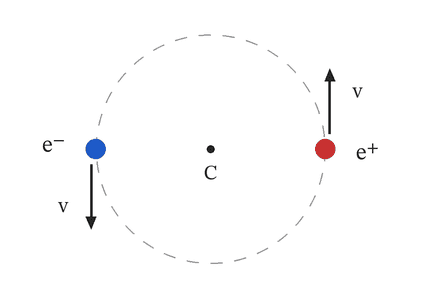
Bohr's results for hydrogen can be used for such a two-particle atom if the electron's mass is replaced by the reduced mass : the energies are then proportional to , and the radius formula gives the distance between the two particles, which is proportional to . For hydrogen, with the electron's mass , take the ground-state energy as and the ground-state radius as . Take .
(a) Find for positronium as a fraction of , and the ground-state energy of positronium.
(b) Find the energy needed to raise positronium from to , and the wavelength of the photon given out in the reverse jump. (The measured energy gap is .)
(c) Find the distance between the electron and the positron in the ground state, and the radius of the circle on which each of them moves.
- 111 mark
Question 11
Competency: Analysis & Evaluation
In a gas at room temperature and normal atmospheric pressure, neighbouring particles are on average about apart. A student argues that an excited hydrogen atom in such a gas can keep its electron orbit undisturbed only if the diameter of the orbit is smaller than this spacing. In Bohr's model the radius of orbit is .
By this rule, what is the highest level that a hydrogen atom in such a gas can reach without being disturbed?
- 121 mark
Question 12
Competency: Analysis & Evaluation
A student estimates how strong the electric field is inside a hydrogen atom. In Bohr's model the electron's ground-state orbit has a radius of (). Dry air breaks down and sparks in a field of about . Take and .
Assertion (A): The electric field of the proton at the electron's ground-state orbit is more than times the field at which air breaks down.
Reason (R): The electric field of a point charge is inversely proportional to the distance from it.
- 133 marks
Question 13
Competency: Analysis & Evaluation
An astronomer records the spectrum of a distant galaxy and finds two bright lines, at and , as shown. (Hypothetical data.) In the laboratory, the first three Balmer lines of hydrogen are Hα at , Hβ at and Hγ at . Because the galaxy is moving away from us, every wavelength in its light reaches us stretched by the same factor; this is called a redshift.
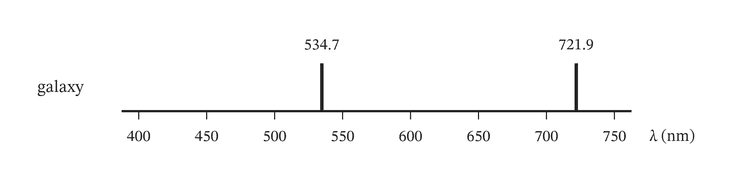
(a) Show that the two lines are the Hα and Hβ lines of hydrogen.
(b) Find the factor by which the wavelengths are stretched.
(c) At what wavelength should the astronomer look for the Hγ line of this galaxy?
- 144 marks
Question 14
Competency: Analysis & Evaluation
In 1896 Edward Pickering found a series of lines in the spectrum of the hot star ζ Puppis. Some of them fall almost exactly on the Balmer lines of hydrogen, but others, such as a line at , fall between them. At first many astronomers thought these lines were a new series of hydrogen. In 1913 Bohr showed that they come from the helium ion He⁺ (), for which , with the electron ending in the level . For hydrogen, . Take .
(a) Show that, in Bohr's simple model, the He⁺ jump gives exactly the same wavelength as the Hα line of hydrogen (the jump ), and find this wavelength.
(b) Find the wavelength of the He⁺ jump , and show that no Balmer line of hydrogen has this wavelength.
(c) Explain why every He⁺ jump to from an even level matches a Balmer line exactly.
- 151 mark
Question 15
Competency: Application
In a hydrogen discharge lamp, the atoms are excited at most to the level , and every possible downward jump takes place. (Hypothetical data.) An infrared detector placed near the lamp responds to all wavelengths from to . Take .
How many different spectral lines of the lamp can the detector record?
- 161 mark
Question 16
Competency: Analysis & Evaluation
Students look at a hydrogen discharge tube through a diffraction grating and see a red line, Hα (), and a blue-green line, Hβ ().
Assertion (A): The Hα line is produced by a larger energy jump of the atom than the Hβ line.
Reason (R): Both the Hα line and the Hβ line are produced by jumps that end on the level .
- 171 mark
Question 17
Competency: Analysis & Evaluation
An astronomer wants to study the Lyman series of hydrogen in the light of a nearby star.
Assertion (A): The Lyman lines of a nearby star cannot be recorded by a telescope on the ground.
Reason (R): All Lyman lines have wavelengths shorter than about , and the Earth's atmosphere absorbs ultraviolet light of such short wavelengths.
- 184 marks
Question 18
Competency: Application
A fluorescent tube contains mercury vapour at low pressure, and electrons in the discharge excite the mercury atoms. The figure shows some energy levels of mercury, measured from the ground state (values rounded). Most of the light the atoms give out is ultraviolet light of wavelength , from the jump . A white coating on the inside of the glass absorbs this ultraviolet light and gives out visible light. Take .
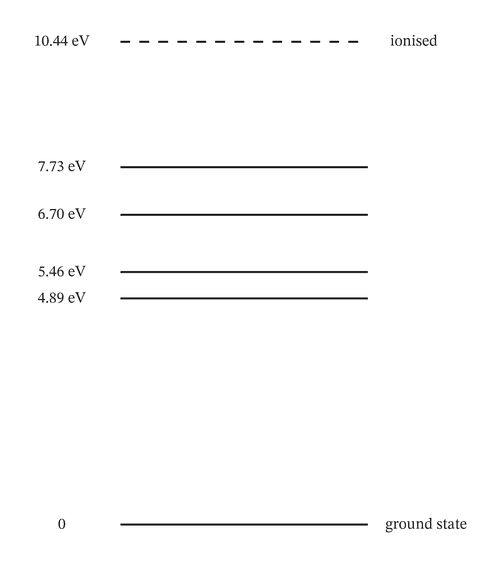
(a) Mercury atoms also give out a green line of in a jump that starts from the level. On which level does this jump end?
(b) Find the wavelength of the light given out in the jump , and state its colour.
(c) Suppose the coating turns each photon it absorbs into one photon of . What fraction of the energy of the ultraviolet light comes out as visible light? Explain why the coating could not turn one visible photon into one ultraviolet photon.
- 194 marks
Question 19
Competency: Analysis & Evaluation
The green and red light of the aurora (the northern and southern lights) comes mainly from oxygen atoms between about and above the ground, excited by fast electrons that arrive along the Earth's magnetic field lines. The figure shows three energy levels of an oxygen atom: the ground state and two excited levels, and above it. Take .

(a) Find the wavelengths of the light given out in the jumps and , and name their colours.
(b) An atom in the level gives out the light of the first jump and then the light of the second. Compare the total energy given out with the energy of the single photon it would give out by jumping straight to the ground state, and find the wavelength of that photon.
(c) On average an atom stays in the level for about before it gives out light, and in the level for about . A collision with another particle can take the energy away first: at a height of about this happens on average about after an atom is excited, and at about about after. (Hypothetical data.) Explain why the red light comes mainly from great heights, while the green light is also given out lower down.
- 201 mark
Question 20
Competency: Application
Many older street lights were low-pressure sodium lamps, which glow a deep yellow. Under such a lamp, a red car and a green car look almost the same dull colour. The figure shows some energy levels of the sodium atom, measured from its ground state 3s, with four downward jumps P, Q, R and S that take place in the lamp. Take , and take visible light to have wavelengths from to .
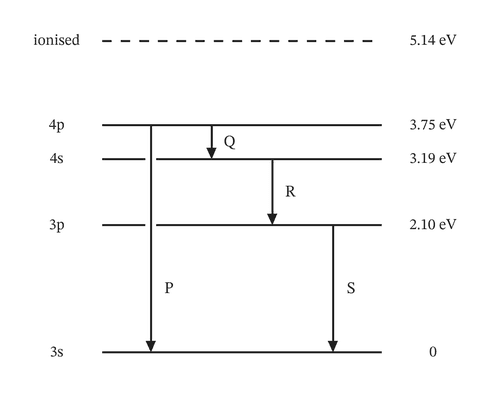
Which jump gives the lamp almost all of its visible light, and so explains why the colours look dull?
- 211 mark
Question 21
Competency: Analysis & Evaluation
A helium–neon laser gives a narrow beam of red light of wavelength . An electric discharge excites the helium atoms, which pass their energy to neon atoms in collisions; the neon atoms then give out the laser light. Take .
Assertion (A): The red light of a helium–neon laser is given out by neon atoms.
Reason (R): The energy of each photon, about , equals the energy of neon's upper laser level above its ground state.
- 221 mark
Question 22
Competency: Application
In a glowing gas cloud around a hot young star, ultraviolet starlight knocks the electrons off hydrogen atoms. A free electron with kinetic energy is then captured by a proton straight into the level , and a single photon is given out. (Hypothetical data.) Take and .
The wavelength of this photon is about
- 234 marks
Question 23
Competency: Analysis & Evaluation
The yellow light of a sodium lamp comes from the single outer electron of the sodium atom (). Ten of sodium's electrons are in the inner shells ( and ), and the outer electron is in the shell . The energy needed to remove this outer electron is measured to be . Two students try to predict this energy with Bohr's formula .
(a) Student P uses and . Find the energy that Student P predicts for removing the outer electron, and compare it with the measured value.
(b) Student Q says that the ten inner electrons cancel the charge of ten of the eleven protons, and uses and . Find Student Q's prediction and compare it with the measured value.
(c) Find the value of that, with , would give the measured . Explain why it lies between the two students' values, and what this shows about Bohr's model.
- 241 mark
Question 24
Competency: Analysis & Evaluation
In Bohr's model the electron in the ground state of hydrogen moves at on a circle of radius (). A student compares the electron's de Broglie wavelength with the size of this orbit. Take and .
Which statement is correct?
- 251 mark
Question 25
Competency: Analysis & Evaluation
A student studying hydrogen discharge tubes asks how long an excited hydrogen atom stays excited before it gives out a photon. (Measurements show that, for most of the low excited states, it is about to .)
Assertion (A): Bohr's model can be used to work out how long a hydrogen atom stays in an excited state before it gives out a photon.
Reason (R): Bohr's model gives the energy of each stationary state of hydrogen, and so the energy of each photon it can give out.
- 264 marks
Question 26
(Hypothetical data.) In Thomson's model, the positive charge of a gold atom is spread uniformly through a sphere of radius . An α-particle (charge , mass ) with kinetic energy passes through such an atom. Consider only the force of the positive sphere; the electrons are far too light to turn the α-particle aside. Take , and .
(i) The force on the α-particle is greatest at the surface of the sphere. Find this largest force.
(ii) Find the speed of the α-particle and the time it takes to travel a distance .
(iii) Take the sideways momentum the α-particle can gain from one atom to be at most (largest force) × (time to travel ). Estimate the largest angle, in degrees, through which one atom can turn the α-particle.
(iv) The gold foil is about 1400 atoms thick. Show that even if every atom turned the α-particle the same way, it could not be scattered through .
- 274 marks
Question 27
(Hypothetical data.) α-particles of kinetic energy fall normally on a gold foil () of thickness , which contains atoms per cubic metre. In Rutherford's theory, an α-particle with impact parameter is scattered through an angle given by , where is its distance of closest approach in a head-on collision. Take , and .
(i) Find .
(ii) Find the impact parameter for which an α-particle is scattered through exactly . Explain why every α-particle with a smaller impact parameter is scattered through more than .
(iii) Each gold nucleus thus acts as a target disc of radius facing the beam. Assuming that the discs of different nuclei do not overlap, estimate the fraction of the α-particles that are scattered through more than .
- 284 marks
Question 28
The figure shows, to scale, the energy levels of the atoms of a certain gas. (Hypothetical data.)
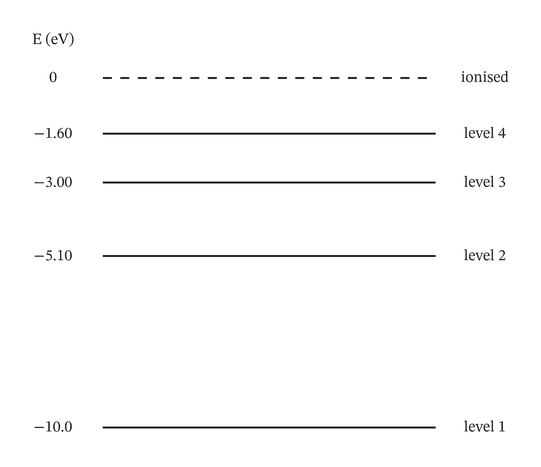
All the atoms are in level 1. A beam of electrons, each with a kinetic energy of , is passed through the gas. Take .
(a) To which excited levels can the electrons raise the atoms? Explain.
(b) Find the wavelengths of all the lines that the gas can then give out.
(c) If the electron beam is replaced by light whose photons each have an energy of , will this light be absorbed by the gas? Explain.
- 294 marks
Question 29
Bohr's model can be applied to the helium ion He⁺ (atomic number , one electron), for which and , with .
(a) Find the wavelength of the He⁺ line for the jump from to . (This line is observed at about .)
(b) Find the energy needed to remove the electron from He⁺ in its ground state. (The measured value is .)
(c) A student treats the neutral helium atom (two electrons) in the same way, giving each electron the Bohr ground-state energy of He⁺. What total energy does this predict for removing both electrons? The measured value is . Explain why Bohr's model fails here.
- 303 marks
Question 30
An alpha particle having kinetic energy of 8.7 MeV is projected towards the nucleus of copper with atomic number . Calculate its nearest distance of approach.
- 313 marks
Question 31
An -particle with kinetic energy 10 MeV is heading towards a stationary point nucleus of atomic number . Calculate the distance of closest approach.
- 323 marks
Question 32
In a head-on collision between the alpha particle and nucleus of gold, the closest distance of approach is 30 fermi. What is the initial kinetic energy of the alpha particle ()?
- 333 marks
Question 33
Find the velocity and frequency of the electron in the first orbit of hydrogen atom? Given, J s, C. Assume the radius of the first orbit of hydrogen to be 0.53 Å and kg.
- 343 marks
Question 34
Calculate the kinetic energy and potential energy of the electron in the first orbit of hydrogen.
- 353 marks
Question 35
The electron in the hydrogen atom makes a transition from the 2nd to the 5th orbit. Calculate the wavelength of the radiation absorbed (Rydberg constant ).
- 363 marks
Question 36
During the transition to the ground state, what is the longest wavelength of light that can be emitted by hydrogen?
- 373 marks
Question 37
The series limit wavelength of Balmer series in hydrogen spectrum is experimentally found to be 3646 Å. Find the wavelength of the first member of the series.
- 383 marks
Question 38
Hydrogen atom in its ground state is excited by means of a monochromatic radiation of wavelength 970.6 Å. How many different wavelengths are possible in the resulting emission spectrum? Find the longest wavelength amongst these.
- 394 marks
Question 39
The wavelength of the first line Lyman series for hydrogen is identical to that of the second line of Balmer series for hydrogen like ion . Calculate the energies of the first four level of . Also find its ionisation potential. Given ground state binding energy of hydrogen atom eV.
- 404 marks
Question 40
An electron of 68.0 eV is required to excite a hydrogen-like atom from its second Bohr orbit to the third. The nuclear charge is . Find the value of , the kinetic energy of the electron in the first Bohr orbit and the wavelength of the electromagnetic radiation required to eject the electron from the first Bohr orbit to infinity.
- 413 marks
Question 41
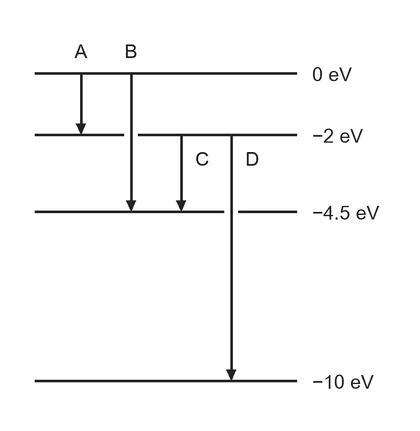
The energy levels of an atom are shown in the figure. Which one of these transitions results in the emission of a photon of wavelength 275 nm?
- 423 marks
Question 42
On an energy level diagram of hydrogen atom, show by a downward or an upward arrow, a transition responsible for
(i) emission lines of Balmer series
(ii) emission lines of Lyman series
(iii) absorption lines of Lyman series