
Competency: Analysis & Evaluation
In 1914 James Franck and Gustav Hertz sent electrons through mercury vapour at low pressure. Electrons from a hot cathode were accelerated by a voltage towards a wire-mesh grid, passed through it, and reached a collecting plate against a small opposing voltage of ; the electrons that reached the plate formed the current. As was raised, the current rose but fell sharply just after , and , as the graph shows. At the same time the vapour gave out ultraviolet light. (Hypothetical data.) Take .
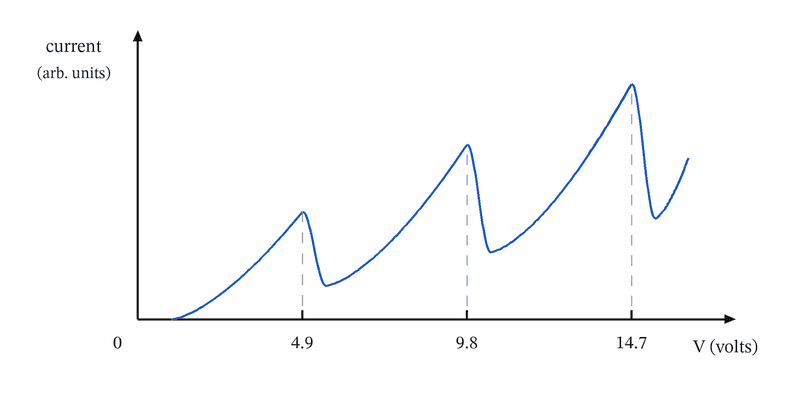
(a) Explain why the current falls sharply just after , and what this shows about the energies that a mercury atom can have.
(b) Each excited atom gives out one photon as it returns to its ground state. Find the wavelength of the ultraviolet light.
(c) An electron is accelerated through . What is the largest number of mercury atoms it can excite on its way to the grid? If it excites that many, can it still reach the plate?