
Competency: Application
Positronium is a short-lived "atom" made of an electron and a positron. The positron is the electron's antiparticle: it has the same mass as the electron but a charge . Positronium forms when positrons slow down in matter, for example in the body during a PET scan. The two particles circle their common centre , which lies midway between them, as shown.
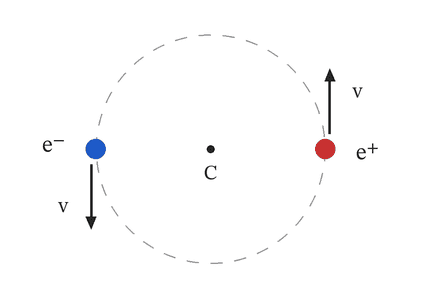
Bohr's results for hydrogen can be used for such a two-particle atom if the electron's mass is replaced by the reduced mass : the energies are then proportional to , and the radius formula gives the distance between the two particles, which is proportional to . For hydrogen, with the electron's mass , take the ground-state energy as and the ground-state radius as . Take .
(a) Find for positronium as a fraction of , and the ground-state energy of positronium.
(b) Find the energy needed to raise positronium from to , and the wavelength of the photon given out in the reverse jump. (The measured energy gap is .)
(c) Find the distance between the electron and the positron in the ground state, and the radius of the circle on which each of them moves.