
Opening your dashboard
Class 12 Maths Chapter 23: Linear Programming Solutions
47 textbook questions with step-by-step answers, free to read, for ISC 2026-27.
Get talked through Ch 23, not just shown the answer
Reading a finished solution is not the same as being able to do it. The AI tutor takes one question at a time and works it with you, in your own words, until you can.
- Ask it out loud, in your own words
- It gives you the next step, not the answer
- Stuck on part (ii)? Start there
47 questions with solutions
3 marks · Mixed difficulty
The first 15 solutions are on this page. This chapter is a long one, so the rest open on their own page to keep this one quick to load.
- 13 marks
Question 1
A dealer wishes to purchase a number of geysers and fans. He has only ₹ 57,600 to invest and has space for at most 20 items. A geyser costs him ₹ 3600 and a fan ₹ 2400. His expectation is that he can sell a geyser at a profit of ₹ 220 and a fan at a profit of ₹ 180. Assuming that he can sell all the items he can buy, formulate it as an LPP to maximize his profit?
Solve with AIWritten solution
Solution:
Key idea: A linear programming problem (LPP) has three parts: the decision variables (the quantities we choose), a linear objective function to be maximized or minimized, and linear constraints (the restrictions, including non-negativity). We build each part from the words of the question.
Step 1 — Choose the decision variables.
Let the dealer buy geysers and fans. These are the two numbers the dealer is free to choose.
Step 2 — Write the objective function.
Each geyser gives a profit of ₹ 220 and each fan a profit of ₹ 180, so the total profit (in ₹) is
The dealer wants this profit to be as large as possible, so is to be maximized.
Step 3 — Write the money constraint.
The geysers cost ₹ 3600 each and the fans ₹ 2400 each, and the dealer has only ₹ 57,600, so the total cost cannot exceed 57,600.
Dividing every term by 1200 (a positive number, so the inequality sign stays the same) gives smaller numbers.
Step 4 — Write the space constraint.
There is space for at most 20 items in all, so the total number of geysers and fans is at most 20.
Step 5 — Add the non-negativity conditions.
The dealer cannot buy a negative number of items, so both variables are at least zero.
Step 6 — Collect the LPP.
We now write the objective function and all the constraints together.
Therefore, the LPP is: maximize subject to , , and .
- 23 marks
Question 2
A decorative item dealer deals in only two items: wall hangings and artificial plants. He has ₹ 15,000 to invest and a space to store at the most 80 pieces. A wall hanging costs him ₹ 300 and artificial plant ₹ 150. He can sell a wall hanging at a profit of ₹ 50 and artificial plant at a profit of ₹ 18. Assuming that he can sell all the items that he buys, formulate a linear programming problem in order to maximize his profit.
Solve with AIWritten solution
Solution:
Key idea: A linear programming problem (LPP) has three parts: the decision variables (the quantities we choose), a linear objective function to be maximized or minimized, and linear constraints (the restrictions, including non-negativity). We build each part from the words of the question.
Step 1 — Choose the decision variables.
Let the dealer buy wall hangings and artificial plants.
Step 2 — Write the objective function.
A wall hanging gives a profit of ₹ 50 and an artificial plant a profit of ₹ 18, so the total profit (in ₹) is
This profit is to be maximized.
Step 3 — Write the investment constraint.
The items cost ₹ 300 and ₹ 150 each, and the dealer can invest at most ₹ 15,000.
Dividing every term by 150 keeps the inequality and simplifies it.
Step 4 — Write the storage constraint.
The store holds at most 80 pieces, so the total number of items bought is at most 80.
Step 5 — Add the non-negativity conditions.
Numbers of items cannot be negative.
Step 6 — Collect the LPP.
We write the objective function and the constraints together.
Therefore, the LPP is: maximize subject to , , and .
- 33 marks
Question 3
Sameer wants to invest at most ₹ 15,000 in Saving certificates and in National Savings Bonds. According to rules, he has to invest at least ₹ 2000 in Saving certificates and at least ₹ 3000 in National Saving Bonds. If the rate of interest on Saving certificates is 8% p.a. and the rate of interest on the National Saving Bonds is 10% p.a.; how should he invest to earn maximum profit? Formulate a LP problem.
Solve with AIWritten solution
Solution:
Key idea: A linear programming problem (LPP) has three parts: the decision variables (the quantities we choose), a linear objective function to be maximized or minimized, and linear constraints (the restrictions, including non-negativity). We build each part from the words of the question. Interest at per annum on ₹ for one year is .
Step 1 — Choose the decision variables.
Let Sameer invest ₹ in Saving certificates and ₹ in National Savings Bonds.
Step 2 — Write the objective function.
The certificates earn 8% a year and the bonds 10% a year, so the yearly interest (in ₹) is
Writing the fractions as decimals gives the objective in its simplest form.
The interest (the "profit" in the question) is to be maximized.
Step 3 — Write the total-investment constraint.
Sameer can invest at most ₹ 15,000 altogether.
Step 4 — Write the rule constraints.
The rules ask for at least ₹ 2000 in certificates and at least ₹ 3000 in bonds.
These two conditions already make and positive, so no separate non-negativity condition is needed.
Step 5 — Collect the LPP.
We write the objective function and the constraints together.
Therefore, the LPP is: maximize subject to , and .
- 43 marks
Question 4
A retired person wants to invest an amount up to ₹ 20,000. His broker recommends investing in two types of bonds and ; bond yielding 10% return on the amount invested and bond yielding 15% return on the amount invested. After some consideration, he decides to invest at least ₹ 5000 in bond and at least ₹ 8000 in bond . He also wants to invest at least as much in bond as in bond . What should his broker suggest if he wants to maximize his return on investments? Formulate LPP.
Solve with AIWritten solution
Solution:
Key idea: A linear programming problem (LPP) has three parts: the decision variables (the quantities we choose), a linear objective function to be maximized or minimized, and linear constraints (the restrictions, including non-negativity). We build each part from the words of the question. A return of on ₹ is .
Step 1 — Choose the decision variables.
Let ₹ be invested in bond and ₹ in bond .
Step 2 — Write the objective function.
Bond returns 10% and bond returns 15% of the amount invested, so the total return (in ₹) is
Writing the fractions as decimals gives
The return is to be maximized.
Step 3 — Write the total-amount constraint.
The person invests an amount up to ₹ 20,000.
Step 4 — Write the minimum-amount constraints.
At least ₹ 5000 goes into bond and at least ₹ 8000 into bond .
Step 5 — Write the comparison constraint.
The person invests at least as much in bond as in bond , so the amount in is not less than the amount in .
Step 6 — Note the non-negativity conditions.
Amounts invested cannot be negative; here and already guarantee this.
Step 7 — Collect the LPP.
We write the objective function and all the constraints together.
Therefore, the LPP is: maximize subject to , , , , and .
- 53 marks
Question 5
A manufacturer produces TVs and VCR in his factory. Production of each TV requires 4 hours of assembly in workshop 1 and 2 hours of assembly in workshop 2, whereas production of each VCR requires 2 hours of assembly in workshop 1 and 5 hours of assembly in workshop 2. Workshop 1 and workshop 2 function for 40 hours and 60 hours in a week, respectively. The profit on each TV is ₹ 3000 and each VCR is ₹ 4000. Assuming that all TVs and VCR are sold in the market, what should be the strategy of the manufacturer to earn maximum profit? Formulate a LP problem.
Solve with AIWritten solution
Solution:
Key idea: A linear programming problem (LPP) has three parts: the decision variables (the quantities we choose), a linear objective function to be maximized or minimized, and linear constraints (the restrictions, including non-negativity). We build each part from the words of the question. When several resources are involved, a small table of hours needed and hours available keeps the constraints straight.
Step 1 — Choose the decision variables.
Let the manufacturer produce TVs and VCRs in a week.
Step 2 — Write the objective function.
Each TV gives a profit of ₹ 3000 and each VCR a profit of ₹ 4000, so the weekly profit (in ₹) is
This profit is to be maximized.
Step 3 — Arrange the hours in a table.
The table lists the assembly hours each item needs in each workshop and the hours each workshop works in a week.
TV VCR Hours available Workshop 1 4 2 40 Workshop 2 2 5 60 Step 4 — Write the workshop constraints.
In workshop 1 the TVs use hours and the VCRs hours, and the total cannot exceed 40 hours.
In workshop 2 the TVs use hours and the VCRs hours, and the total cannot exceed 60 hours.
Step 5 — Add the non-negativity conditions.
The numbers of TVs and VCRs cannot be negative.
Step 6 — Collect the LPP.
We write the objective function and the constraints together.
Therefore, the LPP is: maximize subject to , , and .
- 63 marks
Question 6
A small-scale industrialist produces three types of machines components , and made of steel and brass. The amounts of steel and brass required for each component and the number of man-weeks of labour required to manufacture and assemble one unit of each component are as follows.
Availability Steel 6 5 3 100 kg Brass 3 4 9 75 kg Man-weeks 1 2 1 20 weeks The labour is restricted to 20 man-weeks, steel is restricted to 100 kg per week and the brass to 75 kg per week. The industrialist's profit on each unit of , and is ₹ 6, ₹ 4 and ₹ 7, respectively. Give its mathematical formulation as a linear programming problem such that the total profit is maximum.
Solve with AIWritten solution
Solution:
Key idea: A linear programming problem (LPP) has three parts: the decision variables (the quantities we choose), a linear objective function to be maximized or minimized, and linear constraints (the restrictions, including non-negativity). We build each part from the words of the question. Each row of the given table (one resource) gives one constraint.
Step 1 — Choose the decision variables.
Let , and units of components , and be produced per week.
Step 2 — Write the objective function.
The profits are ₹ 6, ₹ 4 and ₹ 7 per unit, so the weekly profit (in ₹) is
This profit is to be maximized.
Step 3 — Write the steel constraint.
The steel row of the table gives 6, 5 and 3 kg per unit, and only 100 kg is available per week.
Step 4 — Write the brass constraint.
The brass row gives 3, 4 and 9 kg per unit, and only 75 kg is available per week.
Step 5 — Write the labour constraint.
The labour row gives 1, 2 and 1 man-weeks per unit, and labour is restricted to 20 man-weeks.
Step 6 — Add the non-negativity conditions.
The numbers of components cannot be negative.
Step 7 — Collect the LPP.
We write the objective function and the constraints together.
Therefore, the LPP is: maximize subject to , , and .
- 73 marks
Question 7
A cold drink company has three bottling plants, located at two different places. Each plant produces three different drinks , and . The capacities of three plants, in number of bottles per day are as follows.
Product Product Product Plant I 3000 1000 2000 Plant II 1000 1000 4000 Plant III 2000 500 3000 A market survey indicates that during any particular month there will be a demand of 24,000 bottles of , 16,000 bottles of and 48,000 bottles of . The operating costs, per day, of running plants I, II and III are respectively ₹ 600, ₹ 400 and ₹ 500. Formulate it as a linear programming problem to find the number of days. Should the company run each plant during the month so that the production cost is minimized while still meeting up the market demand? Formulate a LP problem.
Solve with AIWritten solution
Solution:
Key idea: A linear programming problem (LPP) has three parts: the decision variables (the quantities we choose), a linear objective function to be maximized or minimized, and linear constraints (the restrictions, including non-negativity). We build each part from the words of the question. Here each row of the table is a plant and each column is a drink, so each constraint is read down one column.
Step 1 — Choose the decision variables.
Let plants I, II and III run for , and days in the month.
Step 2 — Write the objective function.
Running the plants costs ₹ 600, ₹ 400 and ₹ 500 per day, so the monthly operating cost (in ₹) is
This cost is to be minimized.
Step 3 — Write the constraint for drink A.
The column for drink shows 3000, 1000 and 2000 bottles per day from plants I, II and III. At least 24,000 bottles are needed in the month.
Step 4 — Write the constraint for drink B.
The column for drink shows 1000, 1000 and 500 bottles per day. At least 16,000 bottles are needed.
Step 5 — Write the constraint for drink C.
The column for drink shows 2000, 4000 and 3000 bottles per day. At least 48,000 bottles are needed.
Step 6 — Add the non-negativity conditions.
A plant cannot run for a negative number of days.
Step 7 — Collect the LPP.
We write the objective function and the constraints together.
Note: The book's printed answer has the entries 500 and 4000 swapped in the and constraints. The table shows that plant III makes 500 bottles of and plant II makes 4000 bottles of per day, as used above.
Therefore, the LPP is: minimize subject to , , and .
- 83 marks
Question 8
A diet is to contain at least 80 units of vitamin and 100 units of minerals. Two foods and are available. Food costs ₹ 4 per unit and costs ₹ 5 per unit. A unit of food contains at least 3 units of vitamin and 4 units of minerals. A unit of food contains at least 6 units of vitamin and 3 units of minerals. Find the minimum cost for diet that consists of mixture of these two foods and also meets the minimal nutritional requirements. Formulate this as a linear programming problem.
Solve with AIWritten solution
Solution:
Key idea: A linear programming problem (LPP) has three parts: the decision variables (the quantities we choose), a linear objective function to be maximized or minimized, and linear constraints (the restrictions, including non-negativity). We build each part from the words of the question. A requirement of "at least" gives a "" constraint.
Step 1 — Choose the decision variables.
Let the diet contain units of food and units of food .
Step 2 — Write the objective function.
Food costs ₹ 4 per unit and costs ₹ 5 per unit, so the cost of the diet (in ₹) is
This cost is to be minimized.
Step 3 — Arrange the nutrients in a table.
The table gives the units of each nutrient in one unit of each food and the minimum needed.
Minimum needed Vitamin 3 6 80 Minerals 4 3 100 Step 4 — Write the nutrient constraints.
The diet gives units of vitamin , which must be at least 80.
The diet gives units of minerals, which must be at least 100.
Step 5 — Add the non-negativity conditions.
The amounts of food cannot be negative.
Step 6 — Collect the LPP.
We write the objective function and the constraints together.
Note: The question says each food contains "at least" the stated amounts; we use the stated amounts as the exact contents, which is the usual reading and the safe one (any extra only helps to meet the requirement).
Therefore, the LPP is: minimize subject to , , and .
- 93 marks
Question 9
Vitamins and are found in foods and . One unit of food contains 20 units of vitamin and 30 units of vitamin . One unit of food contains 60 units of vitamin and 40 units of vitamin . 1 unit of each of foods and cost ₹ 3 and ₹ 4, respectively. The minimum daily requirement (for a person) of vitamins and is 80 units and 100 units, respectively. Assuming that anything in excess of daily minimum requirements of vitamin and is not harmful, find out the optimum mixture of foods and at the minimum cost which meets the daily minimum requirements of vitamins and . Formulate the above problem as a LP problem.
Solve with AIWritten solution
Solution:
Key idea: A linear programming problem (LPP) has three parts: the decision variables (the quantities we choose), a linear objective function to be maximized or minimized, and linear constraints (the restrictions, including non-negativity). We build each part from the words of the question. A minimum daily requirement gives a "" constraint.
Step 1 — Choose the decision variables.
Let the mixture contain units of food and units of food .
Step 2 — Write the objective function.
One unit of costs ₹ 3 and one unit of costs ₹ 4, so the cost (in ₹) is
This cost is to be minimized.
Step 3 — Write the vitamin A constraint.
The mixture gives units of vitamin , and at least 80 units are needed.
Dividing by 20 gives the same condition in a simpler form.
Step 4 — Write the vitamin B constraint.
The mixture gives units of vitamin , and at least 100 units are needed.
Dividing by 10 gives the simpler form.
Step 5 — Add the non-negativity conditions.
The amounts of food cannot be negative.
Step 6 — Collect the LPP.
We write the objective function and the constraints together.
Therefore, the LPP is: minimize subject to (that is, ), (that is, ), and .
- 103 marks
Question 10
A housewife wishes to mix two types of food and in such a way that the vitamins contents of mixture contain at least 8 units of vitamin and 11 units of vitamin , food costs ₹ 60/kg and food costs ₹ 80/kg. Food contains 3 units/kg of vitamin and 5 units/kg of vitamin while food contains 4 units/kg of vitamin and 2 units/kg of vitamin . Formulate the above problem as a linear programming problem to minimize the cost of mixture.
Solve with AIWritten solution
Solution:
Key idea: A linear programming problem (LPP) has three parts: the decision variables (the quantities we choose), a linear objective function to be maximized or minimized, and linear constraints (the restrictions, including non-negativity). We build each part from the words of the question. Since the prices and vitamin contents are per kg, we measure both foods in kg.
Step 1 — Choose the decision variables.
Let the mixture contain kg of food and kg of food .
Step 2 — Write the objective function.
Food costs ₹ 60 per kg and costs ₹ 80 per kg, so the cost of the mixture (in ₹) is
This cost is to be minimized.
Step 3 — Write the vitamin A constraint.
The mixture gives units of vitamin , and at least 8 units are needed.
Step 4 — Write the vitamin B constraint.
The mixture gives units of vitamin , and at least 11 units are needed.
Step 5 — Add the non-negativity conditions.
The amounts of food cannot be negative.
Step 6 — Collect the LPP.
We write the objective function and the constraints together.
Therefore, the LPP is: minimize subject to , , and .
- 113 marks
Question 11
A small manufacturing firm produces two types of gadgets, and which are first processed in the foundry, then sent to the machine shop for finishing. The number of man-hours of labour required in each shop for the production of each unit of and of and the number of man-hours the firm has available per week are as under:
Foundry Machine shop Gadget 10 5 Gadget 6 4 Firm's capacity per week 1000 600 The profit on the sale of is ₹ 30 per unit as compared with ₹ 20 per unit of .
The problem is to determine the weekly production of gadgets and , so that total profit is maximized.
Formulate the above problem as a linear programming problem.
Solve with AIWritten solution
Solution:
Key idea: A linear programming problem (LPP) has three parts: the decision variables (the quantities we choose), a linear objective function to be maximized or minimized, and linear constraints (the restrictions, including non-negativity). We build each part from the words of the question. Each shop (one column of the table) gives one constraint.
Step 1 — Choose the decision variables.
Let the firm produce gadgets of type and gadgets of type per week.
Step 2 — Write the objective function.
The profit is ₹ 30 on each and ₹ 20 on each , so the weekly profit (in ₹) is
This profit is to be maximized.
Step 3 — Write the foundry constraint.
In the foundry each needs 10 man-hours and each needs 6, and 1000 man-hours are available per week.
Step 4 — Write the machine-shop constraint.
In the machine shop each needs 5 man-hours and each needs 4, and 600 man-hours are available per week.
Step 5 — Add the non-negativity conditions.
The numbers of gadgets cannot be negative.
Step 6 — Collect the LPP.
We write the objective function and the constraints together.
Therefore, the LPP is: maximize subject to , , and .
- 123 marks
Question 12
A certain manufacturer has 75 kg of cashew and 120 kg of groundnuts. These are to be mixed in 1 kg packages as follows: a low grade mixture 250 g of cashew, 750 g of groundnuts, whereas in a high grade mixture 500 g of cashew and 500 g of groundnuts. If the profit on low grade mixture is ₹ 2 per package and that of high grade mixture is ₹ 3 per package, how many packages of each mixture be made for a maximum profit? For this problem, derive the inequations and write the objective function. You need not draw the graph.
Solve with AIWritten solution
Solution:
Key idea: A linear programming problem (LPP) has three parts: the decision variables (the quantities we choose), a linear objective function to be maximized or minimized, and linear constraints (the restrictions, including non-negativity). We build each part from the words of the question. All quantities must be in the same unit, so we change grams to kilograms (1000 g = 1 kg).
Step 1 — Choose the decision variables.
Let packages of the low grade mixture and packages of the high grade mixture be made.
Step 2 — Write the objective function.
The profit is ₹ 2 on a low grade package and ₹ 3 on a high grade package, so the total profit (in ₹) is
This profit is to be maximized.
Step 3 — Change the amounts to kilograms.
Since 1000 g make 1 kg, a low grade package has 0.25 kg (250 g) of cashew and 0.75 kg (750 g) of groundnuts.
A high grade package has 0.5 kg (500 g) of cashew and 0.5 kg of groundnuts.
Step 4 — Write the cashew constraint.
The packages use kg of cashew, and only 75 kg is available.
Multiplying every term by 4 removes the decimals.
Step 5 — Write the groundnut constraint.
The packages use kg of groundnuts, and only 120 kg is available.
Multiplying every term by 4 removes the decimals.
Step 6 — Add the non-negativity conditions.
The numbers of packages cannot be negative.
Step 7 — Collect the LPP.
We write the objective function and the inequations together; the question does not ask for the graph.
Therefore, the objective function is (to be maximized) and the inequations are , , and .
- 133 marks
Question 13
A manufacturer has three machines I, II and III installed in his factory. Machines I and II are capable of being operated for at the most 12 hours, whereas machine III must be operated at least for 5 hours a day. He produces only two items, each requiring the use of the three machines.
The number of hours required for producing 1 unit of each of the items and on the three machines are given in the following table:
Items Machine I Machine II Machine III 1 2 1 2 1 He makes a profit of ₹ 60 on item and ₹ 40 on item . Assuming that he can sell all that he produces, how many of each item should he produce so as to maximize his profit? Formulate the above problem as a linear programming problem.
Solve with AIWritten solution
Solution:
Key idea: A linear programming problem (LPP) has three parts: the decision variables (the quantities we choose), a linear objective function to be maximized or minimized, and linear constraints (the restrictions, including non-negativity). We build each part from the words of the question. "At the most" gives "" and "at least" gives "".
Step 1 — Choose the decision variables.
Let units of item and units of item be produced per day.
Step 2 — Write the objective function.
The profit is ₹ 60 on each and ₹ 40 on each , so the daily profit (in ₹) is
This profit is to be maximized.
Step 3 — Write the constraint for machine I.
Machine I needs 1 hour for each and 2 hours for each , and it works at the most 12 hours.
Step 4 — Write the constraint for machine II.
Machine II needs 2 hours for each and 1 hour for each , and it works at the most 12 hours.
Step 5 — Write the constraint for machine III.
Machine III needs 1 hour for each and hours for each , and it must work at least 5 hours.
Multiplying by 4 gives the same condition without fractions.
Step 6 — Add the non-negativity conditions.
The numbers of items cannot be negative.
Step 7 — Collect the LPP.
We write the objective function and the constraints together.
Therefore, the LPP is: maximize subject to , , , and .
- 143 marks
Question 14
A company makes three different products , and by combining steel and rubber. Product requires 2 units of steel and 3 units of rubber and can be sold at a profit of ₹ 40 per unit. Product requires 3 units of steel and 3 units of rubber and can be sold at a profit of ₹ 45 per unit. Product requires 1 unit of steel and 2 units of rubber and can be sold at a profit of ₹ 24 per unit. There are 100 units of steel and 120 units of rubber available per day. What should be daily production of each of the products, so that the combined profit is maximum?
Solve with AIWritten solution
Solution:
Key idea: A linear programming problem (LPP) has three parts: the decision variables (the quantities we choose), a linear objective function to be maximized or minimized, and linear constraints (the restrictions, including non-negativity). We build each part from the words of the question. With three products we need three decision variables.
Step 1 — Arrange the data in a table.
The table shows the steel and rubber each product needs, the amounts available per day and the profit per unit.
Available per day Steel 2 3 1 100 Rubber 3 3 2 120 Profit (₹) 40 45 24 Step 2 — Choose the decision variables.
Let the company produce units of , units of and units of per day.
Step 3 — Write the objective function.
Reading the profit row, the daily profit (in ₹) is
This profit is to be maximized.
Step 4 — Write the steel constraint.
The steel row gives 2, 3 and 1 units per product, and 100 units are available per day.
Step 5 — Write the rubber constraint.
The rubber row gives 3, 3 and 2 units per product, and 120 units are available per day.
Step 6 — Add the non-negativity conditions.
The numbers of products cannot be negative.
Step 7 — Collect the LPP.
We write the objective function and the constraints together. With three variables this LPP is not solved by the two-dimensional graphical method, and the question asks only for the formulation.
Therefore, the LPP is: maximize subject to , and .
- 153 marks
Question 15
There is a factory located at each of the two places and . From these locations a certain commodity is delivered to each of the three depots situated at , and . The weekly requirements of the depots are, respectively, 5, 5 and 4 units of the commodity while the production capacity of the factories at and are, respectively, 8 and 6 units. The cost of transportation per unit is given below:
From \ To 16 10 15 10 12 10 (Cost in ₹ per unit.)
How many units should be transported from each factory to each depot in order that the transportation cost is minimum? Formulate the above linear programming problem mathematically.
Solve with AIWritten solution
Solution:
Key idea: In a transportation problem where the total supply equals the total demand, everything produced is sent. Then choosing two of the six amounts fixes all the others, so the problem has only two decision variables. Every amount sent must be at least zero, and these conditions become the constraints.
Step 1 — Compare supply and demand.
The two factories can supply this many units in a week:
The three depots need this many units in a week:
Supply equals demand, so every unit made is delivered.
Step 2 — Choose the decision variables.
Let factory send units to depot and units to depot .
Step 3 — Express the other four amounts.
Factory sends 8 units in all, so the rest of its output goes to .
Depot needs 5 units, so factory sends what does not.
Depot needs 5 units, so in the same way
Depot needs 4 units, of which sends , so sends the rest.
Step 4 — Write the total cost.
We multiply each amount by its cost per unit from the table and add the six products.
Opening the brackets gives
Collecting the terms, the terms and the constants gives the objective function.
This cost is to be minimized.
Step 5 — Write the constraints.
Every one of the six amounts must be at least zero. The amounts and give
The amount gives , that is
The amounts and give and , that is
The amount gives , that is
Step 6 — Collect the LPP.
We write the objective function and all the constraints together.
Therefore, with and the units sent from to and , the LPP is: minimize subject to , , , , and .
- 163 marks
Question 16
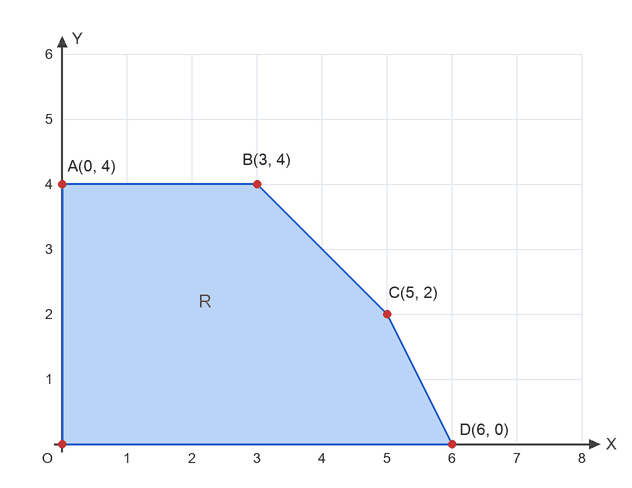
Find the maximum value of each expression on region shown in the figure below.
(i)
(ii)
- 173 marks
Question 17
Find the minimum value of each expression on region shown in the figure below.
(i)
(ii)

- 183 marks
Question 18
(i) Evaluate the linear expression at each corner point of the convex polygonal region shown in the graph below:

(ii) What is the minimum value of over the region shown in the graph above?
- 193 marks
Question 19
Refer to the following system of inequalities , , ,
(i) Graph the solution set of the system.
(ii) Determine the corner points of the region that represents the solution set.
(iii) Find the minimum value of each of the following linear expressions over the region graphed in (i) by evaluating the expression at each of the corner points.
(a) (b) (c)
- 203 marks
Question 20
Refer to the following system of inequalities.
, , , ,
(i) Graph the solution set of the system and label the corner points with their coordinates.
(ii) Find the minimum value of the expression over the region graphed in (i).
(iii) Find the maximum value of the expression over the region graphed in (i).
- 213 marks
Question 21
Minimize subject to the constraints
- 223 marks
Question 22
Minimize
subject to the constraints
- 233 marks
Question 23
Maximize
subject to the constraints
- 243 marks
Question 24
A manufacturer produces two products and . Both the products are processed on two different machines. The available capacity of the first machine is 12 hours and that of second machine is 9 hours. Each unit of product requires 3 hours on both machines and each unit of product requires 2 hours on first machine and 1 hour on the second machine. Each unit of product is sold at a profit of ₹ 5 and at a profit of ₹ 6, find the production level for maximum profit graphically.
- 253 marks
Question 25
A diet for a sick person must contain at least 4000 units of vitamins, 50 units of minerals and 1400 calories. Two foods and are available at a cost of ₹ 4 and ₹ 3 per unit, respectively. One unit of food contains 200 units of vitamins, 1 unit of minerals and 40 calories while one unit of food contains 100 units of vitamins, 2 units of minerals and 40 calories. Find what combinations of foods and should be used to have least cost, satisfying the requirements.
- 263 marks
Question 26
A small firm manufactures gold rings and chains. The combined number of rings and chains manufactured per day is at most 24. It takes one hour to make a ring and half an hour for a chain. The maximum number of hours available per day is 16. If the profit on a ring is ₹ 300 and on a chain is ₹ 190, how many of each should be manufactured daily so as to maximize the profit?
- 273 marks
Question 27
If a young man rides his motorcycle at 25 km/hr, he has to spend ₹ 2 per km on petrol, if he rides at a faster speed of 40 km/hr, the petrol cost increases to ₹ 5 per km. He has ₹ 100 to spend on petrol and wishes to find maximum distance he can travel within one hour. Express this as a linear programming problem and then solve it.
- 283 marks
Question 28
Every gram of wheat provides 0.1 g of protein and 0.25 g of carbohydrates. The corresponding values for rice are 0.05 g and 0.5 g, respectively. Wheat costs ₹ 4 per kg and rice ₹ 6 per kg. The minimum daily requirements of protein and carbohydrates for an average child are 50 g and 200 g, respectively. In what quantities should wheat and rice be mixed in the daily diet so as to provide the maximum daily requirements of protein and carbohydrates at minimum cost?
- 293 marks
Question 29
Two tailors and earn ₹ 150.00 and ₹ 200.00 per day, respectively. can stitch 6 shirts and 4 pants while can stitch 10 shirts and 4 pants per day. How many days shall each work if it is desired to produce (at least) 60 shirts and 32 pants at a minimum labour cost?
- 303 marks
Question 30
A dealer wishes to purchase a number of fans and sewing machines. He has only ₹ 57,600 to invest and has space for at most 20 items. A fan costs him ₹ 3600 and a sewing machine ₹ 2400. He expects to sell a fan at a profit of ₹ 220 and a sewing machine at a profit of ₹ 180. Assuming that he can sell all the items that he buys, how should he invest his money to maximize the profit? Solve graphically and find the maximum profit.
- 313 marks
Question 31
The principal of a school wants to buy some geometry boxes and some pocket dictionaries for giving prizes to 15 children. He wants to buy at least four of each. A geometry box costs ₹ 5 whereas a pocket dictionary costs ₹ 10. How many of each should he buy so that expenditure does not exceed ₹ 100 and at the same time he can buy the largest number of prizes?
- 323 marks
Question 32
Kellogg is a new cereal formed of a mixture of bran and rice that contains at least 88 g of protein and at least 36 mg of iron. Knowing that bran contains 80 g of protein and 40 mg of iron per kg, and that rice contains 100 g of protein and 30 mg of iron per kg, find the minimum cost of producing this new cereal if bran costs ₹ 5 kg and rice costs ₹ 4 per kg.
- 333 marks
Question 33
A manufacturer makes two products and . Product sells at ₹ 200 each and takes hour to make. Product sells at ₹ 300 each and takes one hour to make. There is a permanent order for 14 numbers of product and 16 numbers of product . A working week consists of 60 hours of production and the weekly turnover must not be less than ₹ 10,000.
If the profit on each of product is ₹ 20 and product is ₹ 30, then how many of each should be produced so that the profit is maximum? Also, find the profit.
- 343 marks
Question 34
In my school scholarship is to be given to the students of classes 11 and 12. The class teacher of 11th class said at least 5 students of his class should get the scholarship and the class teacher of 12th class said that at least 4 students of his class should get the scholarship. Each student of 11th class has to get ₹ 30 per month whereas each student of 12th class has to get ₹ 40 per month. The total number of students should be at least 10 but not more than 15. How many students of each class should be selected for the scholarship so as to
(i) minimize
(ii) maximize the amount for the scholarship?
- 353 marks
Question 35
A farmer decides to plant up to 10 hectares with cabbage and potatoes. He decided to grow at least 2, but not more than 8 hectares of cabbage and at least 1, but not more than 6 hectares of potatoes. Let us assume that he makes a profit of ₹ 1500 per hectare on potatoes and ₹ 2000 per hectare on cabbage. How should he plan his farming so as to get the maximum profit? (Assume that all the yield that he gets is sold).
- 363 marks
Question 36
A company manufactures two types of toys and . Type requires 5 minutes each for cutting and 10 minutes each for assembling. Type requires 8 minutes each for cutting and 8 minutes each for assembling. There are 3 hours available for cutting and 4 hours available for assembling in a day. The profit is ₹ 50 each on type and ₹ 60 each on type . How many toys of each type should the company manufacture in a day to maximize the profit?
- 373 marks
Question 37
A factory makes cricket bats and hockey sticks. A bat takes 1.5 hours of machine time and 2 hours of craftsman time while a hockey stick takes 2.5 hours of a machine time and 1.5 hours of craftsman time. In a day the factory has available up to 80 hours of machine time and 70 hours of craftsman time. Show that in order to make maximum profit the factory should produce only cricket bats given that the profits on a cricket bat and a hockey stick are ₹ 50 and ₹ 35, respectively.
- 383 marks
Question 38
A manufacturer produces two types of steel trunks. He has two machines and . The first type of trunk requires 3 hours on machine and 3 hours on machine . The second type requires 3 hours on machine and 2 hours on machine . Machines and can work at most for 18 hours and 15 hours per day, respectively. He earns a profit of ₹ 30 and ₹ 25 per trunk of the first type and second type, respectively. How many trunks of each type must he make each day to make maximum profit?
- 393 marks
Question 39
A small firm manufactures items and . The total number of items and that it can manufacture in a day is at the most 24. Item takes one hour to make while item takes only half an hour. The maximum time available per day is 16 hours. If the profit on one unit of item be ₹ 300 and one unit of item be ₹ 160, how many of each type of items be produced to maximize the profit? Solve the problem graphically.
- 403 marks
Question 40
Two godowns, and , have a grain storage capacity of 100 quintals and 50 quintals, respectively. Their supply goes to three ration shops, , and , whose requirements are 60, 50 and 40 quintals, respectively. The costs of transportation per quintal from the godowns to the shops are given in the following table.
To \ From 6.00 4.00 3.00 2.00 2.50 3.00 (Cost of transportation in ₹ per quintal.)
How should the supply be transported in order that the transportation cost is minimum?
- 413 marks
Question 41
An oil company has two depots, and , with capacities of 7000 L and 4000 L, respectively. The company is to supply oil to three petrol pumps , , whose requirements are 4500 L, 3000 L and 3500 L, respectively. The distances (in km) between the depots and the petrol pumps are given in the following table.
To \ From 7 3 6 4 3 2 (Distance in km.)
Assuming that the transportation cost per km is ₹ 1 per litre, how should the delivery be scheduled in order that the transportation cost is minimum?
- 423 marks
Question 42
A firm manufactures two types of products and and sells them at a profit of ₹ 5 per unit of type and ₹ 3 per unit of type . Each product is processed on two machines and . One unit of type requires one minute of processing time on and two minutes of processing time on , whereas one unit of type requires one minute of processing time on and one minute on . Machines and are respectively available for at most 5 hours and 6 hours in a day. Find out how many units of each type of product should the firm produce in a day in order to maximize the profit. Solve the problem graphically.
- 433 marks
Question 43
A producer has 30 and 17 units of labour and capital, respectively, which he can use to produce two types of goods and . To produce one unit of , 2 units of labour and 3 units of capital are required. Similarly, 3 units of labour and 1 unit of capital is required to produce one unit of . If and are priced at ₹ 100 and ₹ 120, respectively, how should the producer use his resources to maximize the total revenue? Solve the problem, graphically.
- 443 marks
Question 44
A farmer has a supply of chemical fertilizer of type I which contains 10% nitrogen and 6% phosphoric acid and type II fertilizer which contains 5% nitrogen and 10% phosphoric acid. After testing the soil conditions of a field, it is found that at least 14 kg of nitrogen and 14 kg of phosphoric acid is required for a good crop. The fertilizer type I costs ₹ 2.00 per kg and the type II costs ₹ 3.00 per kg. How many kilograms of each fertilizer should be used to meet the requirements and the cost be minimum.
- 453 marks
Question 45
A company produces two types of belts, and . Profits on these types are ₹ 2 and ₹ 1.5 on each belt, respectively. A belt of type requires twice as much time as a belt of type . The company can produce at the most 1000 belts per day. Material for 800 belts per day is available. At the most 400 buckles for belts of type and 700 for those of type are available per day. How many belts of each type should the company produce so as to maximize the profit?
- 463 marks
Question 46
An oil company requires 12,000, 20,000 and 15,000 barrels of high-grade, medium-grade and low-grade oil, respectively. Refinery produces 100, 300 and 200 barrels per day of high-grade, medium-grade and low-grade oil, respectively, while refinery produces 200, 400 and 100 barrels per day of high-grade, medium-grade and low-grade oil, respectively. If refinery costs ₹ 400 per day and refinery costs ₹ 300 per day to operate, how many days should each be run to minimize costs while satisfying requirements.
- 473 marks
Question 47
A company produces soft drinks that has a contract which requires that a minimum of 80 units of the chemical and 60 units of the chemical to go into each bottle of the drink. The chemicals are available in a prepared mix from two different suppliers. Supplier has a mix of 4 units of and 2 units of that costs ₹ 10, the supplier has a mix of 1 unit of and 1 unit of that costs ₹ 4. How many mixes from and should the company purchase to honour contract requirement and yet minimize cost?
What Class 12 Maths Ch 23 covers
The sections of the chapter, in the order the book takes them. Every question above comes from one of these.
- 01Linear Inequations in Two Variables
- 02Formulation of a Linear Programming Problem
- 03Graphical (Corner Point) Method of Solution
- 04Advantages and Limitations of Linear Programming
More ways to study this chapter
The same chapter asked three other ways. Practise it, revise it, and see what the board has set on Ch 23 before.
- Competency-Based Questions (CBQ)Case study questions: a situation, and the part of the chapter that answers it.40questionsOpen
- Previous Year QuestionsQuestions that have actually appeared in board papers, each tagged with its year.9questionsOpen
- Practice QuestionsExtra questions per chapter, for when one attempt at a method is not enough.109questionsOpen
Ch 23 in past ISC papers
The same chapter as the board has actually asked it. These are worded differently from the textbook exercise, which is the point of reading them.
- 15 marks
Board paper question 1
A dietician wishes to mix two kinds of food X and Y in such a way that the mixture contains at least 10 units of vitamin A, 12 units of vitamin B and 8 units of vitamin C. The vitamin contents of one kg food is given below:
Food Vitamin A Vitamin B Vitamin C X 1 unit 2 units 3 units Y 2 units 2 units 1 unit One kg of food X costs ₹ 24 and one kg of food Y costs ₹ 36. Using Linear Programming, find the least cost of the total mixture which will contain the required vitamins.
Solve with AIWritten solution
Solution:
Key idea: The feasible region is the set of points that satisfy every constraint. Here it is unbounded, so we compare at the corner points and then check that the open half-plane where is smaller than the least corner value has no point in common with the region; only then is that corner value the minimum.
Step 1 — Define the variables.
Let the mixture contain kg of food X and kg of food Y. Amounts cannot be negative, so and .
Step 2 — Write the objective function.
One kg of X costs ₹ 24 and one kg of Y costs ₹ 36. We call the total cost ₹ and minimise it.
Step 3 — Write the constraints.
Each kg of X gives 1 unit of vitamin A and each kg of Y gives 2 units, and at least 10 units are needed.
In the same way, vitamin B needs at least 12 units.
We divide this inequality by .
Vitamin C needs at least 8 units.
Step 4 — Draw the boundary lines and shade the feasible region.
We draw each boundary line through its points on the axes.
Boundary line Point on the x-axis Point on the y-axis The origin does not satisfy any of the three "at least" constraints (for example is false), so each allowed half-plane lies on the side of its line away from the origin. Together with and , this gives the unbounded shaded region below.
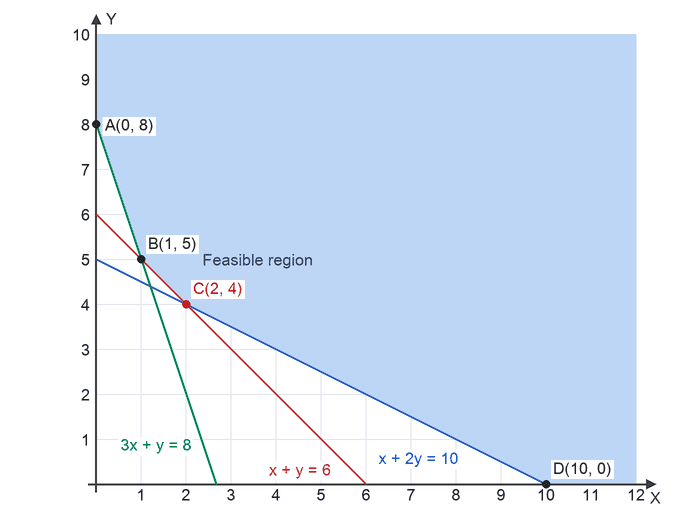
Step 5 — Find the corner points.
The line meets the y-axis at , and meets the x-axis at .
For , we solve and together. Subtracting the second equation from the first removes .
We substitute this value of into .
For , we solve and together. Subtracting the first equation from the second removes .
We substitute this value of into .
Both points satisfy the third constraint as well: at the value of is 11, and at the value of is 10.
Step 6 — Evaluate Z at each corner point.
We substitute each corner point into .
Corner point Working Value of (in ₹) The smallest corner value is 192, at .
Step 7 — Check the unbounded region.
Since the region is unbounded, we look at the open half-plane . Dividing by , it is . Every corner gives (24 at , 17 at , 16 at , 20 at ), and the region extends only upwards and to the right, where increases. So the half-plane has no point in common with the feasible region, and 192 is the minimum.
Therefore, the least cost of the mixture is ₹ 192, using 2 kg of food X and 4 kg of food Y.
- 25 marks
Board paper question 2
A company manufactures two types of products A and B. Each unit of A requires 3 grams of nickel and 1 gram of chromium, while each unit of B requires 1 gram of nickel and 2 grams of chromium. The firm can produce 9 grams of nickel and 8 grams of chromium. The profit is ₹ 40 on each unit of product of type A and ₹ 50 on each unit of type B. How many units of each type should the company manufacture so as to earn maximum profit? Use linear programming to find the solution.
Solve with AIWritten solution
Solution:
Key idea: The feasible region of a linear programming problem is the set of points that satisfy every constraint. If it is bounded, the maximum and the minimum of the objective function occur at corner points, so we find every corner point and compare the values of there.
Step 1 — Define the variables.
Let the company make units of product A and units of product B. The numbers of units cannot be negative, so and .
Step 2 — Write the objective function.
The profit is ₹ 40 on each unit of A and ₹ 50 on each unit of B. We call the total profit ₹ and maximise it.
Step 3 — Write the constraints.
We read "the firm can produce 9 grams of nickel and 8 grams of chromium" as the amounts of the two metals available, so the metal used cannot exceed them. Each unit of A uses 3 g of nickel and each unit of B uses 1 g.
Each unit of A uses 1 g of chromium and each unit of B uses 2 g.
Step 4 — Draw the boundary lines and shade the feasible region.
We draw each boundary line through its points on the axes.
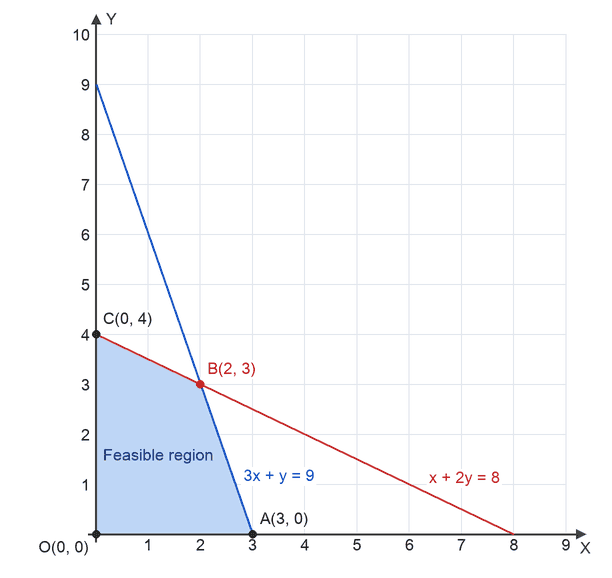
Boundary line Point on the x-axis Point on the y-axis The origin satisfies both constraints ( and ), so each allowed half-plane is on the origin's side of its line. With and , the feasible region is the shaded quadrilateral .
Step 5 — Find the corner points.
Three corners lie on the axes: , where meets the x-axis, and where meets the y-axis.
For , we solve the two boundary equations together. We multiply by and subtract , which removes .
We substitute this value of into .
Step 6 — Evaluate Z at each corner point.
We substitute each corner point into .
Corner point Working Value of (in ₹) The region is bounded, so the largest corner value, 230 at , is the maximum.
Therefore, the company should make 2 units of product A and 3 units of product B, for a maximum profit of ₹ 230.
- 35 marks
Board paper question 3
A farmer has a supply of chemical fertilizer of type A which contains 10% nitrogen and 6% phosphoric acid and of type B which contains 5% nitrogen and 10% phosphoric acid. After the soil test, it is found that at least 7 kg of nitrogen and the same quantity of phosphoric acid is required for a good crop. The fertilizer of type A costs ₹ 5.00 per kg and the type B costs ₹ 8.00 per kg. Using Linear programming, find how many kilograms of each type of fertilizer should be bought to meet the requirement and for the cost to be minimum. Find the feasible region in the graph.
Solve with AIWritten solution
Solution:
Key idea: The feasible region is the set of points that satisfy every constraint. Here it is unbounded, so we compare at the corner points and then check that the open half-plane where is smaller than the least corner value has no point in common with the region; only then is that corner value the minimum.
Step 1 — Define the variables.
Let the farmer buy kg of fertilizer A and kg of fertilizer B, with and .
Step 2 — Write the objective function.
Type A costs ₹ 5 per kg and type B costs ₹ 8 per kg. We call the total cost ₹ and minimise it.
Step 3 — Write the constraints.
Type A has nitrogen and type B has , and at least 7 kg of nitrogen is needed.
We multiply both sides by to clear the fractions.
Type A has phosphoric acid and type B has , and at least 7 kg is needed.
We multiply both sides by .
Step 4 — Draw the boundary lines and shade the feasible region.
We draw each boundary line through its points on the axes.
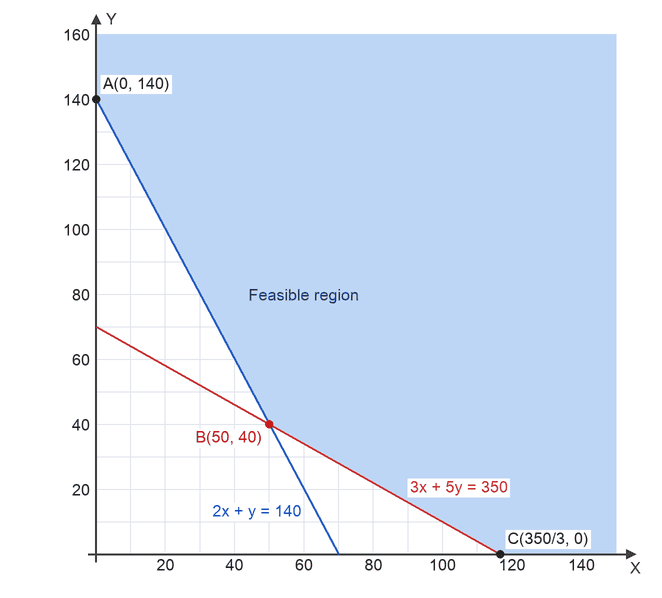
Boundary line Point on the x-axis Point on the y-axis The origin fails both constraints ( is false), so each allowed half-plane is on the side away from the origin. With and , the feasible region is the unbounded shaded region below.
Step 5 — Find the corner points.
The line meets the y-axis at , and meets the x-axis at .
For , we solve the two boundary equations together. We rearrange , and write ; then we substitute it into .
We substitute this value of into .
Step 6 — Evaluate Z at each corner point.
We substitute each corner point into .
Corner point Working Value of (in ₹) The smallest corner value is 570, at .
Step 7 — Check the unbounded region.
We look at the open half-plane . Every corner gives , and the region extends only upwards and to the right, where increases. So the half-plane has no point in common with the feasible region, and 570 is the minimum.
Therefore, the farmer should buy 50 kg of fertilizer A and 40 kg of fertilizer B, at a minimum cost of ₹ 570.
- 46 marks
Board paper question 4
A carpenter has 90, 80 and 50 running feet respectively of teak wood, plywood and rosewood which is used to produce product A and product B. Each unit of product A requires 2, 1 and 1 running feet and each unit of product B requires 1, 2 and 1 running feet of teak wood, plywood and rosewood respectively. If product A is sold for Rs 48 per unit and product B is sold for Rs 40 per unit, how many units of product A and product B should be produced and sold by the carpenter, in order to obtain the maximum gross income?
Formulate the above as a Linear Programming Problem and solve it, indicating clearly the feasible region in the graph.
Solve with AIWritten solution
Solution:
Key idea: The feasible region of a linear programming problem is the set of points that satisfy every constraint. If it is bounded, the maximum and the minimum of the objective function occur at corner points, so we find every corner point and compare the values of there.
Step 1 — Define the variables.
Let the carpenter make units of product A and units of product B, with and .
Step 2 — Write the objective function.
Product A sells for Rs 48 per unit and product B for Rs 40 per unit. We call the gross income Rs and maximise it.
Step 3 — Write the constraints.
Teak wood: each unit of A needs 2 running feet and each unit of B needs 1, out of 90.
Plywood: A needs 1 and B needs 2 running feet, out of 80.
Rosewood: A and B need 1 running foot each, out of 50.
Step 4 — Draw the boundary lines and shade the feasible region.
We draw each boundary line through its points on the axes.
Boundary line Point on the x-axis Point on the y-axis The origin satisfies all three constraints, so each allowed half-plane is on the origin's side of its line. With and , the feasible region is the shaded pentagon .
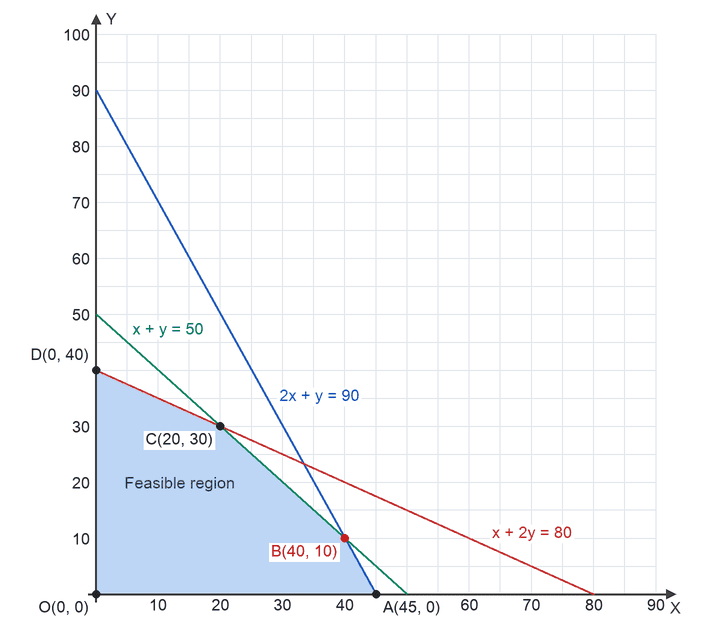
Step 5 — Find the corner points.
On the axes, the region ends at on and at on , because these are the nearest of the three lines to the origin along each axis.
For , we solve and together. Subtracting the second equation from the first removes .
We substitute this value of into .
For , we solve and together. Subtracting the second equation from the first removes .
We substitute this value of into .
Each point also satisfies the third constraint: at the plywood used is 60 running feet, and at the teak used is 70 running feet.
Step 6 — Evaluate Z at each corner point.
We substitute each corner point into .
Corner point Working Value of (in Rs) The region is bounded, so the largest corner value, 2320 at , is the maximum.
Therefore, the carpenter should make 40 units of product A and 10 units of product B, for a maximum gross income of Rs 2320.
- 56 marks
Board paper question 5
A company uses three machines to manufacture two types of shirts, half sleeves and full sleeves. The number of hours required per week on machine , and for one Shirt of each type is given in the following table :
Half sleeves 1 2 8/5 Full sleeves 2 1 8/5 None of the machines can be in operation for more than 40 hours per week. The profit on each half sleeve shirt is ₹ 1 and the profit on each full sleeve shirt is ₹ 1.50. How many of each type of shirts should be made per week to maximise the company's profit?
Solve with AIWritten solution
Solution:
Key idea: The feasible region of a linear programming problem is the set of points that satisfy every constraint. If it is bounded, the maximum and the minimum of the objective function occur at corner points, so we find every corner point and compare the values of there.
Step 1 — Define the variables.
Let the company make half sleeve shirts and full sleeve shirts per week, with and .
Step 2 — Write the objective function.
The profit is ₹ 1 on a half sleeve shirt and ₹ 1.50 on a full sleeve shirt. We call the weekly profit ₹ and maximise it.
Step 3 — Write the constraints.
No machine may run for more than 40 hours a week. For machine , the table gives 1 hour per half sleeve shirt and 2 hours per full sleeve shirt.
For machine , the hours are 2 and 1.
For machine , each shirt takes hours.
We multiply both sides by .
Step 4 — Draw the boundary lines and shade the feasible region.
We draw each boundary line through its points on the axes.
Boundary line Point on the x-axis Point on the y-axis The origin satisfies all three constraints, so each allowed half-plane is on the origin's side of its line. With and , the feasible region is the shaded pentagon .
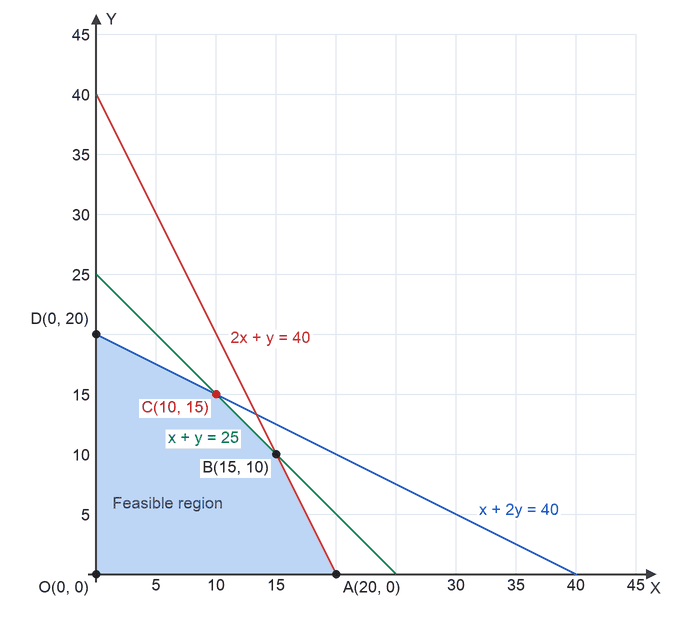
Step 5 — Find the corner points.
On the axes, the region ends at on and at on .
For , we solve and together. Subtracting the second equation from the first removes .
We substitute this value of into .
For , we solve and together. Subtracting the second equation from the first removes .
We substitute this value of into .
Each point also satisfies the remaining machine limit: at machine runs 35 hours, and at machine runs 35 hours.
Step 6 — Evaluate Z at each corner point.
We substitute each corner point into .
Corner point Working Value of (in ₹) The region is bounded, so the largest corner value, 32.5 at , is the maximum. Both numbers at are whole numbers, as numbers of shirts must be.
Therefore, the company should make 10 half sleeve shirts and 15 full sleeve shirts per week, for a maximum profit of ₹ 32.50 per week.
- 64 marks
Board paper question 6
Solve the following Linear Programming Problem graphically.
Maximize subject to:
Solve with AIWritten solution
Solution:
Key idea: The feasible region of a linear programming problem is the set of points that satisfy every constraint. If it is bounded, the maximum and the minimum of the objective function occur at corner points, so we find every corner point and compare the values of there.
Step 1 — Draw the boundary lines.
We replace each inequality by an equation and draw the line through two of its points.
Boundary line First point Second point Step 2 — Shade the feasible region.
The origin satisfies all three constraints (, and ), so each allowed half-plane is on the origin's side of its line. With and , the feasible region is the shaded pentagon .
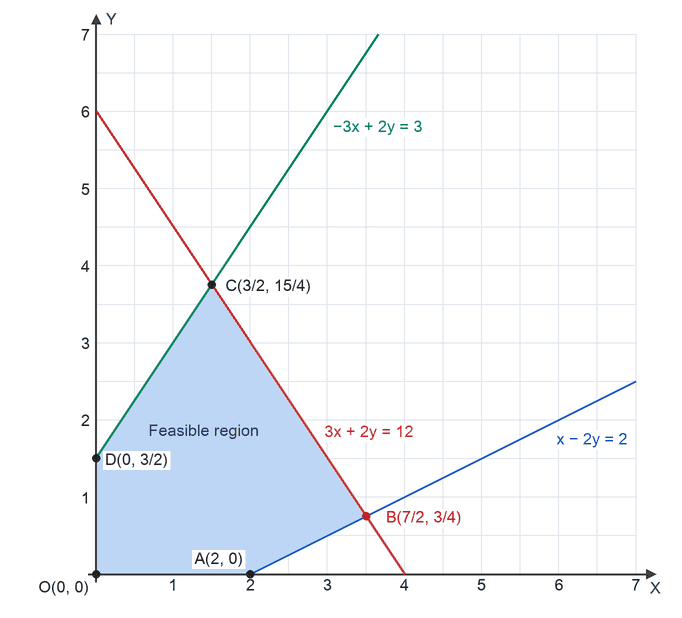
Step 3 — Find the corner points.
On the axes, meets the x-axis at and meets the y-axis at .
For , we solve and together. Adding the equations removes .
We put this value into , so .
For , we solve and together. Adding the equations removes .
We put this value into , so .
Step 4 — Evaluate Z at each corner point.
We substitute each corner point into .
Corner point Working Value of The region is bounded, so the largest corner value, 19 at , is the maximum.
Therefore, the maximum value of Z is 19, at and .
All 9 board paper questions for this chapter, solved the same way.
Class 12 Maths Ch 23 questions students ask
How many questions are there in Class 12 Maths Ch 23?
47 questions. Every one is solved step by step on this page.
Are these Class 12 Maths solutions free?
Yes. Every question and its full working is free to read, with no account needed.
Can I download the Class 12 Maths Ch 23 solutions as a PDF?
There is no PDF to download. Every solution is on this page instead, which means it is searchable, always the current syllabus, and readable on a phone. Use your browser's print option if you want it on paper.