
Question 213 marksMedium
Minimize subject to the constraints
Confirming your payment
Sign up now and get 250 free tokens.
Linear Programming · Question 21 of 47
Minimize subject to the constraints
Solution:
Key idea: Corner point method. When the feasible region is bounded, a linear expression takes its greatest and least values at corner points, so we evaluate it at every corner and compare. We draw each boundary line, test to find the correct side, and then find the corners.
Step 1 — Draw the boundary lines.
We draw each line from the two points where it meets the axes.
The line passes through and .
The line passes through and .
The line passes through and .
Step 2 — Shade the feasible region.
The origin satisfies (as ) but not or . So the region lies below the first line, above the other two, and in the first quadrant. It is bounded.
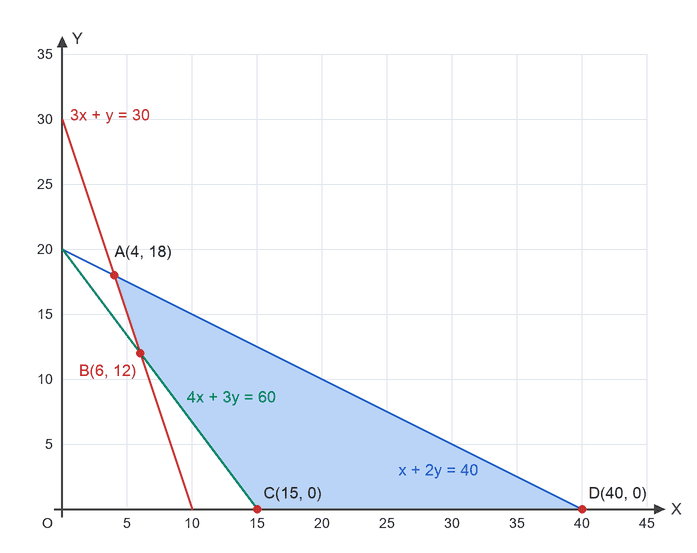
Step 3 — Find corner A.
Corner is where the lines and meet.
From the first equation , and we put this into the second.
Then , so and is .
Step 4 — Find corner B.
Corner is where the lines and meet.
Multiplying the first equation by 3 gives
Subtracting from this removes .
Then , so and is .
Step 5 — Find corners C and D.
The line meets the -axis at , and the line meets it at .
Step 6 — Evaluate Z at the corners.
We put each corner into .
| Corner point | |
|---|---|
| minimum | |
The least value is 240, at .
Therefore, the minimum value of is 240, when and .