
Question 223 marksMedium
Minimize
subject to the constraints
Confirming your payment
Sign up now and get 250 free tokens.
Linear Programming · Question 22 of 47
Minimize
subject to the constraints
Solution:
Key idea: Corner point method for an unbounded region. We evaluate the expression at every corner and take the smallest value . Because the region is unbounded, is the minimum only if the open half-plane "expression " has no point in common with the region; we check this by writing the expression as a sum of the constraint expressions with positive multipliers.
Step 1 — Draw the boundary lines.
The line passes through and .
The line passes through and .
Step 2 — Shade the feasible region.
The origin satisfies neither nor , so the region lies on the far side of both lines, in the first quadrant. It is unbounded.
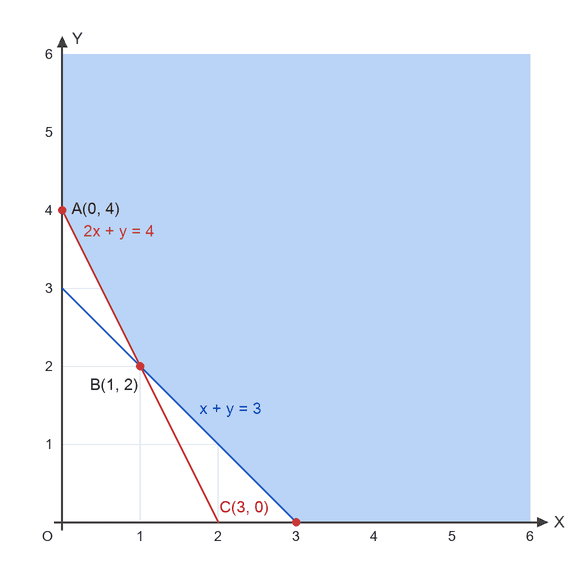
Step 3 — Find the corner points.
Corner is where meets the -axis, so is .
Corner is where the two lines meet.
We subtract the left sides and the right sides of and ; this removes .
Then , so and is .
Corner is where meets the -axis, so is .
Step 4 — Evaluate Z at the corners.
We put each corner into .
| Corner point | |
|---|---|
| minimum |
The smallest corner value is 9, at .
Step 5 — Check the unbounded region.
We write using the constraint .
Every feasible point has and , so . The open half-plane has no point in common with the region, so 9 is the minimum.
Therefore, the minimum value of is 9, at and .