Solution:
Key idea: The feasible region is the set of points that satisfy every constraint. Here it is unbounded, so we compare Z at the corner points and then check that the open half-plane where Z is smaller than the least corner value has no point in common with the region; only then is that corner value the minimum.
Step 1 — Define the variables.
Let the mixture contain x kg of food X and y kg of food Y. Amounts cannot be negative, so x≥0 and y≥0.
Step 2 — Write the objective function.
One kg of X costs ₹ 24 and one kg of Y costs ₹ 36. We call the total cost ₹ Z and minimise it.
Z=24x+36y
Step 3 — Write the constraints.
Each kg of X gives 1 unit of vitamin A and each kg of Y gives 2 units, and at least 10 units are needed.
x+2y≥10
In the same way, vitamin B needs at least 12 units.
2x+2y≥12
We divide this inequality by 2.
x+y≥6
Vitamin C needs at least 8 units.
3x+y≥8
Step 4 — Draw the boundary lines and shade the feasible region.
We draw each boundary line through its points on the axes.
| Boundary line | Point on the x-axis | Point on the y-axis |
|---|
| x+2y=10 | (10,0) | (0,5) |
| x+y=6 | (6,0) | (0,6) |
| 3x+y=8 | (38,0) | (0,8) |
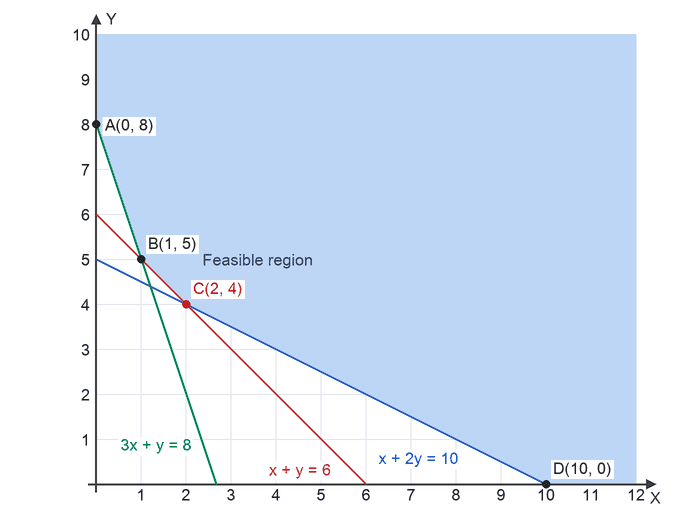
The origin does not satisfy any of the three "at least" constraints (for example 0≥10 is false), so each allowed half-plane lies on the side of its line away from the origin. Together with x≥0 and y≥0, this gives the unbounded shaded region below.
Step 5 — Find the corner points.
The line 3x+y=8 meets the y-axis at A(0,8), and x+2y=10 meets the x-axis at D(10,0).
For B, we solve 3x+y=8 and x+y=6 together. Subtracting the second equation from the first removes y.
2x=2
x=1
We substitute this value of x into x+y=6.
y=6−1
y=5
For C, we solve x+y=6 and x+2y=10 together. Subtracting the first equation from the second removes x.
y=4
We substitute this value of y into x+y=6.
x=6−4
x=2
Both points satisfy the third constraint as well: at B(1,5) the value of x+2y is 11, and at C(2,4) the value of 3x+y is 10.
Step 6 — Evaluate Z at each corner point.
We substitute each corner point into Z=24x+36y.
| Corner point | Working | Value of Z (in ₹) |
|---|
| A(0,8) | 24×0+36×8 | 288 |
| B(1,5) | 24×1+36×5 | 204 |
| C(2,4) | 24×2+36×4 | 192 |
| D(10,0) | 24×10+36×0 | 240 |
The smallest corner value is 192, at C(2,4).
Step 7 — Check the unbounded region.
Since the region is unbounded, we look at the open half-plane 24x+36y<192. Dividing by 12, it is 2x+3y<16. Every corner gives 2x+3y≥16 (24 at A, 17 at B, 16 at C, 20 at D), and the region extends only upwards and to the right, where 2x+3y increases. So the half-plane has no point in common with the feasible region, and 192 is the minimum.
Therefore, the least cost of the mixture is ₹ 192, using 2 kg of food X and 4 kg of food Y.
