
Opening your dashboard
Class 12 Maths Chapter 23 Linear Programming: Previous Year Questions
9 questions on Chapter 23, each solved step by step. Class 12 Maths, ICSE 2026-27.
9 questions with solutions
4–6 marks · Medium difficulty
The first 5 solutions are on this page. This chapter is a long one, so the rest open on their own page to keep this one quick to load.
- 15 marks
Question 1
A dietician wishes to mix two kinds of food X and Y in such a way that the mixture contains at least 10 units of vitamin A, 12 units of vitamin B and 8 units of vitamin C. The vitamin contents of one kg food is given below:
Food Vitamin A Vitamin B Vitamin C X 1 unit 2 units 3 units Y 2 units 2 units 1 unit One kg of food X costs ₹ 24 and one kg of food Y costs ₹ 36. Using Linear Programming, find the least cost of the total mixture which will contain the required vitamins.
Solve with AIWritten solution
Solution:
Key idea: The feasible region is the set of points that satisfy every constraint. Here it is unbounded, so we compare at the corner points and then check that the open half-plane where is smaller than the least corner value has no point in common with the region; only then is that corner value the minimum.
Step 1 — Define the variables.
Let the mixture contain kg of food X and kg of food Y. Amounts cannot be negative, so and .
Step 2 — Write the objective function.
One kg of X costs ₹ 24 and one kg of Y costs ₹ 36. We call the total cost ₹ and minimise it.
Step 3 — Write the constraints.
Each kg of X gives 1 unit of vitamin A and each kg of Y gives 2 units, and at least 10 units are needed.
In the same way, vitamin B needs at least 12 units.
We divide this inequality by .
Vitamin C needs at least 8 units.
Step 4 — Draw the boundary lines and shade the feasible region.
We draw each boundary line through its points on the axes.
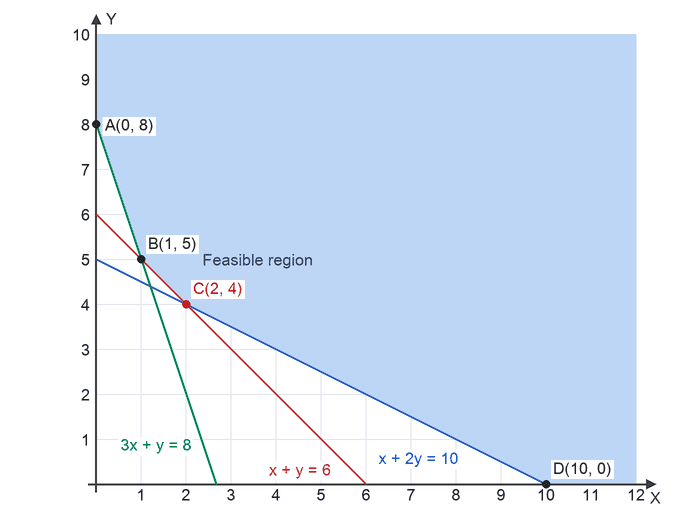
Boundary line Point on the x-axis Point on the y-axis The origin does not satisfy any of the three "at least" constraints (for example is false), so each allowed half-plane lies on the side of its line away from the origin. Together with and , this gives the unbounded shaded region below.
Step 5 — Find the corner points.
The line meets the y-axis at , and meets the x-axis at .
For , we solve and together. Subtracting the second equation from the first removes .
We substitute this value of into .
For , we solve and together. Subtracting the first equation from the second removes .
We substitute this value of into .
Both points satisfy the third constraint as well: at the value of is 11, and at the value of is 10.
Step 6 — Evaluate Z at each corner point.
We substitute each corner point into .
Corner point Working Value of (in ₹) The smallest corner value is 192, at .
Step 7 — Check the unbounded region.
Since the region is unbounded, we look at the open half-plane . Dividing by , it is . Every corner gives (24 at , 17 at , 16 at , 20 at ), and the region extends only upwards and to the right, where increases. So the half-plane has no point in common with the feasible region, and 192 is the minimum.
Therefore, the least cost of the mixture is ₹ 192, using 2 kg of food X and 4 kg of food Y.
- 25 marks
Question 2
A company manufactures two types of products A and B. Each unit of A requires 3 grams of nickel and 1 gram of chromium, while each unit of B requires 1 gram of nickel and 2 grams of chromium. The firm can produce 9 grams of nickel and 8 grams of chromium. The profit is ₹ 40 on each unit of product of type A and ₹ 50 on each unit of type B. How many units of each type should the company manufacture so as to earn maximum profit? Use linear programming to find the solution.
Solve with AIWritten solution
Solution:
Key idea: The feasible region of a linear programming problem is the set of points that satisfy every constraint. If it is bounded, the maximum and the minimum of the objective function occur at corner points, so we find every corner point and compare the values of there.
Step 1 — Define the variables.
Let the company make units of product A and units of product B. The numbers of units cannot be negative, so and .
Step 2 — Write the objective function.
The profit is ₹ 40 on each unit of A and ₹ 50 on each unit of B. We call the total profit ₹ and maximise it.
Step 3 — Write the constraints.
We read "the firm can produce 9 grams of nickel and 8 grams of chromium" as the amounts of the two metals available, so the metal used cannot exceed them. Each unit of A uses 3 g of nickel and each unit of B uses 1 g.
Each unit of A uses 1 g of chromium and each unit of B uses 2 g.
Step 4 — Draw the boundary lines and shade the feasible region.
We draw each boundary line through its points on the axes.
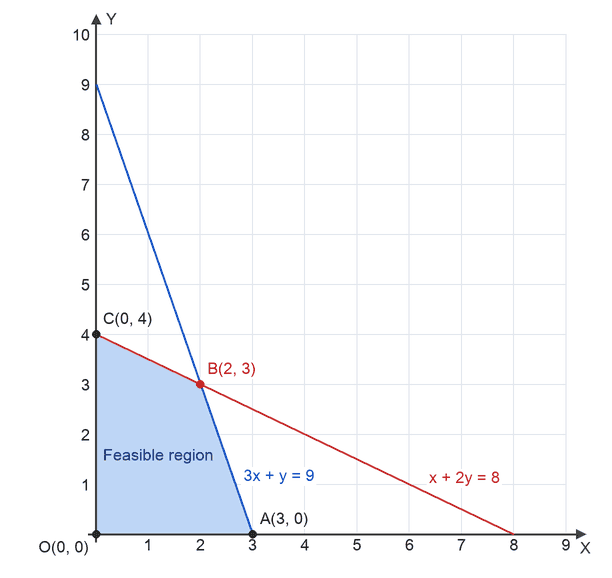
Boundary line Point on the x-axis Point on the y-axis The origin satisfies both constraints ( and ), so each allowed half-plane is on the origin's side of its line. With and , the feasible region is the shaded quadrilateral .
Step 5 — Find the corner points.
Three corners lie on the axes: , where meets the x-axis, and where meets the y-axis.
For , we solve the two boundary equations together. We multiply by and subtract , which removes .
We substitute this value of into .
Step 6 — Evaluate Z at each corner point.
We substitute each corner point into .
Corner point Working Value of (in ₹) The region is bounded, so the largest corner value, 230 at , is the maximum.
Therefore, the company should make 2 units of product A and 3 units of product B, for a maximum profit of ₹ 230.
- 35 marks
Question 3
A farmer has a supply of chemical fertilizer of type A which contains 10% nitrogen and 6% phosphoric acid and of type B which contains 5% nitrogen and 10% phosphoric acid. After the soil test, it is found that at least 7 kg of nitrogen and the same quantity of phosphoric acid is required for a good crop. The fertilizer of type A costs ₹ 5.00 per kg and the type B costs ₹ 8.00 per kg. Using Linear programming, find how many kilograms of each type of fertilizer should be bought to meet the requirement and for the cost to be minimum. Find the feasible region in the graph.
Solve with AIWritten solution
Solution:
Key idea: The feasible region is the set of points that satisfy every constraint. Here it is unbounded, so we compare at the corner points and then check that the open half-plane where is smaller than the least corner value has no point in common with the region; only then is that corner value the minimum.
Step 1 — Define the variables.
Let the farmer buy kg of fertilizer A and kg of fertilizer B, with and .
Step 2 — Write the objective function.
Type A costs ₹ 5 per kg and type B costs ₹ 8 per kg. We call the total cost ₹ and minimise it.
Step 3 — Write the constraints.
Type A has nitrogen and type B has , and at least 7 kg of nitrogen is needed.
We multiply both sides by to clear the fractions.
Type A has phosphoric acid and type B has , and at least 7 kg is needed.
We multiply both sides by .
Step 4 — Draw the boundary lines and shade the feasible region.
We draw each boundary line through its points on the axes.
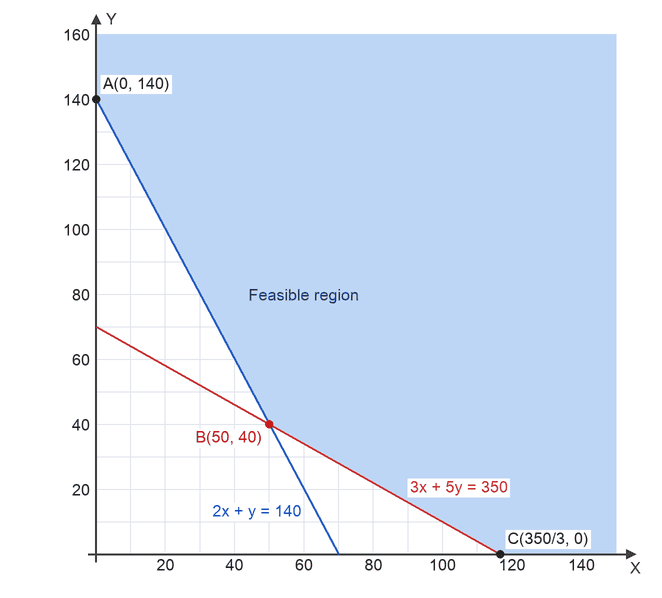
Boundary line Point on the x-axis Point on the y-axis The origin fails both constraints ( is false), so each allowed half-plane is on the side away from the origin. With and , the feasible region is the unbounded shaded region below.
Step 5 — Find the corner points.
The line meets the y-axis at , and meets the x-axis at .
For , we solve the two boundary equations together. We rearrange , and write ; then we substitute it into .
We substitute this value of into .
Step 6 — Evaluate Z at each corner point.
We substitute each corner point into .
Corner point Working Value of (in ₹) The smallest corner value is 570, at .
Step 7 — Check the unbounded region.
We look at the open half-plane . Every corner gives , and the region extends only upwards and to the right, where increases. So the half-plane has no point in common with the feasible region, and 570 is the minimum.
Therefore, the farmer should buy 50 kg of fertilizer A and 40 kg of fertilizer B, at a minimum cost of ₹ 570.
- 46 marks
Question 4
A carpenter has 90, 80 and 50 running feet respectively of teak wood, plywood and rosewood which is used to produce product A and product B. Each unit of product A requires 2, 1 and 1 running feet and each unit of product B requires 1, 2 and 1 running feet of teak wood, plywood and rosewood respectively. If product A is sold for Rs 48 per unit and product B is sold for Rs 40 per unit, how many units of product A and product B should be produced and sold by the carpenter, in order to obtain the maximum gross income?
Formulate the above as a Linear Programming Problem and solve it, indicating clearly the feasible region in the graph.
Solve with AIWritten solution
Solution:
Key idea: The feasible region of a linear programming problem is the set of points that satisfy every constraint. If it is bounded, the maximum and the minimum of the objective function occur at corner points, so we find every corner point and compare the values of there.
Step 1 — Define the variables.
Let the carpenter make units of product A and units of product B, with and .
Step 2 — Write the objective function.
Product A sells for Rs 48 per unit and product B for Rs 40 per unit. We call the gross income Rs and maximise it.
Step 3 — Write the constraints.
Teak wood: each unit of A needs 2 running feet and each unit of B needs 1, out of 90.
Plywood: A needs 1 and B needs 2 running feet, out of 80.
Rosewood: A and B need 1 running foot each, out of 50.
Step 4 — Draw the boundary lines and shade the feasible region.
We draw each boundary line through its points on the axes.
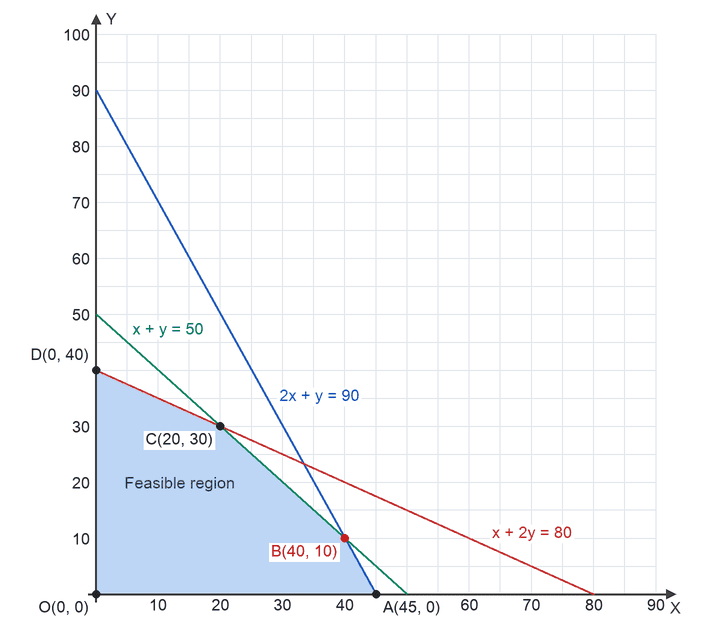
Boundary line Point on the x-axis Point on the y-axis The origin satisfies all three constraints, so each allowed half-plane is on the origin's side of its line. With and , the feasible region is the shaded pentagon .
Step 5 — Find the corner points.
On the axes, the region ends at on and at on , because these are the nearest of the three lines to the origin along each axis.
For , we solve and together. Subtracting the second equation from the first removes .
We substitute this value of into .
For , we solve and together. Subtracting the second equation from the first removes .
We substitute this value of into .
Each point also satisfies the third constraint: at the plywood used is 60 running feet, and at the teak used is 70 running feet.
Step 6 — Evaluate Z at each corner point.
We substitute each corner point into .
Corner point Working Value of (in Rs) The region is bounded, so the largest corner value, 2320 at , is the maximum.
Therefore, the carpenter should make 40 units of product A and 10 units of product B, for a maximum gross income of Rs 2320.
- 56 marks
Question 5
A company uses three machines to manufacture two types of shirts, half sleeves and full sleeves. The number of hours required per week on machine , and for one Shirt of each type is given in the following table :
Half sleeves 1 2 8/5 Full sleeves 2 1 8/5 None of the machines can be in operation for more than 40 hours per week. The profit on each half sleeve shirt is ₹ 1 and the profit on each full sleeve shirt is ₹ 1.50. How many of each type of shirts should be made per week to maximise the company's profit?
Solve with AIWritten solution
Solution:
Key idea: The feasible region of a linear programming problem is the set of points that satisfy every constraint. If it is bounded, the maximum and the minimum of the objective function occur at corner points, so we find every corner point and compare the values of there.
Step 1 — Define the variables.
Let the company make half sleeve shirts and full sleeve shirts per week, with and .
Step 2 — Write the objective function.
The profit is ₹ 1 on a half sleeve shirt and ₹ 1.50 on a full sleeve shirt. We call the weekly profit ₹ and maximise it.
Step 3 — Write the constraints.
No machine may run for more than 40 hours a week. For machine , the table gives 1 hour per half sleeve shirt and 2 hours per full sleeve shirt.
For machine , the hours are 2 and 1.
For machine , each shirt takes hours.
We multiply both sides by .
Step 4 — Draw the boundary lines and shade the feasible region.
We draw each boundary line through its points on the axes.
Boundary line Point on the x-axis Point on the y-axis The origin satisfies all three constraints, so each allowed half-plane is on the origin's side of its line. With and , the feasible region is the shaded pentagon .
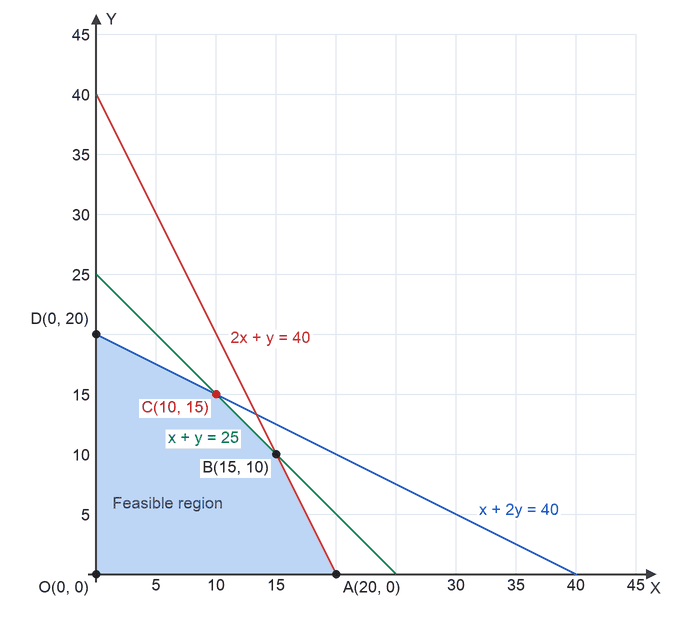
Step 5 — Find the corner points.
On the axes, the region ends at on and at on .
For , we solve and together. Subtracting the second equation from the first removes .
We substitute this value of into .
For , we solve and together. Subtracting the second equation from the first removes .
We substitute this value of into .
Each point also satisfies the remaining machine limit: at machine runs 35 hours, and at machine runs 35 hours.
Step 6 — Evaluate Z at each corner point.
We substitute each corner point into .
Corner point Working Value of (in ₹) The region is bounded, so the largest corner value, 32.5 at , is the maximum. Both numbers at are whole numbers, as numbers of shirts must be.
Therefore, the company should make 10 half sleeve shirts and 15 full sleeve shirts per week, for a maximum profit of ₹ 32.50 per week.
- 64 marks
Question 6
Solve the following Linear Programming Problem graphically.
Maximize subject to:
- 74 marks
Question 7
Aman has ₹ 1500 to purchase rice and wheat for his grocery shop. Each sack of rice and wheat costs ₹ 180 and ₹ 120 respectively. He can store a maximum number of 10 bags in his shop. He will earn a profit of ₹ 11 per bag of rice and ₹ 9 per bag of wheat.
(i) Formulate a Linear Programming Problem to maximise Aman's profit.
(ii) Calculate the maximum profit.
- 84 marks
Question 8
Two different types of books have to be stacked in the shelf of a library. The first type of book weighs 1 kg and has a thickness of 6 cm. The second type of book weighs 1.5 kg and has a thickness of 4 cm. The shelf is 96 cm long and can support a maximum weight of 21 kg.
How should both the types of books be placed in the shelf to include the maximum number of books? Formulate a Linear Programming Problem and solve it graphically.
- 94 marks
Question 9
Raunak is a small-scale entrepreneur who sells sewing machines in a rural market. He wants to expand his business but has two main constraints: Capital and Storage.
He has a total capital of ₹5,760 to invest. The godown can store a maximum number of 20 sewing machines.
Raunak sells two types of machines:
- Electronic sewing machine, each costs him ₹360.
- Manually operated sewing machine, each costs him ₹240.
His wife Radhika suggests selling an electronic machine at a profit of ₹22 and a manually operated sewing machine at a profit of ₹18.
Using the concept of Linear Programming Problem, find the number of sewing machines of each type that Raunak should sell to maximise his profit.