Solution:
Key idea: The feasible region of a linear programming problem is the set of points that satisfy every constraint. If it is bounded, the maximum and the minimum of the objective function Z occur at corner points, so we find every corner point and compare the values of Z there.
Step 1 — (i) Define the variables.
Let Aman buy x sacks of rice and y sacks of wheat. The numbers of sacks are whole numbers, and x≥0, y≥0.
Step 2 — (i) Write the objective function.
He earns ₹ 11 on each sack of rice and ₹ 9 on each sack of wheat. We call his profit ₹ Z and maximise it.
Z=11x+9y
Step 3 — (i) Write the constraints.
A sack of rice costs ₹ 180 and a sack of wheat costs ₹ 120, and he has ₹ 1500.
180x+120y≤1500
We divide both sides by 60.
3x+2y≤25
He can store at most 10 bags.
x+y≤10
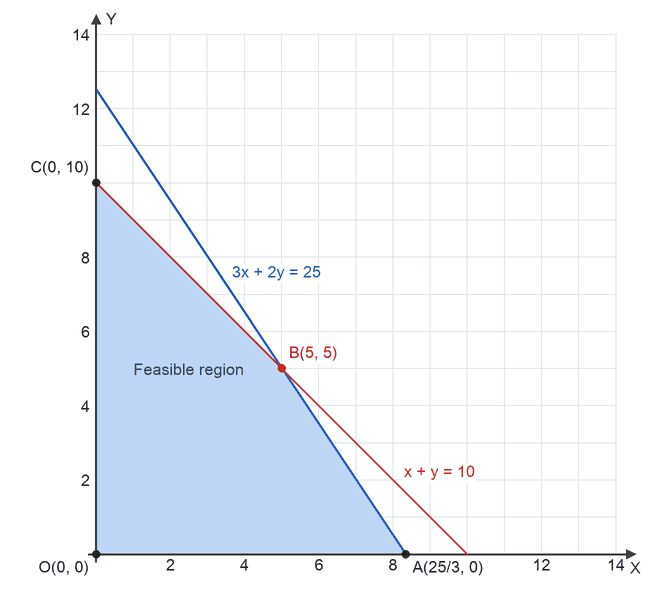
So the problem is: maximise Z=11x+9y subject to 3x+2y≤25, x+y≤10, x≥0 and y≥0.
Step 4 — (ii) Draw the feasible region.
We draw each boundary line through its points on the axes.
| Boundary line | Point on the x-axis | Point on the y-axis |
|---|
| 3x+2y=25 | (325,0) | (0,225) |
| x+y=10 | (10,0) | (0,10) |
The origin satisfies both constraints, so each allowed half-plane is on the origin's side of its line. The feasible region is the shaded quadrilateral OABC.
Step 5 — (ii) Find the corner points.
On the axes, the region ends at A(325,0) on 3x+2y=25 and at C(0,10) on x+y=10.
For B, we solve the two boundary equations together. We multiply x+y=10 by 2 and subtract it from 3x+2y=25, which removes y.
3x+2y−(2x+2y)=25−20
x=5
We substitute this value of x into x+y=10.
y=10−5
y=5
Step 6 — (ii) Evaluate Z at each corner point.
We substitute each corner point into Z=11x+9y.
| Corner point | Working | Value of Z (in ₹) |
|---|
| O(0,0) | 11×0+9×0 | 0 |
| A(325,0) | 11×325+9×0 | 3275≈91.67 |
| B(5,5) | 11×5+9×5 | 100 |
| C(0,10) | 11×0+9×10 | 90 |
The region is bounded, so the largest corner value, 100 at B(5,5), is the maximum. Both numbers at B are whole numbers, as numbers of sacks must be.
Therefore, Aman should buy 5 sacks of rice and 5 sacks of wheat, and his maximum profit is ₹ 100.
