Solution:
Key idea: The feasible region of a linear programming problem is the set of points that satisfy every constraint. If it is bounded, the maximum and the minimum of the objective function Z occur at corner points, so we find every corner point and compare the values of Z there.
Step 1 — Define the variables.
Let the carpenter make x units of product A and y units of product B, with x≥0 and y≥0.
Step 2 — Write the objective function.
Product A sells for Rs 48 per unit and product B for Rs 40 per unit. We call the gross income Rs Z and maximise it.
Z=48x+40y
Step 3 — Write the constraints.
Teak wood: each unit of A needs 2 running feet and each unit of B needs 1, out of 90.
2x+y≤90
Plywood: A needs 1 and B needs 2 running feet, out of 80.
x+2y≤80
Rosewood: A and B need 1 running foot each, out of 50.
x+y≤50
Step 4 — Draw the boundary lines and shade the feasible region.
We draw each boundary line through its points on the axes.
| Boundary line | Point on the x-axis | Point on the y-axis |
|---|
| 2x+y=90 | (45,0) | (0,90) |
| x+2y=80 | (80,0) | (0,40) |
| x+y=50 | (50,0) | (0,50) |
The origin satisfies all three constraints, so each allowed half-plane is on the origin's side of its line. With x≥0 and y≥0, the feasible region is the shaded pentagon OABCD.
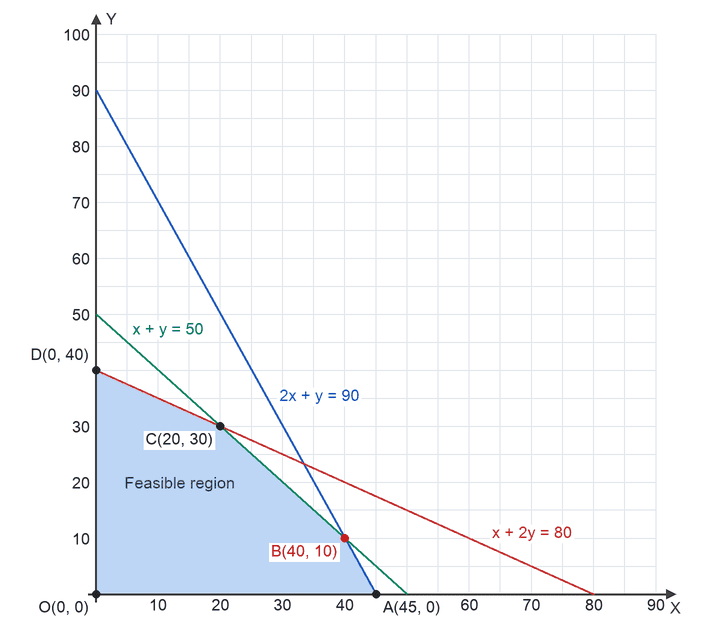
Step 5 — Find the corner points.
On the axes, the region ends at A(45,0) on 2x+y=90 and at D(0,40) on x+2y=80, because these are the nearest of the three lines to the origin along each axis.
For B, we solve 2x+y=90 and x+y=50 together. Subtracting the second equation from the first removes y.
x=40
We substitute this value of x into x+y=50.
y=50−40
y=10
For C, we solve x+2y=80 and x+y=50 together. Subtracting the second equation from the first removes x.
y=30
We substitute this value of y into x+y=50.
x=50−30
x=20
Each point also satisfies the third constraint: at B(40,10) the plywood used is 60 running feet, and at C(20,30) the teak used is 70 running feet.
Step 6 — Evaluate Z at each corner point.
We substitute each corner point into Z=48x+40y.
| Corner point | Working | Value of Z (in Rs) |
|---|
| O(0,0) | 48×0+40×0 | 0 |
| A(45,0) | 48×45+40×0 | 2160 |
| B(40,10) | 48×40+40×10 | 2320 |
| C(20,30) | 48×20+40×30 | 2160 |
| D(0,40) | 48×0+40×40 | 1600 |
The region is bounded, so the largest corner value, 2320 at B(40,10), is the maximum.
Therefore, the carpenter should make 40 units of product A and 10 units of product B, for a maximum gross income of Rs 2320.
