Solution:
Key idea: The feasible region of a linear programming problem is the set of points that satisfy every constraint. If it is bounded, the maximum and the minimum of the objective function Z occur at corner points, so we find every corner point and compare the values of Z there.
Step 1 — Define the variables.
Let the company make x units of product A and y units of product B. The numbers of units cannot be negative, so x≥0 and y≥0.
Step 2 — Write the objective function.
The profit is ₹ 40 on each unit of A and ₹ 50 on each unit of B. We call the total profit ₹ Z and maximise it.
Z=40x+50y
Step 3 — Write the constraints.
We read "the firm can produce 9 grams of nickel and 8 grams of chromium" as the amounts of the two metals available, so the metal used cannot exceed them. Each unit of A uses 3 g of nickel and each unit of B uses 1 g.
3x+y≤9
Each unit of A uses 1 g of chromium and each unit of B uses 2 g.
x+2y≤8
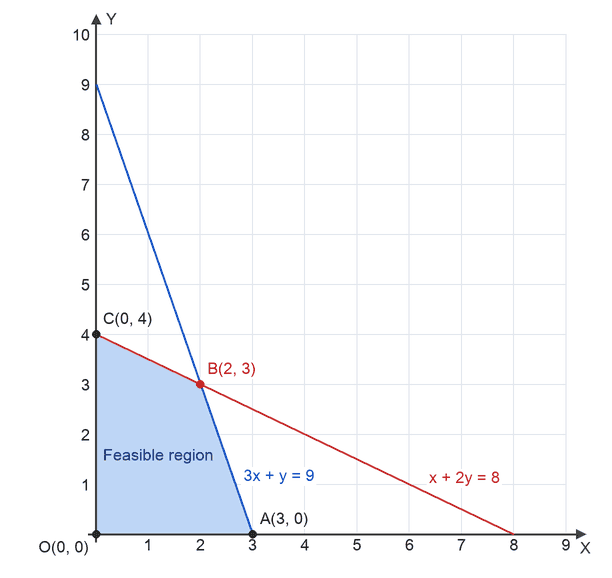
Step 4 — Draw the boundary lines and shade the feasible region.
We draw each boundary line through its points on the axes.
| Boundary line | Point on the x-axis | Point on the y-axis |
|---|
| 3x+y=9 | (3,0) | (0,9) |
| x+2y=8 | (8,0) | (0,4) |
The origin satisfies both constraints (0≤9 and 0≤8), so each allowed half-plane is on the origin's side of its line. With x≥0 and y≥0, the feasible region is the shaded quadrilateral OABC.
Step 5 — Find the corner points.
Three corners lie on the axes: O(0,0), A(3,0) where 3x+y=9 meets the x-axis, and C(0,4) where x+2y=8 meets the y-axis.
For B, we solve the two boundary equations together. We multiply 3x+y=9 by 2 and subtract x+2y=8, which removes y.
6x+2y−(x+2y)=18−8
5x=10
x=2
We substitute this value of x into 3x+y=9.
y=9−6
y=3
Step 6 — Evaluate Z at each corner point.
We substitute each corner point into Z=40x+50y.
| Corner point | Working | Value of Z (in ₹) |
|---|
| O(0,0) | 40×0+50×0 | 0 |
| A(3,0) | 40×3+50×0 | 120 |
| B(2,3) | 40×2+50×3 | 230 |
| C(0,4) | 40×0+50×4 | 200 |
The region is bounded, so the largest corner value, 230 at B(2,3), is the maximum.
Therefore, the company should make 2 units of product A and 3 units of product B, for a maximum profit of ₹ 230.
