Solution:
Key idea: To solve an LPP graphically we choose the decision variables, write the objective function and the constraints, draw the feasible region, find its corner points and evaluate the objective function at each corner (corner point method). For a bounded region the best corner value is the optimum.
Step 1 — Choose the decision variables.
Let the principal buy x geometry boxes and y pocket dictionaries.
Step 2 — Write the objective function.
The number of prizes is
P=x+y
This number is to be maximized.
Step 3 — Write the constraints.
At least four of each are to be bought.
x≥4,y≥4
A box costs ₹ 5 and a dictionary ₹ 10, and the spending must not exceed ₹ 100.
5x+10y≤100
Dividing by 5 gives
x+2y≤20
Step 4 — Draw the feasible region.
The region lies to the right of x=4, above y=4 and on the origin side of x+2y=20 (which passes through (20,0) and (0,10)).
It is a triangle.
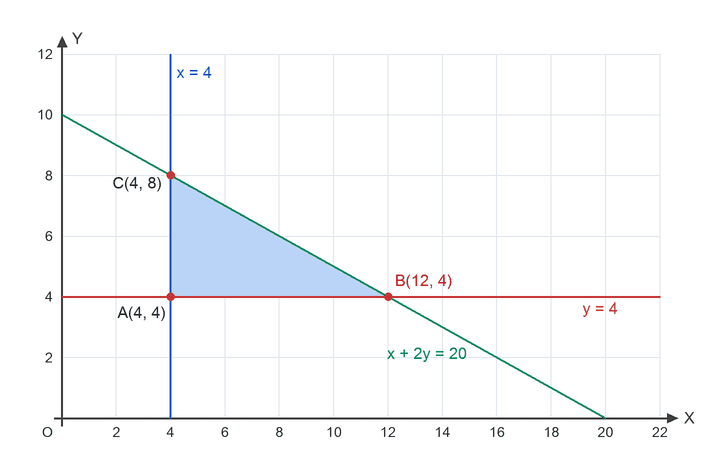
Step 5 — Find the corner points.
Corner A is where the lines x=4 and y=4 meet, so A is (4,4).
Corner B is on y=4 and x+2y=20, so x+8=20; hence x=12 and B is (12,4).
Corner C is on x=4 and x+2y=20, so 2y=16; hence y=8 and C is (4,8).
Step 6 — Evaluate P at the corners.
The region is bounded, so we put each corner into P=x+y.
| Corner point | P=x+y |
|---|
| A(4,4) | 4+4=8 |
| B(12,4) | 12+4=16 ← maximum |
| C(4,8) | 4+8=12 |
The greatest value is 16, at B(12,4). The cost is 12×5+4×10 rupees, which is exactly ₹ 100.
Note: The number of children (15) does not enter the constraints. The 16 prizes are enough for every child to get one.
Therefore, the principal should buy 12 geometry boxes and 4 pocket dictionaries, giving the largest number of prizes, 16.
