Solution:
Key idea: Corner point method for an unbounded region. We evaluate the expression at every corner and take the smallest value m. Because the region is unbounded, m is the minimum only if the open half-plane "expression <m" has no point in common with the region; we check this by writing the expression as a sum of the constraint expressions with positive multipliers. Each boundary line is drawn from two of its points, and testing O(0,0) tells us which side of the line is wanted.
Step 1 — Part (i): draw the boundary lines.
We draw each boundary line from two easy points.
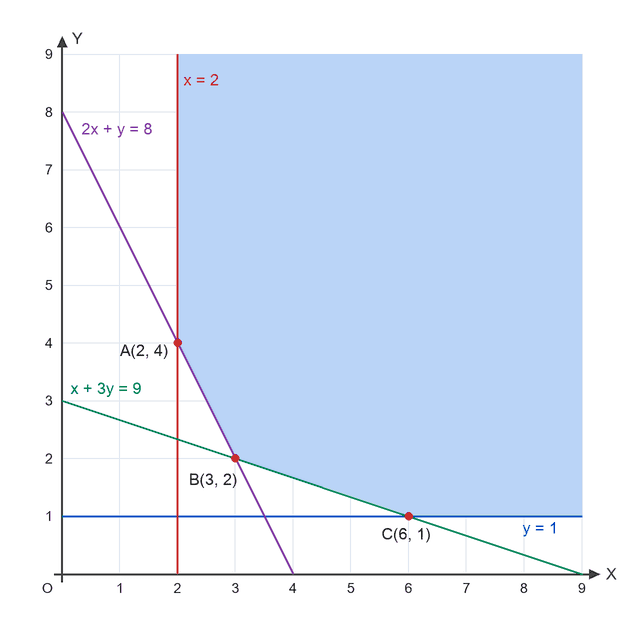
The line y=1 is horizontal and x=2 is vertical.
The line x+3y=9 passes through (9,0) and (0,3).
The line 2x+y=8 passes through (4,0) and (0,8).
Step 2 — Part (i): choose the correct side of each line.
Putting O(0,0) into x+3y≥9 gives 0≥9, which is false, so this region lies on the side away from O.
In the same way 0≥8 is false, so 2x+y≥8 also lies away from O.
The region is above y=1 and to the right of x=2.
The solution set is the shaded unbounded region.
Step 3 — Part (ii): find corner A.
Corner A is where the lines x=2 and 2x+y=8 meet.
We put x=2 into the second equation.
2(2)+y=8
y=4
So A is (2,4).
Step 4 — Part (ii): find corner B.
Corner B is where the lines 2x+y=8 and x+3y=9 meet.
From the first equation y=8−2x, and we put this into the second.
x+3(8−2x)=9
x+24−6x=9
−5x=−15
x=3
Then y=8−2(3), so y=2 and B is (3,2).
Step 5 — Part (ii): find corner C.
Corner C is where the lines x+3y=9 and y=1 meet.
We put y=1 into the first equation.
x+3(1)=9
x=6
So C is (6,1).
The point where the lines y=1 and 2x+y=8 meet, namely (3.5,1), gives 3.5+3=6.5<9, so it is not in the region and is not a corner.
Step 6 — Part (iii)(a): minimize x + 5y.
We evaluate x+5y at the three corners.
| Corner point | x+5y |
|---|
| A(2,4) | 2+5×4=22 |
| B(3,2) | 3+5×2=13 |
| C(6,1) | 6+5×1=11 ← minimum |
The smallest corner value is 11, at C(6,1). To check the unbounded region, we write
x+5y=(x+3y)+2y
In the region, x+3y≥9 and y≥1, so
x+5y≥9+2
x+5y≥11
The half-plane x+5y<11 has no point in common with the region, so the minimum is 11.
Step 7 — Part (iii)(b): minimize 5x + y.
We evaluate 5x+y at the three corners.
| Corner point | 5x+y |
|---|
| A(2,4) | 5×2+4=14 ← minimum |
| B(3,2) | 5×3+2=17 |
| C(6,1) | 5×6+1=31 |
The smallest corner value is 14, at A(2,4). To check the unbounded region, we write
5x+y=3x+(2x+y)
In the region, x≥2 and 2x+y≥8, so
5x+y≥6+8
5x+y≥14
The half-plane 5x+y<14 has no point in common with the region, so the minimum is 14.
Step 8 — Part (iii)(c): minimize x + y.
We evaluate x+y at the three corners.
| Corner point | x+y |
|---|
| A(2,4) | 2+4=6 |
| B(3,2) | 3+2=5 ← minimum |
| C(6,1) | 6+1=7 |
The smallest corner value is 5, at B(3,2). To check the unbounded region, we write
x+y=52(2x+y)+51(x+3y)
In the region, 2x+y≥8 and x+3y≥9, so
x+y≥516+59
x+y≥5
The half-plane x+y<5 has no point in common with the region, so the minimum is 5.
Therefore, the corner points are (2,4), (3,2) and (6,1), and the minimum values are (a) 11 at (6,1), (b) 14 at (2,4) and (c) 5 at (3,2).
